dailynewsnblog
Ars Technica: The Voyager Golden Record is perhaps the best known example of humans attempting to communicate with an alien species, spearheaded by the late Carl Sagan, among others. But what are the odds that, despite our best efforts, any aliens will ever be able to decipher our “message in a bottle”?
Daniel Whiteson: I did an informal experiment where I printed out a picture of the Pioneer plaque and showed it to a bunch of grad students who were young enough to not have seen it before. This is Sagan’s audience: biological humans, same brain, same culture, physics grad students—none of them had any idea what any of that was supposed to refer to. NASA gave him two weeks to come up with that design. I don’t know that I would’ve done any better. It’s easy to criticize.
Those folks, they were doing their best. They were trying to step away from our culture. They didn’t use English, they didn’t even use mathematical symbols. They understood that those things are arbitrary, and they were reaching for something they hoped was going to be universal. But in the end, nothing can be universal because language is always symbols, and the choice of those symbols is arbitrary and cultural. It’s impossible to choose a symbol that can only be interpreted in one way.
Fundamentally, the book is trying to poke at our assumptions. It’s so inspiring to me that the history of physics is littered with times when we have had to abandon an assumption that we clung to desperately, until we were shown otherwise with enough data. So we’ve got to be really open-minded about whether these assumptions hold true, whether it’s required to do science, to be technological, or whether there is even a single explanation for reality. We could be very well surprised by what we discover.
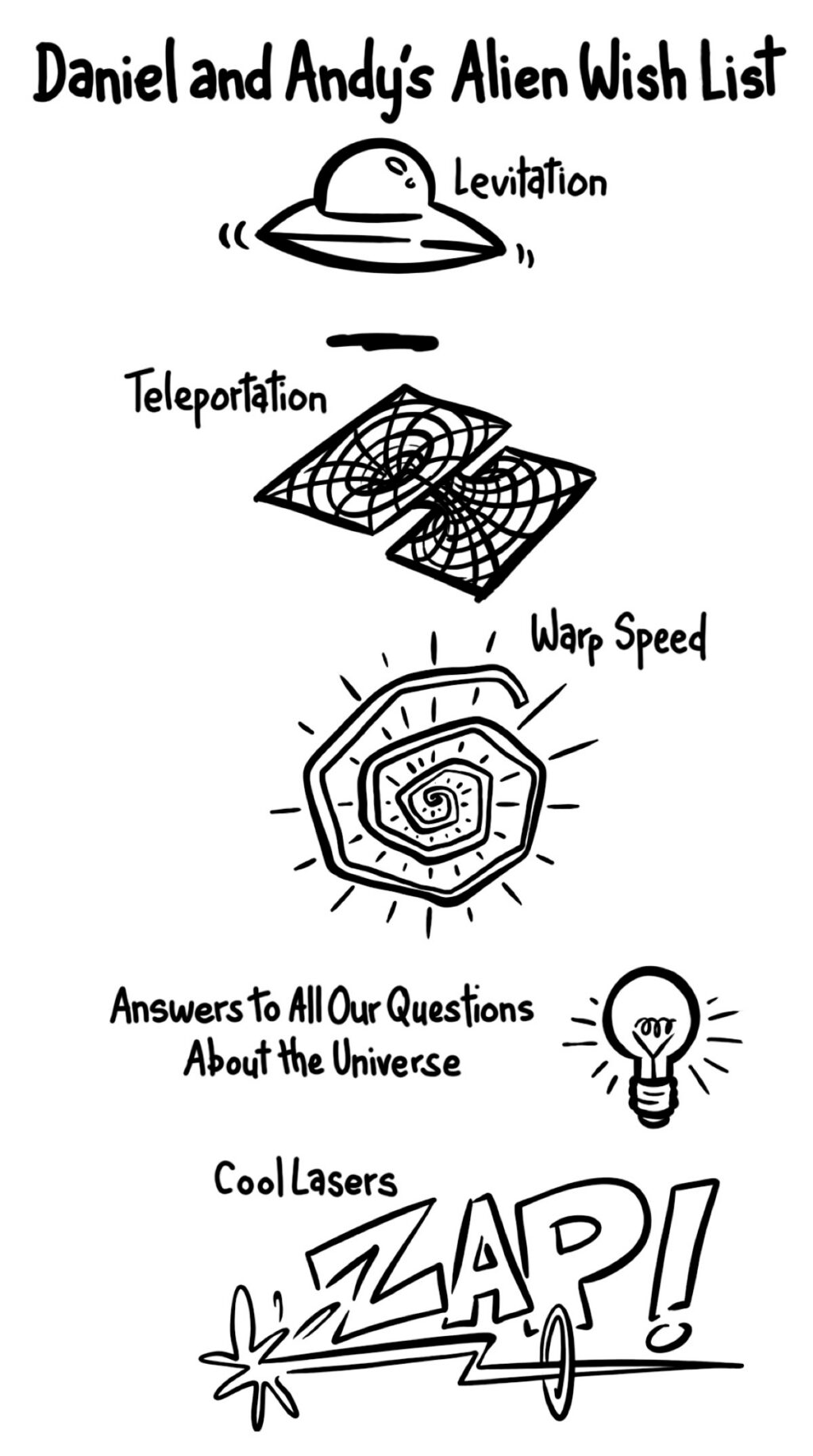

Ars Technica: It’s often assumed that math and physics are the closest thing we have to a universal language. You challenge that assumption, probing such questions as “what does it even mean to ‘count’”?
Daniel Whiteson: At an initial glance, you’re like, well, of course mathematics is required, and of course numbers are universal. But then you dig into it and you start to realize there are fuzzy issues here. So many of the assumptions that underlie our interpretation of what we learned about physics are that way. I had this experience that’s probably very common among physics undergrads in quantum mechanics, learning about those calculations where you see nine decimal places in the theory and nine decimal places in the experiment, and you go, “Whoa, this isn’t just some calculational tool. This is how the universe decides what happens to a particle.”