dailynewsnblog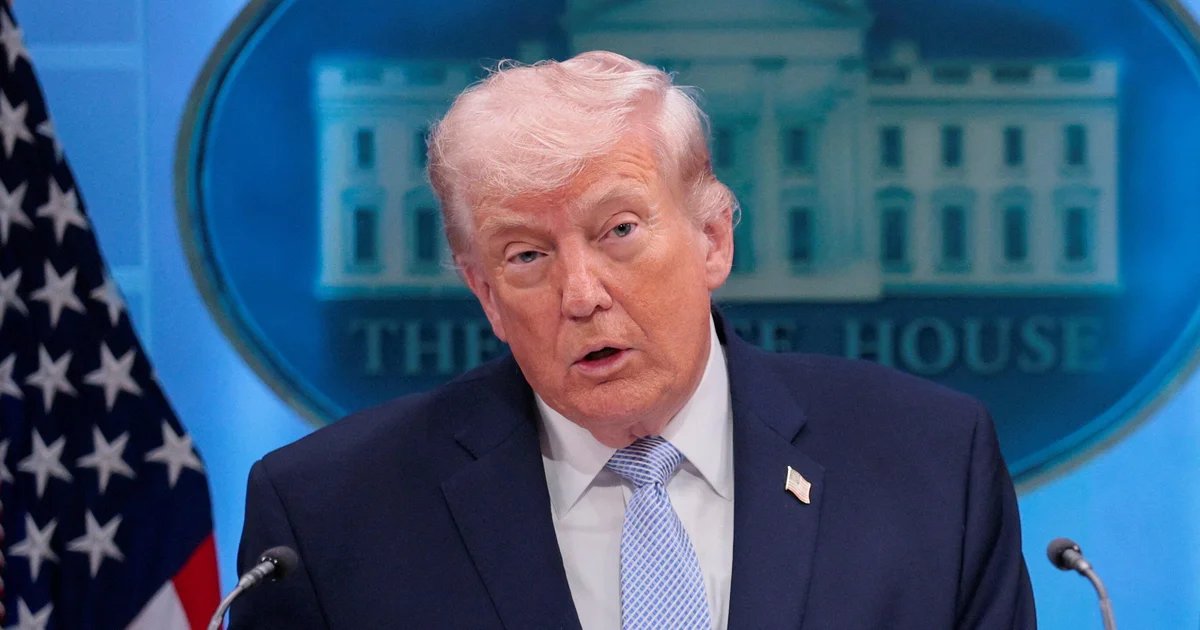
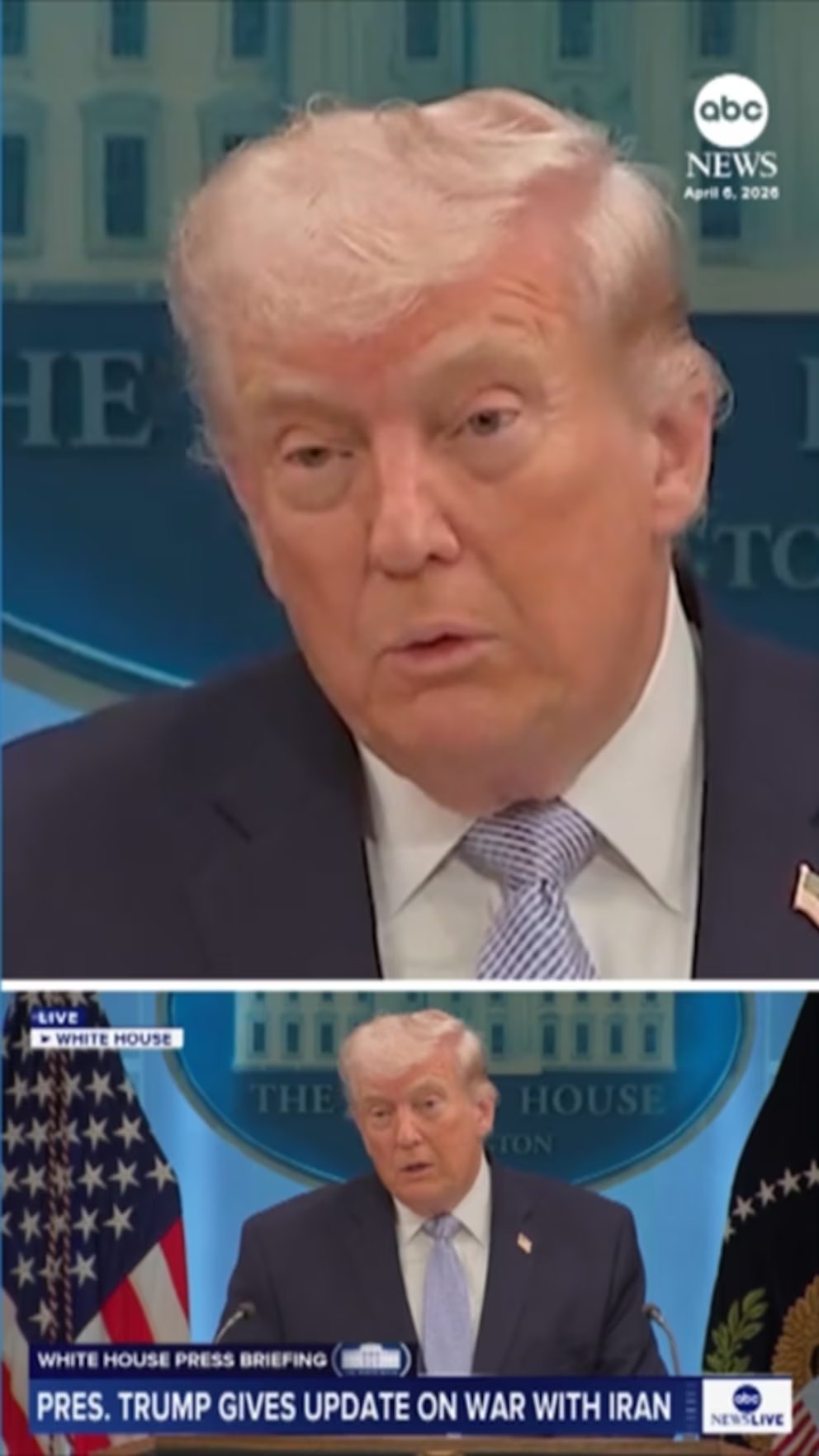
Washington — President Trump and top national security officials shed new light on the daring rescues of two American airmen who were shot down over Iran last week, detailing the intense effort that extracted both men from enemy soil.
Speaking at a news conference at the White House, the president said the mission was “one of the largest, most complex, most harrowing combat searches — I guess you would call it a search and rescue mission — ever attempted by the military.”
The American F-15E fighter jet was downed by Iranian fire on Friday. The plane’s pilot was located and rescued that same day, but the second crew member, a weapon systems officer, remained missing in Iran’s mountainous terrain. The president announced early Sunday morning that the weapon systems officer had also been rescued.
The operation involved more than 150 planes and more than 200 munitions, CBS News reported earlier Monday. The stranded officer had only a handgun to defend himself.
Joined at the White House by Defense Secretary Pete Hegseth, Joint Chiefs Chairman Gen. Dan Caine and CIA Director John Ratcliffe, Mr. Trump said he “ordered the U.S. armed forces to do whatever was necessary to bring our brave warriors back home” soon after the jet was shot down.
Brendan SMIALOWSKI /AFP via Getty Images 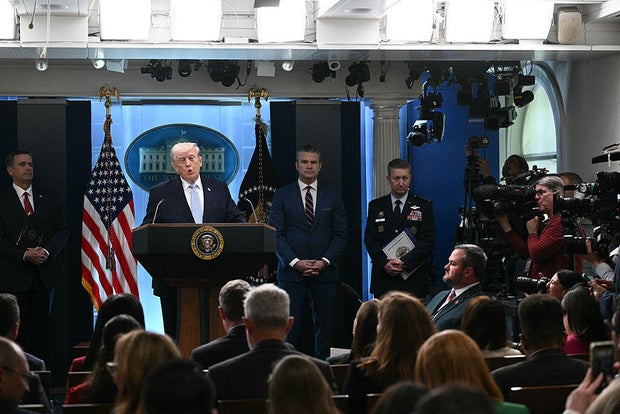
The president said it was a “risky decision” to attempt to recover the airmen, since the U.S. could have ended up with “100 dead as opposed to one or two.”
“It’s a hard decision to make, but in the United States military, we leave no American behind. We don’t do it,” he said.
The president said the pilot of the fighter jet was located in the first wave of search-and-rescue operations and picked up by a U.S. helicopter crew that “faced gunfire at very close range.”
Mr. Trump said the second crew member was injured “quite badly” and stranded in an area “teaming with terrorists,” far from the pilot’s location. He said the airman followed his training and began climbing toward a higher altitude to evade capture, scaling cliff faces, treating his own wounds and contacting U.S. forces to transmit his location.
Hegseth said when the airman was able to access his emergency transponder, “his first message was simple and it was powerful — he sent a message, ‘God is good.'”
The president said, “In a breathtaking show of skill and precision, lethality and force, America’s military descended on the area … engaged the enemy, rescued the stranded officer, destroyed all threats and exited Iranian territory while taking no casualties of any kind.”
Mr. Trump said the officer “had evaded capture on the ground in Iran for almost 48 hours. That’s a long time when you’re in tough shape and when you’re bleeding.”
The president said the large number of forces involved in the operation was meant, in part, to throw the Iranians off the trail of the officer’s trail.
“We wanted to have them think he was in a different location, because they had a vast military force out there. Thousands, thousands of people were looking,” he said. “So we wanted them to look in different areas. So we were scattered all over, like we were right on top of them. We had seven different locations where they thought — and they were very confused — they said, ‘Well, wait a minute, they’ve got groups here.'”
Ratcliffe, the CIA chief, called the challenge of the search-and-rescue operation “comparable to hunting for a single grain of sand in the middle of a desert.” He said it was also a “race against the clock,” making it critical to locate the American aviator as soon as possible. He said for that reason, the CIA launched a “deception campaign to confuse the Iranians who were desperately hunting for our airman.”
“On Saturday morning, we achieved our primary objective by finding and providing confirmation that one of America’s best and bravest was alive and concealed in a mountain crevice, still invisible to the enemy, but not to the CIA,” Ratcliffe said. “That confirmation was relayed by Secretary Hegseth to the president, and the operation quickly moved to the execution phase.”
Hegseth said “the United States military will go anywhere at any time to protect our own and complete the mission.” He added that “we flew for seven hours in daylight over Iran to get the first pilot, and we flew seven hours in the middle of the night to get the second.”
“And Iran did nothing about it,” Hegseth said.
Caine, the Joint Chiefs chairman, said the mission was “incredibly dangerous” and detailed a firefight that preceded the rescue of the downed pilot. He said drones, A-10 jets and other aircraft were “violently suppressing and engaging the enemy in a close-in gunfight to keep them away from the front-seater and allow the pickup force to get into the objective area.”
A pilot of one of the A-10s took fire and “continued to fight, continued the mission, and then upon exit, flew his aircraft into another country and determined that the airplane was not landable,” Caine said. The A-10 pilot “made the decision to eject over friendly territory, and was quickly and safely recovered,” the chairman said.
Caine said the rescue operations showed that “the United States of America will recover our war fighters anywhere in the world, under any conditions, when we want to. We will always bring overwhelming skill and firepower.”
The news conference came after the president posted his latest threat on Sunday to destroy Iranian power plants and other civilian infrastructure if a deal isn’t reached to reopen the Strait of Hormuz. Mr. Trump extended the deadline until Tuesday at 8 p.m. ET, after vowing that “Tuesday will be Power Plant Day, and Bridge Day, all wrapped up in one, in Iran.”
The president said Monday at the White House that “the entire country could be taken out in one night, and that night might be tomorrow night.”