dailynewsnblog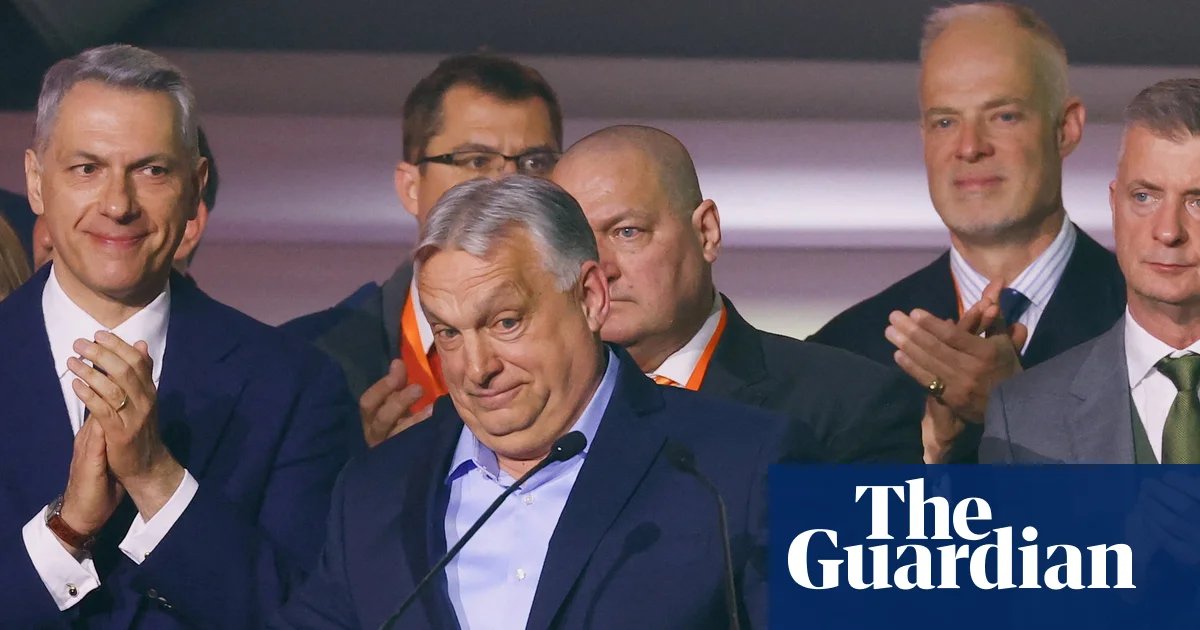
Hungary’s opposition Tisza party, led by Péter Magyar, has won the general election, ending leader Viktor Orbán’s 16-year grip on power, in a result that is likely to rattle the White House and reshape the country’s relationship with the EU.
Less than three hours after polls closed on Sunday, Orbán conceded defeat after what he described as a “painful” election result.
“I congratulated the victorious party,” Orbán told supporters in Budapest. “We are going to serve the Hungarian nation and our homeland from opposition as well.”
Thirty minutes before polls were set to close, a record 77.8% of the country’s voters – some seven percentage points above the previous 2002 record – had turned up at polling stations across the central European country. Throughout the hard-fought campaign Orbán and his rightwing populist government had consistently trailed in the polls, suggesting the election could bring an end to his efforts to transform Hungary into an “illiberal democracy” and reshape the country’s relations with the EU, Moscow and Washington.
With 72% of the vote counted, results projected a win of 138 seats in the 199-seat parliament for the main opposition party, Tisza, led by Magyar, , a former member of Orbán’s Fidesz party who broke ranks with it in 2024.
The election was being closely watched in countries around the world, with many viewing it as a test of the resilience of the Maga movement and the global far right, many of whom have long cited Orbán as an inspiration and sought to follow his playbook.
As Orbán trailed in the polls, rightwing leaders from around the globe scrambled to rally behind him. JD Vance last week turned up in Budapest for a two-day visit, with the US vice-president telling reporters that he had travelled to the capital to “help” Orbán win. Donald Trump had also repeatedly endorsed Orbán, most recently on Friday when he posted: “I AM WITH HIM ALL THE WAY!”
In January, leaders including Italy’s Giorgia Meloni and Israel’s Benjamin Netanyahu also made it clear they were backing Orbán.
Since 2010, Orbán – the EU’s longest-serving leader – had sought to turn Hungary into a vanguard of illiberalism, with the aim, he said, of defending traditional Christian family values against what he saw as an onslaught of western liberalism and multiculturalism.
His rightwing populist government used its time in office to steadily whittle away at the checks and balances that constrained its power: rewriting election laws to its own benefit, manoeuvring to put loyalists in control of an estimated 80% of the country’s media, and retooling the country’s judiciary.
Hundreds of thousands of people last summer took to the streets of Budapest in defiance of the government’s efforts to ban Pride and other events involving the LGBTQ+ community.
The election has played out on both the global and domestic stages, as Orbán sought to convince voters Hungary risked being swept up in war in Ukraine,while Magyar focused on domestic issues with pledges to crack down on corruption, repair Orbán’s antagonistic relationship with the EU and funnel funds into the country’s crumbling public services.
Both candidate stayed on message as they cast their ballots on Sunday morning. Magyar called on Hungarians to vote in a “decisive election”, later insisting that “tonight the nightmare we have been living these past years will come to an end”.
Orbán reiterated his warnings of a “major crisis” awaiting Europe and suggested his government was the safest pair of hands to handle turbulent times. “Fortunately we have a lot of friends in the world. From America to China to Russia and the Turkish world,” he told reporters after casting his ballot on Sunday.
The campaign said his government’s ties to Moscow come under scrutiny after leaked audio and transcripts alleged that Orbán had told Vladimir Putin, “I am at your service”, and that a minister had shared confidential EU information with the Russian government. Orbán’s government cited the leaks as evidence of foreign interference.
Among those who had mobilised in large numbers against Orbán and Fidesz were young people – many of whom had come of age as the country plunged in press freedom rankings, was accused of being an “electoral autocracy”, and became the most corrupt country in the EU. One poll suggested that as many as 65% of voters under the age of 30 were planning to cast their vote against Orbán.
Speaking to the Guardian, several students said their future hinged on the outcome of the elections.
“I’m very afraid that Hungary will leave the European Union,” said Blanka, 21, in Budapest. “If things don’t change, I will probably move out, and I think a lot of my friends think the same.”
In the lead-up to Sunday’s vote, analysts pointed to three possible outcomes of the election: a Magyar majority that Orbán accepts, a Magyar majority that Orbán does not accept, or an Orbán majority.
Even if Magyar succeeded in taking power, many were expecting change to come slowly. During Fidesz’s 16 years in power, the party stacked the Hungarian state, media and judiciary with loyalists; how they respond to a change in government remains up in the air.
There was also the question of whether Magyar could win a simple majority or a super-majority – meaning a win of least two-thirds of the 199 seats in Hungary’s parliament. A super-majority would allow Magyar and his party to amend the constitution and laws, allowing them to reverse some of the changes made by Orbán and Fidesz and potentially unlock EU funds.
“We know that, even if we change governments, the next four to eight years are going to be hard because they just absolutely took the country to shit. There’s no other way to say it,” said Betti, 24, in Budapest. “It’s going to be hard, but it’s probably still going to be better.”