dailynewsnblog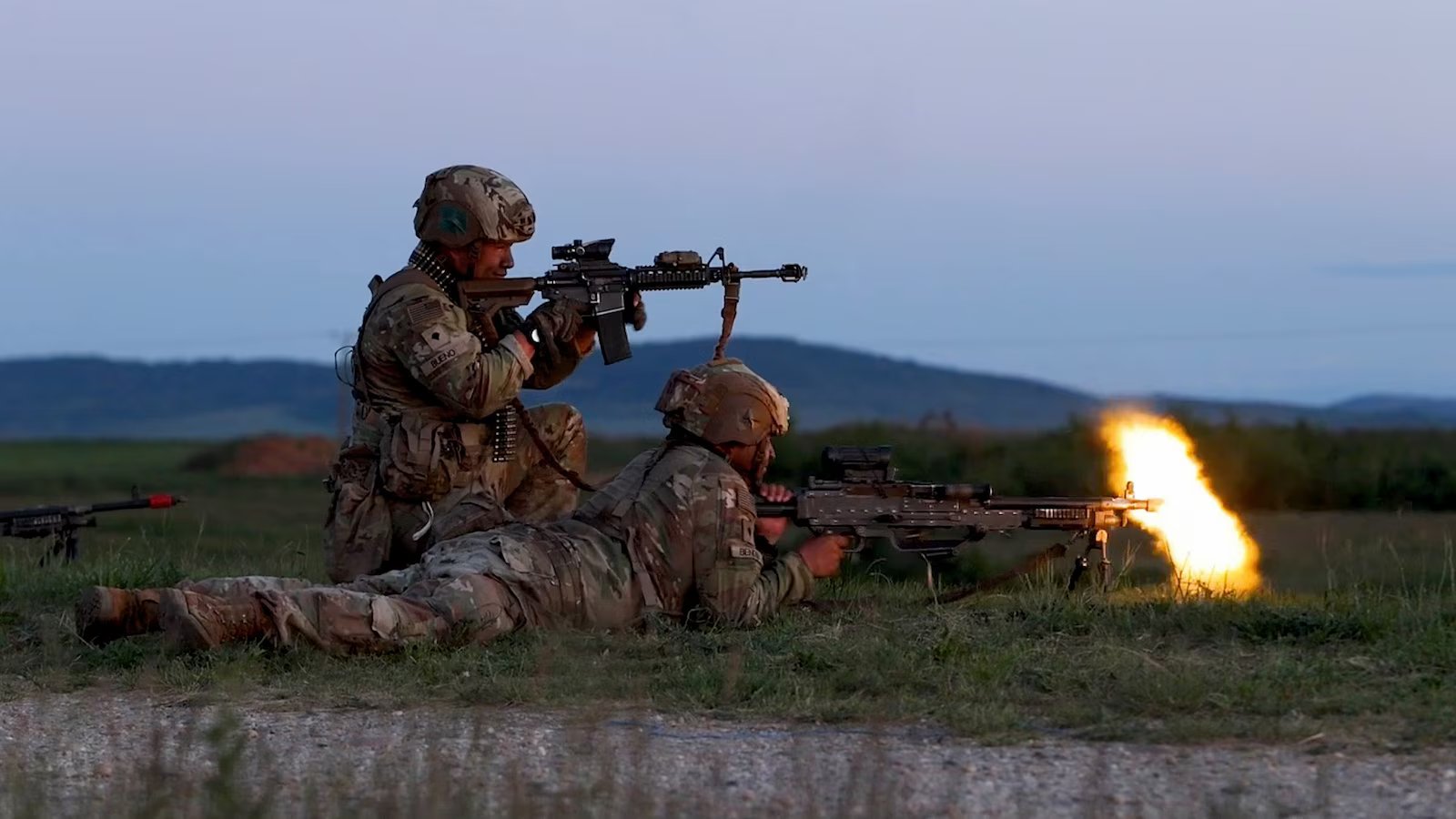
President Donald Trump is moving as many as 5,000 ground troops into the Middle East while pointedly declining to say whether they could ultimately be ordered into combat in Iran, a step retired generals and other experts told ABC News would significantly escalate the conflict and could carry steep risks of U.S. casualties.

U.S. Army paratroopers, assigned to 82nd Airborne Division, execute Joint Force Entries as part of a multinational exercise at Luna and Cincu, Romania, May 13-15, 2024.
US Army
Some 1,500 paratroopers from the Army’s 82nd Airborne Division are preparing to deploy, according to a U.S. official. At the same time, Marine units based in Japan are sailing toward the region, with additional Marines from California potentially following in the weeks ahead.

U.S. Army paratroopers, assigned to 82nd Airborne Division, execute Joint Force Entries as part of a multinational exercise at Luna and Cincu, Romania, May 13-15, 2024.
US Army
The retired generals and experts commented on the following scenarios:
Kharg Island
One key target is Kharg Island, Iran’s primary oil export hub, a relatively small, exposed landmass roughly a third the size of Manhattan that would leave U.S. forces vulnerable to strikes from the Iranian mainland.
“This is part of a longstanding plan, all of this has been looked at for many years,” retired Gen. Frank McKenzie, a former commander of U.S. Central Command, which oversees operations in the Middle East, told ABC News.
Seizing the island would deal a major blow to Tehran’s economy, undercutting one of its most critical revenue streams and decapitating its key means of waging economic warfare.

Paratroopers assigned to 2nd Battalion, 82nd Airborne Division conduct live fire exercises at Fort Bragg, North Carolina, July 28, 2025.
Spc Jayreliz Batista Prado/US Army, File
The move would also align with the strategic importance of the Strait of Hormuz, the narrow waterway linking the island through which roughly 20% of the world’s oil supply transits by ship. Iran has already effectively choked off maritime traffic through the strait, sending fuel prices skyrocketing.
“If I were in Vegas and I were betting, I would say it’s most likely that we will see some kind of amphibious operation once the appropriate combat power has been marshaled in the area,” retired Lt. Gen. Karen Gibson, a former director of intelligence for U.S. Central Command, said.

U.S. Army paratroopers, assigned to 82nd Airborne Division, execute Joint Force Entries as part of a multinational exercise at Luna and Cincu, Romania, May 13-15, 2024.
US Army
Seizing the territory would likely require a complex assault operation, retired top commanders and experts have explained. One option could involve paratroopers from the 82nd Airborne Division parachuting onto the island, a tactic that saw its heyday during World War II.
The division has not conducted a combat jump since the U.S. invasion of Panama in 1989, but it frequently trains for it.

U.S. Marines, with Marine Medium Tiltrotor Squadron, 31st Marine Expeditionary Unit conduct flight operations with a UH-1Y Huey helicopter on the flight deck of the USS New Orleans, Feb. 6, 2026.
Specialist 2nd Class Anita Wallace/U.S. Navy
Marines could attempt an amphibious landing though that approach would leave forces exposed while crossing the strait. Helicopter insertions offer another pathway, but would carry their own vulnerabilities, particularly in contested airspace, the experts said.

Map of the Strait of Hormuz
Anadolu via Getty Images
“Taking the islands that are in the Strait of Hormuz are exactly the kind of mission that the Marine Corps was designed to do,” Gibson said.
Likely meant to send message
Those Marine and Army units could supplement special operations forces. But the forces being deployed are light infantry, units that lack the large armored vehicles, including tanks, that typically underpin sustained ground offensives.
Keeping those troops supplied with food, water, ammunition, and other essentials would pose a significant logistical challenge. Absent those resources, any push onto the Iranian mainland would be exceptionally difficult and likely come with high casualties, and would likely demand a significantly larger force, the experts said.
“I think [they] would get swallowed up pretty quickly if they went into the mainland,” said retired Gen. Joseph Votel, also a former head of U.S. Central Command, said.

A soldier with the 31st Marine Expeditionary Unit, fires a .50 caliber machine gun during a live-fire deck shoot aboard the forward-deployed amphibious assault ship USS New Orleans during a training exercise in the Philippine Sea, Feb. 21, 2026.
Cpl. Rebeka Falcon/U.S. Marine Corps
He added that while the troop numbers may appear sizable, the new contingent is most likely intended to send a message of force to the regime to support U.S. diplomacy or to take a small island like Kharg.
“It looks like responsiveness,” Votel said of the forces entering Central Command. “It looks like messaging.”
Noting Kharg’s distance from the Iranian mainland — just 12 miles — Votel said U.S. forces could risk drone or missile assaults.
“If [they’re] not able to get into protected locations and or have their own defensive capabilities, or be able to provide kind of an envelope around them, then they could be very, very vulnerable to that kind of stuff,” he said.

This satellite image provided by Maxar Technologies shows damage at the Fordo enrichment facility in Iran after U.S. strikes, June 22, 2025.
Satellite image 2025 Maxar Technologies
Nuclear infrastructure
Another potential target includes Iran’s nuclear infrastructure, including the three sites struck by the U.S. last summer, to excavate highly enriched uranium and other materials for nuclear weapons trapped under rubble.
“It would be a very complex, high-risk operation,” Christine Wormuth, president of Nuclear Threat Initiative, a global security nonprofit group, said.
Many of those facilities sit hundreds of miles inland, posing steep logistical challenges that would require a large and enduring U.S. presence. Wormuth, who served as Army secretary during the Biden administration, said securing the sites could demand extensive engineering support — including heavy construction equipment — as well as a significant security force, potentially numbering in the hundreds of troops per location.

Defense Secretary Pete Hegseth speaks during a press conference at the Pentagon in Washington, March 10, 2026.
ABC News
The Trump administration has claimed sweeping gains against Iran’s military, with Defense Secretary Pete Hegseth repeatedly touting the near-total destruction of Tehran’s navy and air force and a sustained campaign to cripple its ability to rebuild key weapons systems.
But even as Pentagon leaders point to battlefield dominance, Iran has demonstrated an ability to strike back, with seven U.S. troops killed in Iranian attacks and more than 300 wounded so far. The administration has also not articulated its plans for the region once the war ends.
“I think the military performance has been very, very impressive, Votel said. “But I think we have to, we always have to be careful of conflating tactical successes with strategic policy success in terms of this.”
ABC News’ Patrick Reevell contributed to this report.