By Julie Ingwersen
MANHATTAN, Kansas, March 25 (Reuters) – Inside a locked chamber the size of a walk-in freezer in Manhattan, Kansas, a few dozen wheat plants growing under bright LED lights are being genetically modified with a sunflower gene to resist drought.
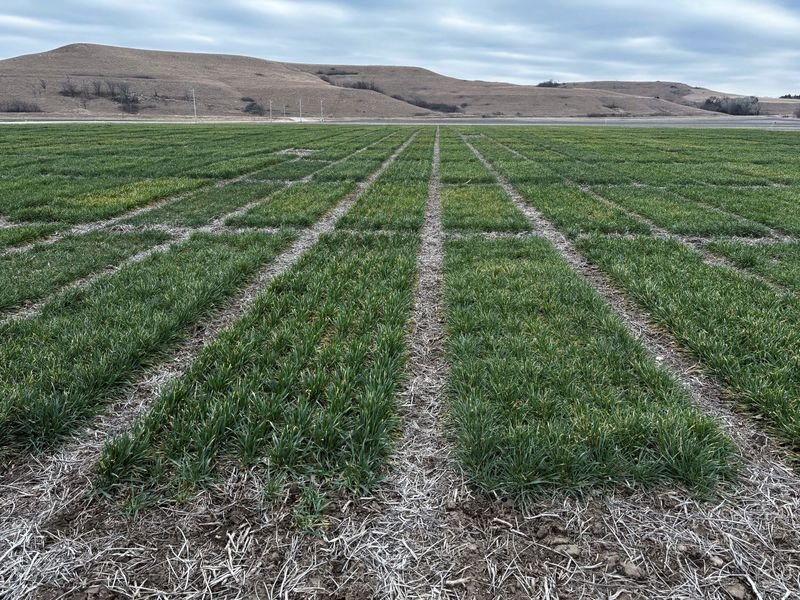
Some 20 miles away, at a research center in Junction City, scientists are developing hybrid wheat seeds that promise higher, more consistent crop yields as drought becomes more common across the Plains.
Taken together, the experiments could change the future of the struggling U.S. wheat industry, which is being threatened by shifting consumer trends and the rise of lower-cost global rivals eroding America’s export dominance. The U.S. economic prospects for wheat, a crop that’s been cultivated for 10,000 years, hang in the balance.
When it comes to technology, for decades wheat has been the horse-and-buggy to its sports car brethren, corn and soybeans. And American farmers have been growing less of the crop, sometimes planting it only in rotation with other crops to preserve soil health.
But hybrid wheat is finally becoming more widely available, and genetically modified varieties may launch in the U.S. within a few years. The push represents a bet that the science will arrive in time to make it profitable enough to matter for growers.
“Wheat hasn’t been, for lack of a better word, a technified crop,” said Jon Rich, Syngenta’s hybrid wheat operations head, who has spent years developing the product. Wheat buyers have been more resistant to GMO wheat due in part to consumer skepticism, while most GMO corn and soybeans are used as feed for animals.
SHRINKING DEMAND
Once the world’s top wheat exporter, the U.S. has not held that title since 2017, according to federal data. Farmers are grappling with a three-decade downtrend in per-capita flour consumption, a trend reinforced by the Trump administration’s new federal dietary guidelines and the rise of gluten-free diets.
Wheat industry millers and scientists who gathered for an annual meeting last month in Olathe, Kansas, said the new guidelines stigmatize grain-based foods, further diminishing the market.
“The fact that we are having to say ‘bread is real food’ – it’s unfortunate,” said Jane DeMarchi, president of the North American Millers’ Association.
The United States became a corn-growing behemoth in part due to an early 20th-century breakthrough that has eluded wheat: hybrid seeds, which yield more grain even under stressful conditions such as drought. Average U.S. corn yields rose from around 25 bushels an acre in the 1930s to 186.5 bushels in 2025.
Creating a hybrid wheat seed isn’t as simple. The seeds and plants are much smaller than corn and have more complex genetics, making hybridization efforts costly for companies to develop and sell.
But recent scientific advances in DNA sequencing have lowered costs for breeders, triggering a boom in research and commercialization efforts. Seed and chemical companies Syngenta and Corteva are pushing forward in the U.S., projecting billion-dollar payouts – eventually.
Chuck Magro, Corteva’s chief executive, says the company has “cracked the code,” and that its hybrid hard red winter wheat used to make bread can increase crop yields by 20%. Corteva plans to release the seed commercially in the U.S. in 2027.
Syngenta, the Swiss agrichemicals and seeds group of China’s state-owned Sinochem, has been selling hybrid spring wheat seed to farmers in the northern Plains states since 2023, reaching 12,000 to 15,000 acres in 2025. Still, that’s a fraction of the 45 million U.S. wheat acres seeded annually.
Syngenta and Corteva also are working on other hybrids, including for soft wheat used in pastries and Asian-style noodles, in coming years. But it’s a gamble if farmers will be willing to pay for seeds that can cost twice as much as conventional offerings.
GMO CROPS
The vast majority of U.S. corn and soybeans are grown from genetically modified seeds that offer built-in herbicide tolerance and resistance to yield-robbing pests. That is one hope for wheat too, scientists said, and GMO technology could eventually offer traits that boost nutrition or grain quality, too.
“Anything that gives our producers an advantage can improve profitability – that would be welcome,” said Allan Fritz, a longtime wheat breeder with Kansas State University.
The plants in the Manhattan, Kansas, lab have been genetically modified with a drought-resistant trait known as HB4, developed by Argentina’s Bioceres Crop Solutions, and bred to tolerate a particular herbicide not currently used on wheat. While that grain was approved for U.S. production by the USDA in 2024, none has been planted on U.S. fields.
Genetic lines of wheat vary by region, so public university researchers are testing whether the HB4 traits will function in wheat grown in the U.S. Plains. Field trials are still at least two years away, according to Brad Erker of the Colorado Wheat Research Foundation, a farmer-governed trade group that has partnered with Bioceres to commercialize HB4 in the U.S.
Selling GMO wheat seed is even further off, by 2030 or 2032 at the earliest, Erker said, and will only occur if major buyers of U.S. wheat, such as Japan and Mexico, agree to allow purchases.
“That’s part of the goal with this, to make it more attractive to grow wheat,” said Erker. “We don’t have GMO technology for our farmers in wheat, and corn and soy and sunflowers and sugarbeets and cotton all do.”
(Reporting by Julie Ingwersen; editing by Emily Schmall and David Gaffen)


 dailynewsnblog