dailynewsnblog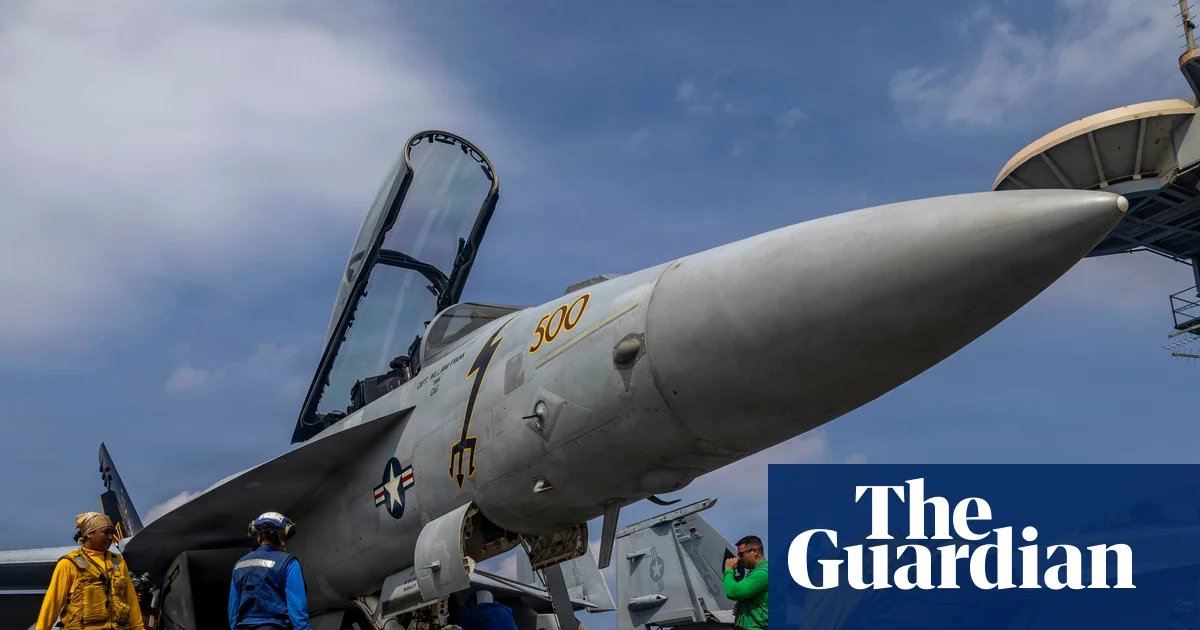
Donald Trump has said it will be clear within “probably 10 days” whether he can reach a nuclear deal with Iran, as the US military buildup in the Middle East intensifies with the impending arrival of a second carrier strike group.
The US president, speaking at the inaugural meeting of his Board of Peace in Washington DC, insisted Iran could not have a nuclear weapon and emphasised that “bad things will happen” if the country continued “to threaten regional stability”.
Giving a possible timeline, Trump said: “Maybe we’re going to make a deal, but you’re going to be finding out over the next probably 10 days,” as the US waits for Iran to respond after talks between the two on Tuesday.
The White House envoys Steve Witkoff and Jared Kushner met Iranian officials in Geneva to discuss Iran’s nuclear enrichment programme, set back but not eliminated after US and Israeli bombing during the 12-day war last June.
After the diplomatic meeting, Iran promised to respond within two weeks to US demands that it abandon enrichment altogether in return for sanctions relief – roughly consistent with Trump’s mooted timeline.
However, last summer Trump gave himself two weeks to decide whether he would bomb Iran’s underground nuclear enrichment facility at Fordow, only to strike it with B-2 stealth bombers within a few days.
Experts say there are already sufficient US military assets in the Middle East to begin an aerial bombing campaign against Iran, potentially in conjunction with Israel, though it is less clear what this would achieve.
The USS Abraham Lincoln aircraft carrier and other warships in a strike group have been in the Arabian Sea for nearly a month, with nine squadrons of aircraft including F-35 Lightning IIs and F/A-18 Super Hornets.
A second carrier strike group, led by the USS Gerald R Ford, was last confirmed to be in the Atlantic west of Morocco on Tuesday. It is expected to head through the strait of Gibraltar and towards the eastern Mediterranean, a voyage of several days.
The Ford, the world’s largest aircraft carrier, sailed from the Caribbean Sea, where last month the warship was involved in the seizure of Venezuela’s Nicolás Maduro from a fortified compound in a night raid.
Together, the carrier strike groups could generate “several hundred strike sorties a day for a few weeks, an intensity greater than during the 12-days war” said Matthew Savill, the director of military sciences at the Royal United Services Institute.
Even without the Ford, planes flying from the Lincoln could fly 125 or more bombing missions a day, giving the US the means to start attacking government and military sites in Iran in an aerial campaign if Trump chooses to attack.
Aviation experts have tracked a large movement of military planes to the Middle East as the US ramps up pressure on Iran. Six E-3 Sentry Awacs, critical for real-time command and control operations, are now deployed at Prince Sultan airbase in Saudi Arabia, having been moved from the US and Japan.
“The question, however, is: what is all this buildup for?” Savill said. The sizeable deployment of air and sea assets suggests the US military is giving Trump the option of launching a wide-ranging bombing campaign, beyond an effort that might focus on Iran’s supreme leader, Ali Khamenei, and other senior figures.
Last month, Trump promised people protesting against the Iranian regime that “help is on its way”, but at that time the US military presence was limited. Now that warships and fighter jets are available, and the protests have been bloodily suppressed, the US leader has switched to focus on Iran’s nuclear ambitions.
Options include a further bombing campaign against the already degraded weapons programme. That could include targeting the Pickaxe Mountain complex near Natanz and Taleghan 2 at Parchin, two nuclear sites not targeted in the 12-day war.
In November, experts from the Institute for Science and International Security concluded that Iran “does not appear able to enrich uranium in any significant manner or make gas centrifuges in significant numbers” after the war.
However, the location and status of 440kg of 60% enriched uranium that was held by Iran remained uncertain. Theoretically Iran has enough uranium to make 10 nuclear weapons if it could be further enriched above 90% and weaponised.
Israel has been pressing for the US to focus on Iran’s ballistic missile programme, considered to be the country’s most potent military threat. Iran is estimated to have about 2,000 ballistic missiles in its stock with up to 25 launch bases around the country, six of which were not attacked by Israel in June.
Iran does not possess capable air defences, which were easily suppressed by the Israeli military in the short summer war, meaning its best available form of defence would be to counterattack. On Tuesday Khamenei threatened to send US warships “to the bottom of the sea”.
A volley of ballistic missiles is difficult to shoot down entirely even with sophisticated air defence systems of the types used by the US and Israel and there were signs that Iran had improved its hit rate in the summer conflict.
At the start of the 12-day war, only 8% of Iranian missiles were getting through, but on 22 June, two days before its end, 10 out of 27 missiles hit Israel, according to the Jewish Institute for National Security of America.
The US has been increasing its air defence systems in the region in case Iran were to respond by striking against Israel, other allies in the Middle East or its own regional bases.
Satellite imagery shows a Patriot air defence system has been placed at Al-Udeid airbase in Qatar, the regional headquarters of the US Central Command. US destroyers near Cyprus can target ballistic missiles heading towards Israel.
The UK has already indicated to the US it will not allow its airbases such as RAF Fairford in Gloucestershire or Diego Garcia in the Indian Ocean to be used for runs by B-2 bombers – but it and other western nations may get drawn in to defend allies in the Middle East.
Last month the RAF’s 12 Squadron redeployed to Qatar, its Typhoon jets ready to operate in self-defence if the Gulf country is attacked.