dailynewsnblog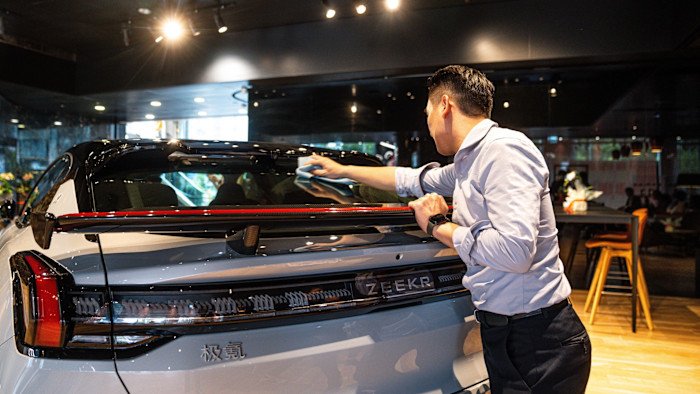
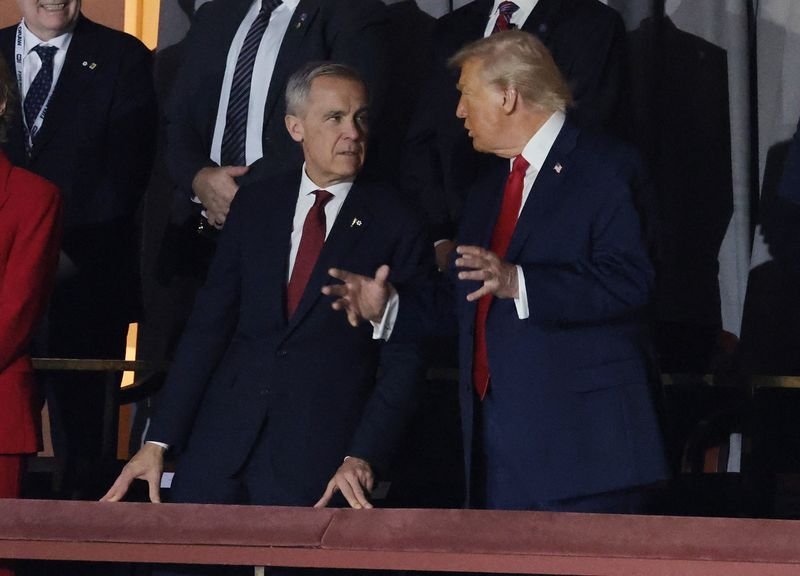
President Donald Trump spooked the US automobile industry last month when he told business leaders during a visit to Detroit that he would “love” if Chinese carmakers built plants in the US, creating jobs and hiring “your friends and your neighbours”.
His comments, coupled with hints by Geely that it could enter the US market within the next three years, have put American auto executives on edge over the possibility that the world’s second-largest car market could soon have cut-throat competition with Chinese rivals that has swept across Europe, south-east Asia and Latin America.
“Assuming that the Chinese are given the opportunity to come into the US, they will bring a very competitive model that will challenge not just the Detroit original equipment makers, but also the Japanese, European and Korean OEMs in this market,” said David Dauch, chief executive of Dauch Corp, the auto supplier created from the merger between American Axle & Manufacturing and the UK’s Dowlais.
“If there is a level playing field, that’s fantastic. If not, then I don’t think [the US] will allow China in this market to impact jobs here,” Dauch told the FT.
Executives in the US and China remain cautious about the possibility of a sudden policy shift in Washington ahead of the president’s planned visit to China in April, where a trade deal could be signed.
Tu Le, founder of Detroit-based consultancy Sino Auto Insights, said there has been a jump in enquiries from anxious North American manufacturers seeking advice on the question of whether they should defend against Chinese competition or whether it was better to partner with the rivals.
Mark Wakefield, global automotive market lead at consultancy AlixPartners, also said senior leaders at US carmakers were feeling “quite paranoid and concerned” about the prospect of Chinese rivals entering the US market.
He said they were trying to work out how to replicate some of the development processes that allow Chinese companies to deliver their products at such speed, while also considering whether to resist China’s entry or to take advantage of it by “providing a beachhead” into the US market.
Some Chinese carmakers have struck a more sceptical note.
“Building a factory is long-term planning, while Trump is a businessman whose policies are subject to change,” said an executive at a leading Chinese electric vehicle company.
The US has in effect banned Chinese cars from entering its market after Joe Biden’s administration imposed 100 per cent tariffs on EV imports from China in 2024. The Trump administration retained the tariffs as well as Biden-era restrictions on the use of Chinese software and hardware for vehicles with a built-in internet connection.
“The rationale for the tariffs still holds, and will continue to hold,” said Navtej Dhillon, who served on Biden’s National Economic Council and developed the 100 per cent tariff plan. He added that the measures were supported by US carmakers and suppliers.
However, senior industry leaders in Detroit also worry that without access to Chinese technology and manufacturing knowhow, they will soon be left behind on the global stage and eventually in the US as well.
The answer, for now, appears to be to partner with Chinese companies outside of the US. Stellantis, which owns the Jeep, Dodge and Ram brands as well as Peugeot and Fiat, bought a 20 per cent stake in Leapmotor in 2023 to help the Chinese start-up grow sales in Europe by using the group’s dealers and plants.
Meanwhile, Ford is in talks with Geely about a partnership that could involve sharing production capacity and vehicle platforms in Europe. According to two people familiar with Ford’s thinking, any such relationship with a Chinese group would probably prove an intermediate step towards entry into the US market.
Ford said: “We have discussions with lots of companies all the time on a variety of topics. Sometimes they materialise, sometimes they don’t.”
The Dearborn, Michigan-based company has also talked to Xiaomi and BYD about a potential future partnership, said several people familiar with the situation.
The discussions with Xiaomi have been denied by both companies. But Le said US executives would be “neglecting their fiduciary duties if they weren’t talking to companies like Xiaomi, given the imminent nature of the threat”.
Sean Tucker, a managing editor at Kelley Blue Book, noted there was a “gaping hole” at the lower end of the market following a long-term shift by the Detroit carmakers and other rivals towards larger, higher-margin models.
“If the Chinese suddenly show up tomorrow, then they will serve that need before any other automaker can respond to the opening,” Tucker said.
A more likely priority in the near term for Chinese carmakers, said analysts, would be to secure their foothold in Canada, which in January struck a deal with Beijing to accept imports of 49,000 electric cars with a 6.1 per cent tariff, abandoning its 100 per cent tariff.
Jiří Opletal, chief executive of China EV Marketplace, a Hong Kong-based company that helps export China-made EVs to overseas customers, said that while the volume of Chinese EVs in Canada would be limited, “once access exists, it becomes much harder to reverse entirely. In other words, the floodgates are about to be opened.”
Le said Ottawa’s policy would have wider ramifications for Detroit carmakers if Chinese groups were to start production in Canada and erode their share in that country’s market.
“We will literally be surrounded by Chinese vehicles in Canada and Mexico,” he added, noting that “the US is likely now competing against Mexico and Canada for foreign direct investment from one or more of the Chinese OEMs”.
Geely, which also owns Volvo Cars and Polestar, has recently suggested that its entry into the US was a question of “when and where” and that it could share the Swedish group’s facility in South Carolina.
Volvo Cars chief Håkan Samuelsson said it could co-operate with Geely in assembling its vehicles if there was any excess capacity but cautioned against collaboration in software.
“If we’re going to have a strong car industry in the US, I think it would be good if there would be new technology and new competitors entering the market,” he added.