dailynewsnblog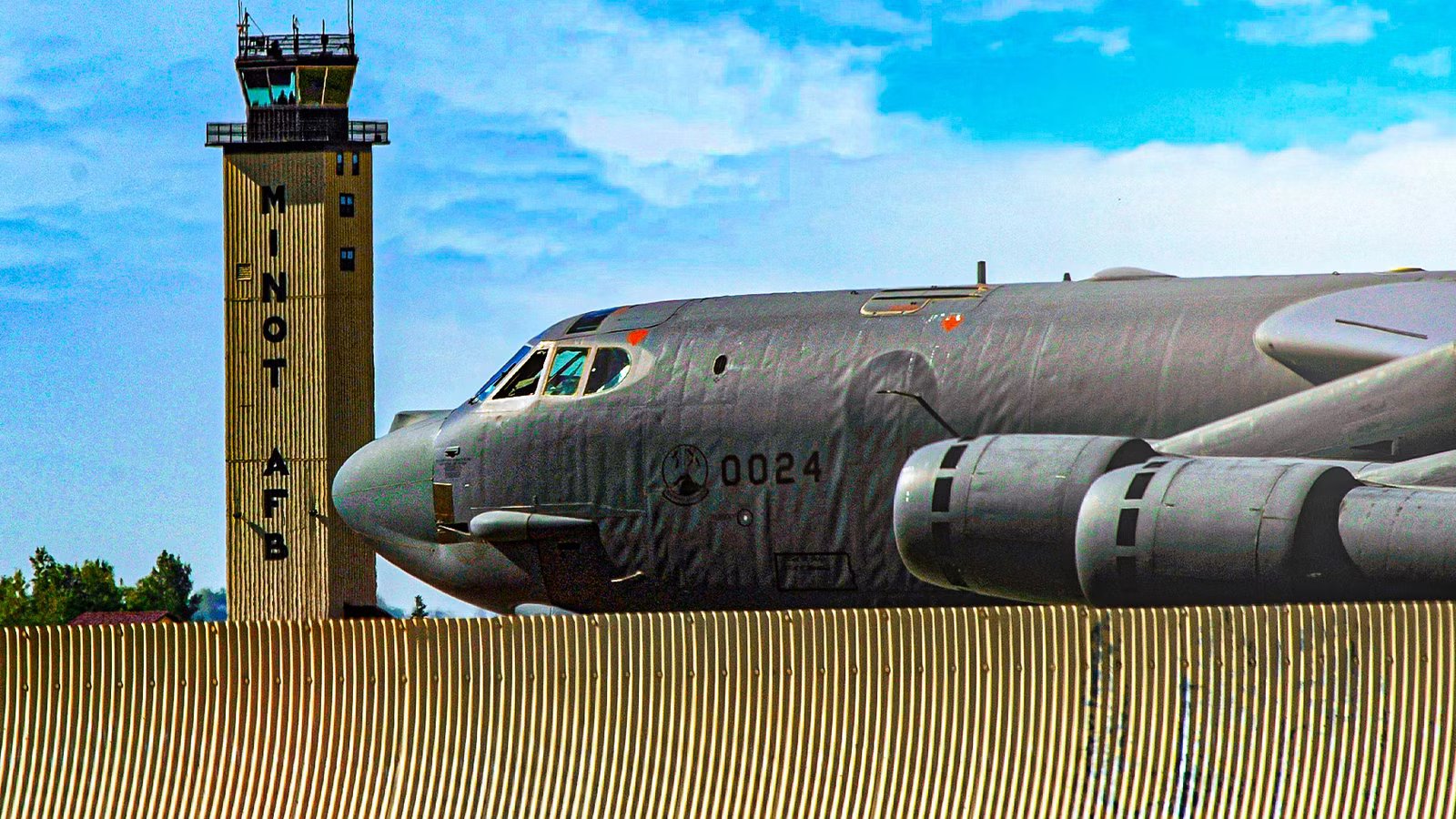
During the Cold War, the United States constructed dozens of air bases designed for a conflict that many feared could escalate to nuclear levels with little warning. Some of these installations have since closed or transitioned to civilian use, but several bases explicitly built during that era remain active today. These airfields continue to support frontline aircraft, strategic deterrence missions, and intelligence operations worldwide.
Instead of disappearing into history, many Cold War-era air bases quietly adapted as the geopolitical landscape shifted after 1991. This article focuses on US Air Force bases built or significantly shaped during the Cold War that remain operational today and why. By examining when they were built, the missions they initially supported, and the aircraft currently stationed there, it becomes evident how deeply Cold War planning still influences modern US airpower.
Minot Air Force Base: Built For Nuclear War, Still On Alert

Minot Air Force Base, in North Dakota, stands as a prime example of a Cold War installation that has maintained its original purpose. Activated in 1957, the base was built during the peak of Strategic Air Command’s nuclear growth. Its remote location and large surrounding airspace made it perfect for hosting both strategic bombers and ballistic missiles. Not many US bases exemplify Cold War deterrence strategies as this one does.
During the Cold War, Minot became home to B-52 Stratofortress bombers and a network of Minuteman intercontinental ballistic missile silos spread across the northern Great Plains. According to the US Air Force, the base was designed for continuous readiness, with aircraft and missile crews maintained at high alert levels in case of a Soviet first strike. This dual bomber-and-missile mission placed Minot AB at the core of America’s nuclear deterrent posture. You can read more about this base and its history on the official USAF Minot AFB page.
Today, Minot Air Force Base remains unique within the US Air Force. It still operates B-52H bombers under Air Force Global Strike Command, alongside Minuteman III missile units and UH-1N helicopters used for missile field security. While command structures and technology have evolved since the Cold War, Minot’s primary mission, strategic nuclear deterrence, has remained remarkably consistent for nearly seven decades.
Barksdale Air Force Base: The Other Pillar Of Strategic Air Command

Barksdale Air Force Base is located in Louisiana, and it is one of the most critical Cold War-era bases still in operation, even though its origins predate the Cold War itself. During the 1950s and 1960s, Barksdale was fundamentally reshaped into a Strategic Air Command stronghold. Its role as a nuclear bomber base placed it at the heart of America’s deterrence strategy. Today, it remains one of the most active bomber bases in the US.
During the Cold War, Barksdale hosted B-47 Stratojet and later B-52 Stratofortress bombers, many of which stood on nuclear alert during periods of heightened tension, such as the Cuban Missile Crisis. The US Air Force notes that Barksdale played a major role in maintaining bomber readiness, both airborne and ground-based, throughout the Cold War. The base also became closely associated with long-range strike planning and nuclear command operations.
Today, Barksdale is one of only two permanent B-52 operating bases, alongside Minot. It also hosts the E-4B National Airborne Operations Center aircraft, often referred to as the “doomsday planes.” While the Cold War has ended, Barksdale’s infrastructure and mission set remain deeply tied to the era that defined its modern identity.

The 7 Oldest United States Air Force Bases & Their Strategic Roles
Discover the rich history and vital roles of the USAF’s oldest active bases.
Whiteman Air Force Base: Cold War Foundations Of Stealth Bombing

Whiteman Air Force Base in Missouri gains its modern significance from Cold War strategic planning, even though the airfield existed before that era. The base was heavily redeveloped in the late 1950s as part of Strategic Air Command’s bomber dispersal strategy. This overhaul prepared Whiteman to support the next generation of long-range strike aircraft. Its Cold War legacy is closely linked to the rise of stealth technology.
Reactivated in 1951, Whiteman initially became a B-47 Stratojet base and later a B-52 bomber base as SAC aimed to reduce vulnerability to a surprise nuclear attack. By the late Cold War, its infrastructure and location made it a prime candidate to host the B-2 Spirit stealth bomber. The US Air Force notes that Whiteman was selected in the 1980s specifically to support stealth operations designed to penetrate advanced Soviet air defenses.
Today, Whiteman Air Force Base is the only operational base for the B-2 Spirit and is expected to play a key role in future bomber operations. Its Cold War-era runways, security layout, and hardened facilities remain ideally suited for stealth bomber operations. What began as a Cold War dispersal base has become one of the most strategically sensitive installations in the US Air Force.
Beale And Offutt: Cold War Intelligence From Air And Ground

Intelligence gathering was a defining feature of the Cold War, and Beale Air Force Base in California was built specifically to support that mission. According to the base’s history, it was initially a US Army training field operational during WWII, but it was transferred to the USAF in 1948. Its role placed it at the center of some of the Cold War’s most secretive aviation programs. Unlike many reconnaissance sites, Beale never lost its operational relevance.
Beale Air Force Base was activated in April 1951 and became synonymous with high-altitude reconnaissance and strategic surveillance. It hosted the U-2 Dragon Lady and later the SR-71 Blackbird, aircraft designed to collect intelligence deep inside denied airspace. Offutt, meanwhile, served as the headquarters of Strategic Air Command, coordinating America’s nuclear bomber force and later hosting reconnaissance aircraft, including the RC-135 series.
Today, Beale continues its reconnaissance mission with U-2S and RQ-4 Global Hawk aircraft, while Offutt serves as the headquarters of US Strategic Command. Although satellites now play a significant role in intelligence collection, both bases remain operationally relevant, relying on Cold War-era infrastructure adapted for modern ISR and command missions.

What US Air Force Bases Have F-35s?
Ten air force bases are listed as bases for the USAF F-35A, although they can operate from many more bases.
Elmendorf And Nellis: Cold War Fighter And Tactics Bases

Not all Cold War air bases were centered on nuclear bombers or reconnaissance aircraft. Fighter operations and tactical development were equally critical, particularly for air defense and combat readiness against Soviet aircraft. Elmendorf Air Force Base in Alaska and Nellis Air Force Base in Nevada emerged as two very different but equally important Cold War installations. Each played a distinct role in shaping how the US Air Force prepared for high-end aerial combat.
Elmendorf Air Force Base was activated in August 1951 as part of the United States’ northern air defense network. Positioned just a few hundred miles from the Soviet Union, its primary Cold War mission was to intercept Soviet bombers approaching North America over the Arctic. The base supported interceptor aircraft and radar coverage tied into the broader North American Aerospace Defense Command (NORAD), making it a frontline installation throughout the Cold War.
During the Cold War, Elmendorf supported interceptor aircraft and radar coverage tied to the broader North American Aerospace Defense Command (NORAD) system. This Cold War base is probably the most geographically critical due to its proximity to Russia. You might have heard of it recently because of the US-Russia summit between Trump and Putin held there earlier this year.
According to the US Air Force, Elmendorf was designed to maintain constant readiness in one of the harshest operating environments on Earth. Now part of Joint Base Elmendorf-Richardson, the installation hosts F-22 Raptor squadrons and C-17 Globemaster III transports.
Nellis Air Force Base followed a very different Cold War path. While the airfield itself predates the Cold War, Nellis evolved during the 1950s–1970s into the US Air Force’s premier center for fighter tactics, weapons employment, and adversary training. According to the US Air Force, lessons learned from encounters with Soviet-built aircraft and air defense systems directly shaped training programs at Nellis, including the foundations of exercises such as the Red Flag.
Cold War Training Bases That Never Stopped Training

It’s worth noting that not all Cold War air bases were built for combat or reconnaissance. Many were designed to train the massive number of pilots required for a potential long-term conflict. Several of these training bases remain active today, quietly shaping the next generation of US Air Force aviators.
Columbus Air Force Base in Mississippi was activated in 1951 to meet Cold War pilot-training demands. Likewise, Laughlin Air Force Base in Texas expanded significantly during the same period to support high-throughput training operations. According to the USAF, both bases were designed for continuous operations, high sortie rates, and standardized training pipelines.
Today, all these bases continue to train pilots using modern variants of aircraft concepts first introduced during the Cold War. Although the geopolitical threat might have changed, the need for skilled aircrews has not. These training bases demonstrate how Cold War infrastructure quietly transitioned into a permanent foundation for US Air Force readiness. For aviation historians, these bases offer a living link to one of the most intense periods in aerospace history. Bombers, fighters, and reconnaissance aircraft continue to operate from runways laid down during the Cold War, often with surprisingly minor modifications. The aircraft may be newer, but the foundations remain familiar.
Currently, the US Air Force prepares for future platforms such as the Northrop Grumman B-21 Raider and next-generation fighters, and so, many of these Cold War-built bases are expected to remain in service. Long after the Cold War ended, its air bases continue to shape how and where American military aircraft operate.