dailynewsnblog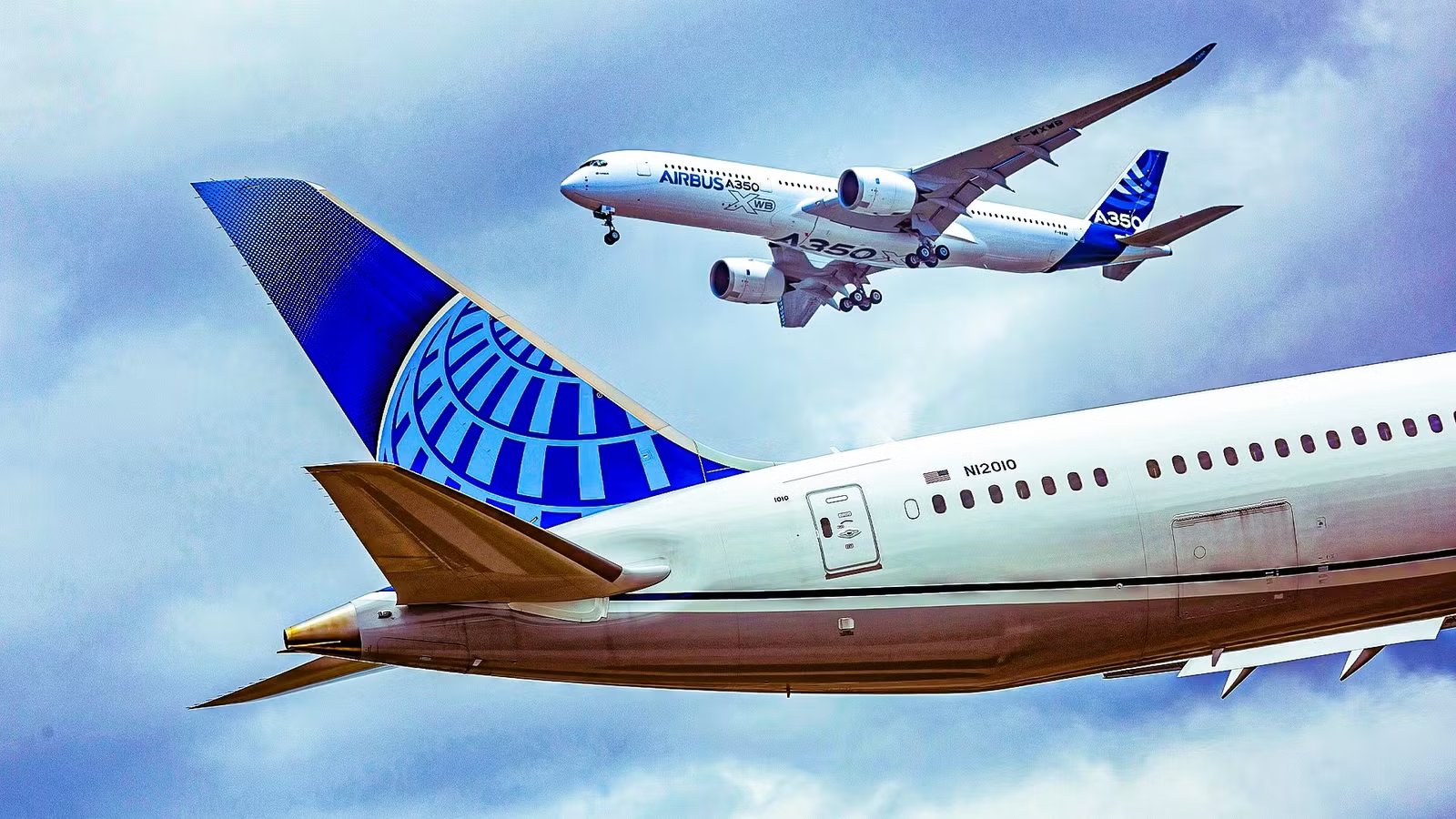
The long-simmering story of  United Airlines’ order for the Airbus A350 just took its sharpest turn yet. According to its latest SEC 10-K filing, the Chicago-based airline has officially removed the Airbus widebody from its “expected aircraft deliveries.” This after years of filings that have consistently maintained that it still expected to take the 45 A350s at a much later date.
The trigger for this sudden change? The filing also contains a newly disclosed dispute with Rolls‑Royce involving a widebody engine purchase and maintenance agreement, undoubtedly referring to the Trent XWB engines that would equip any future A350s. The dispute centers around a $175 million commitment payment, and a demand for repayment after what United calls a breach, the kind of dispute that can easily ripple into fleet plans when an aircraft has a single engine supplier.
The A350 That Wouldn’t Land: United’s 15-Year Detour

United placed its original order for the Airbus A350 back in 2009, ordering 25 of the aircraft’s first and smaller variant, the A350-900. Then in 2013, the carrier increased this order to 35 aircraft and converted them all to the larger A350-1000. However, just four years later, United Airlines once again reverted to the A350-900, increasing the total number on order to 45, and that is how it has remained ever since.
For nearly a decade, United’s A350 order has lived in a strange in-between state: real enough to be contractually on the books, yet distant enough to be repeatedly reshaped, deferred, and treated as a decision for “later.” As recently as September, United CEO Scott Kirby was stating that the airline expects a 2030 timeframe to make its decision about the A350, saying that:
“By the end of the decade, we will be well into retiring the 767. It is a natural time to at least think about whether to make the Airbus A350 order firm in the 2030 timeframe.”
Now everything has changed, and while it’s just a single data point on a table buried in a regulatory finding, it marks a massive shift by United. In its 2024 10-K filing, United listed 45 A350s as “Contractual Aircraft Deliveries” and, crucially, still includes them in “Expected Aircraft Deliveries“, shown in the far-out bucket (“After 2025”).
A year later, it was the same pattern: 45 A350s remain, still shown as expected, now pushed out (“After 2026”). However, this year’s 10-K filing is different: The contract line stays — 45 A350s are shown as contractual deliveries “After 2027” — but “Expected Aircraft Deliveries” for the A350 goes to zero/blank across every bucket. That “expected deliveries” shift is the headline. Airlines often carry long-term commitments that are technically alive but operationally dormant.
The easiest way to see when something has moved from “real plan” to “optionality” is how management describes it in investor-facing planning tables. United’s own tables show a clear evolution: expected A350 deliveries were previously acknowledged; now they are not. It is telling its regulators and its investors that it is not expecting to ever take delivery of the A350.
Engines, Lawyers, and a Filing That Raises More Questions

The other major new ingredient is the Rolls-Royce dispute disclosed in the 2025 10‑K, a section that reads like a legal fight with real commercial stakes. United says it entered into agreements with Rolls‑Royce in 2010 for widebody engine purchases and maintenance services, and that it paid Rolls‑Royce a $175 million commitment payment in 2017.
United then states that in December 2025, following what it describes as a breach by Rolls‑Royce, it demanded repayment representing the commitment payment plus contractual escalation. Rolls‑Royce did not pay, and subsequently terminated the agreements while asserting United breached them. United says each side contends the other owes damages, and it is also “considering further implications… with respect to other parties.”
That last phrase, “other parties,” is where industry watchers’ eyebrows go up. The A350 is powered exclusively by Rolls‑Royce Trent XWB engines, and is the only Rolls-Royce-powered aircraft that United has in its fleet or on order. So United is specifically referring to Airbus here, and makes it even clearer with its 10-K filing, where it splits the A350 story into two parallel truths:
- Contractual status: 45 A350s still appear as firm commitments, contractually sitting “After 2027.”
- Planning reality: United shows no expected A350 deliveries at all — a notable change from the 2024 and 2025 10‑Ks.
Airbus responded to Simple Flying’s request for comment, saying: “Airbus has no comment on this matter. We suggest you contact United Airlines and Rolls-Royce for further information.” United Airlines and Rolls-Royce had not responded by the time of publication, and likely won’t, given the pending legal matters, but this article will be updated if a response is received. In any case, there remains a lot that still needs to be publicly confirmed.
United and Airbus have repeatedly amended their A350 deal over the years, and the contract exhibits are heavily redacted for confidentiality. Put bluntly: a lot is unknown, the amendments are redacted, the delivery schedule details are not publicly visible in full, and nothing in the filing says “canceled.” However, investor-facing documents increasingly support a simpler interpretation: United is no longer planning around taking the A350, even if the contractual framework hasn’t been formally zeroed out.

Why Don’t Any US Carriers Fly The Airbus A350 Apart From Delta Air Lines?
One of its major rivals could start flying the Airbus widebody next decade.
What Happens Next: Cancellation, Conversion, Or A Very Long Goodbye

So what happens now? For starters, United will undoubtedly use the A350 order as leverage in its dispute with Rolls-Royce. The total order for 45 A350s is worth more than $15 billion at current rates, although United’s contract will be for far less, having no doubt negotiated a substantial discount on 2009 rates. But a single Trent XWB engine costs approximately $25 million, so Rolls-Royce has a $2 billion+ interest in the order.
There are several plausible endgames, and United has enough contractual and strategic wiggle room that the final outcome may not look like a clean headline cancellation. Here’s what is likely on the table:
|
Potential Outcomes For The United Airlines A350 Order |
|
|
Negotiated Termination |
United cancels the remaining A350 commitments and closes the chapter. If the Rolls‑Royce dispute is materially tied to the economics of bringing the A350 online (engines, support, escalation clauses), the easiest fix may be to unwind the plan entirely. The challenge is always the same: penalties, deposits, and how much value either side assigns to keeping the relationship intact. |
|
Further Deferral |
United could potentially keep 45 A350s contractually in a far-out bucket for years, treating them as an option-like hedge while it continues to build out its Boeing 787 strategy. |
|
Value Conversion |
A more subtle outcome would be a behind-the-scenes restructuring where economic value tied up in the A350 agreement is redirected into other Airbus products. The most obvious would be converting to additional A321neo-family aircraft, where United is already a major customer. However, while this would be attractive to both United and Airbus and avoid too much negative PR, it would leave Rolls-Royce out in the cold. |
For now, the most defensible takeaway is also the most striking: United hasn’t publicly canceled the A350, but in its latest 10‑K, it has removed the A350 from “expected deliveries,” reversing how it treated the order in prior annual filings. That is not a paperwork typo; it’s a signal, and it’s the kind of signal that, in aviation, usually shows up well before the press release does.