dailynewsnblog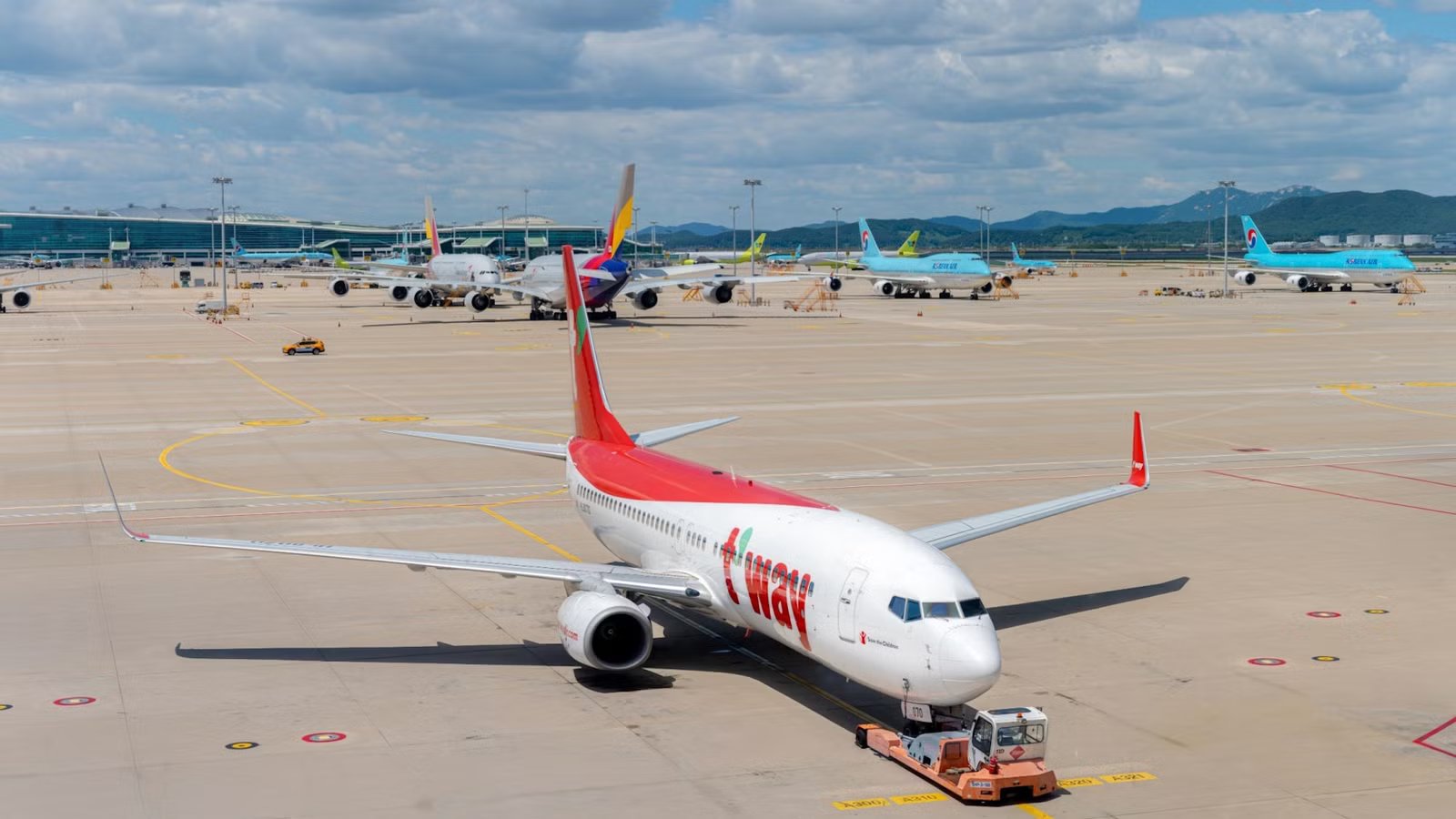
Taipei’s Taoyuan International Airport (TPE) recently faced a bottleneck after a T’way Air  Boeing 737-800 lost a right main-gear tire during a routine landing, leaving debris on the runway and forcing controllers to close the strip for further inspection. The airport switched to single-runway operations due to the height of an arrival bank, which pushed aircraft into holding patterns and ultimately delayed departures on the ground.
Aviation-monitor accounts have said that three different flights declared fuel emergencies within around ten minutes of each other as the queue continued to grow. The jet taxied clear safely, and no injuries were reported as a result of this incident. However, the episode still highlights how a simple mechanical anomaly can quickly ripple across the operations of a busy hub airport in minutes. We aim to discuss this incident in detail and its impacts on the airport and the airline.
The Incident Occurred On February 8

On the morning of February 8, T’way Air flight TW687 from Jeju Island arrived at Taiwan Taoyuan International Airport (TPE), and, at 3:52 P.M. local time, the aircraft suffered the detachment of its right main landing gear’s tire upon touchdown. The crew kept the Boeing 737-800 under control and quickly taxied to parking stand A2, stopping at 3:54 P.M., and authorities reported no injuries.
Taoyuan International Airport Corporation (the management company behind the facility) immediately suspended operations on the airport’s north runway and routed all traffic to the south runway while crews conducted a foreign object debris sweep and marked and removed aircraft components. The north runway reopened at 5:35 P.M. By the time the height of the evening peak arrival bank took place, delays were reduced to under 20 minutes. Only around 14 flights were affected, and the longest delay was that of a Japan Airlines jet that spent about an hour on the taxiway.
What Exactly Did This All Mean For The Airport?

Taoyuan International is built around two parallel runways. When one is unavailable, the airport does not just lose slots but rather operational flexibility. This kind of situation forces controllers to merge all arrivals and departures onto a single runway, increasing spacing requirements for wake turbulence and slowing the arrival rate to keep taxiways and gates from getting saturated. This is why even a roughly two-hour runway closure can create knock-on delays for hours.
Aircraft circling overhead will burn fuel, and departures will miss their departure windows. Late arrivals will push gate turns into the next bank. The aircraft operator’s ultimate priority was also safety, with any loose tire, wheel hardware, or metal fragments becoming foreign object debris that can be ingested by engines or puncture other tires, all so that a full sweep is non-negotiable.
Aviation-monitor posts claim that multiple fuel emergencies underline how quickly holding can become a constraint. This event also tests crisis communications, towing readiness across the board, and coordination between ATC, airlines, and maintenance crews, especially during peak periods with banked schedules.

Anchorage Airport’s Suspicious String Of Blown Tire Incidents
A closer look at the role tires play during a flight.
What Does This Mean For The Airline Itself?

For T’way Air, the immediate issue is proving that this was contained and understood as an unacceptable problem. A tire detachment can stem from underinflation or overheating, brake issues, foreign object damage, or problems with the wheel and axle assembly. This is also where investigators will scrutinize maintenance logs, recent wheel changes, torque procedures, and parts traceability.
The aircraft may be grounded until inspections are complete, potentially creating knock-on cancellations in a tight, low-cost schedule. There are also delays on the customer side, with missed connections and compensation obligations quickly outweighing the cost of the hardware itself, something that is an especially big issue if multiple rotations are disrupted as a result.
In the longer term, these kinds of incidents will pressure airlines to demonstrate robust awareness of these kinds of situations. Pre-flight check systems will be scrutinized, alongside maintenance quality control. This is all because public perception often treats lost wheel situations as a near-disaster, even when the landing itself is safe. T’way has noted that it is cooperating with authorities, and it apologized to the passengers involved in the incident in question.