dailynewsnblog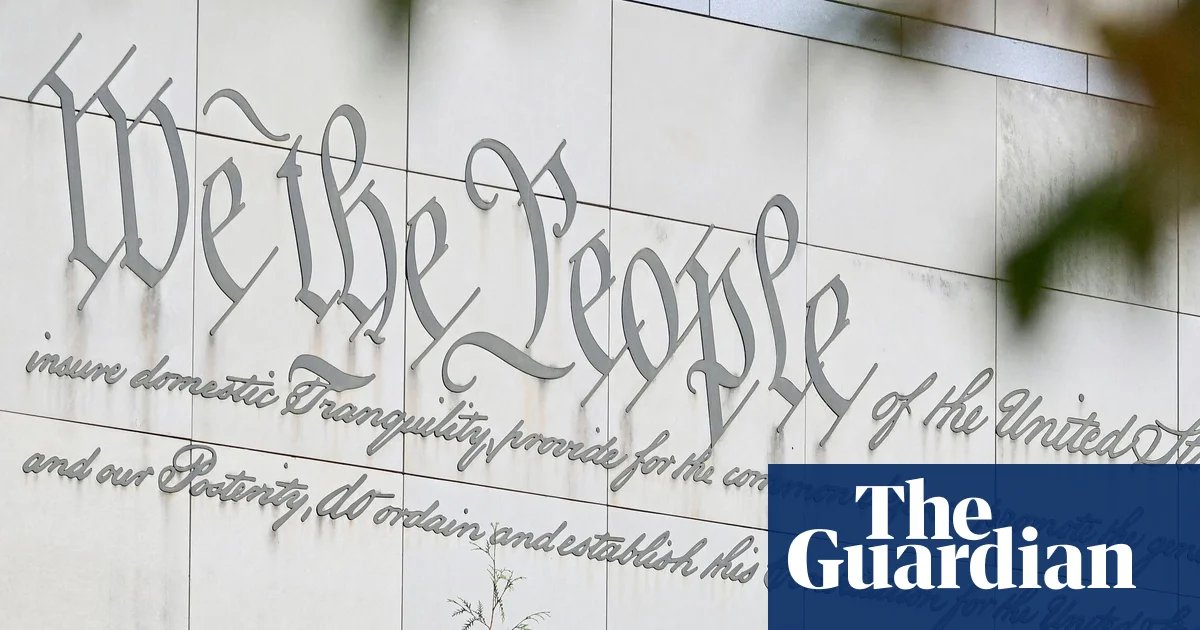
The first and only museum dedicated to the US constitution has been plunged into turmoil over the sudden departure of its president, a legal scholar widely respected for his commitment to non-partisanship.
The National Constitution Center (NCC) in Philadelphia announced last month that Jeffrey Rosen would step down after 12 years to be replaced by Vince Stango on an interim basis.
Rosen, 61, shaped the centre’s scholarly output, public programming and global profile. He was central to its preparations for the 250th anniversary of US independence in July, personally overseeing much of the educational content.
Some at the NCC felt that, while Rosen’s gifts as a public intellectual and ambassador were beyond reproach, he showed less appetite for the bread-and-butter management of running an organisation and it was time to make a change.
One member of the centre’s board, however, alleges that the then chair, Doug DeVos, and his successor, Mike George, had a more sinister political motive for ousting Rosen.
“The two chairmen’s reprehensible actions were all about Donald Trump and the celebration of the 250th anniversary of America’s founding on July 4, 2026, and nothing whatsoever about Mr Rosen,” J Michael Luttig, a retired federal appeals court judge, told the Guardian in an email.
There is no firm evidence of a link between Rosen’s departure and an effort to curry favour with the White House. Several sources at the centre, approached by the Guardian, bridled at the suggestion and categorically insisted that politics played no part in the leadership transition.
Stango, 48, the interim president and chief executive, said: “As we were contemplating the future and what the next 10 years looked like, Jeff made the decision to step down.
“He, and we, feel as though he came in at a time when we needed his leadership. He elevated our national voice. He helped, in partnership with me and others on the team, grow the Constitution Center to where it is today. He felt it was time to step down and focus on his other interests, his personal scholarship.”
Despite the conflicting accounts, there is no doubt the NCC has endured a difficult and acrimonious few months. DeVos and George hired an external employment lawyer to interview staff about workplace issues including how the organisation was being led.
The issue came to a head in December when the board’s executive committee convened via Zoom. One source says members were surprised when DeVos and George asserted for the first time that there was a leadership crisis. Another source denies this and insists it was not the first time board members had been informed.
According to one account, Rosen had become paranoid about his position and tendered his resignation in the expectation that it would be refused. But the executive committee voted through the proposal unanimously.
But Luttig had immediate misgivings. He began circulating detailed emails to the full board, laying out documents and correspondence that, he claimed, had been withheld by the leadership. (Others discount this claim.) These communications continued almost daily in the run-up to the next full board meeting on 7 January.
Luttig, a conservative critic of Trump who testified to the congressional panel investigating the January 6 insurrection at the US Capitol, said via email: “I told the Board of Trustees repeatedly before the Board Meeting that there never had been a ‘crisis’ at the NCC until the two chairmen created the crisis at the NCC themselves as pretext to push Jeff Rosen out.”
Luttig claims that a significant number of board members said that, in the weeks leading up to the January 7 meeting – and even during and after the vote – they did not understand the issue involving Rosen. They said the two chairmen had not provided them with the relevant information, leaving them unprepared to vote on Rosen’s resignation, according to Luttig.
Luttig adds that several members wanted the opportunity to speak with Rosen informally to hear his perspective. Despite repeated requests, he says the chairman refused to share the information the board sought and proceeded to force a vote on Rosen’s resignation over the board’s objections on 7 January – though others dispute this claim.
The judge said: “On January 7, 2026, Mr George and Mr DeVos forced the Board to vote to accept Mr Rosen’s resignation over the objections of both the Board and Mr Rosen, who had told Mr George and Mr DeVos that he did not want the Board to accept his resignation, he just wanted the two chairmen to allow him to talk to the Board.
“Had the two chairmen not forced the Board to vote over its objection, the Board would never have accepted Mr Rosen’s resignation and Mr Rosen would still be the President and CEO of the National Constitution Center today.”
DeVos is the former president of Amway, a marketing company that sells health and beauty products, and brother-in-law of Betsy DeVos, who was education secretary in the first Trump administration. The DeVos family are major Republican donors. George was the head of Qurate Retail, the parent company of QVC.
Multiple sources at the centre praised both men for their non-partisan approach and dismissed the idea that they could be trying to please Trump as false. One said: “The personal politics of trustees played no role in this change, nor did it have anything to do with the Trump administration whatsoever. Zero.”
Luttig tried to quit but the board did not vote to accept his resignation, though his name has been removed as a trustee from the NCC website. Rosen has been granted the title of CEO emeritus but is expected to take a back seat, much to the dismay of fellow historians who prized his leadership.
David Blight, an American history professor at Yale University, said: “Mostly all I can express is chagrin and great disappointment that he’s leaving. My impression is the staff had great respect for Jeff.”
Blight praised Rosen’s stewardship of the centre’s annual retreat, adding: “It’s one of the most extraordinary things I’ve ever been to because it’s run by Jeff – or used to be run by Jeff – in a thoroughly bipartisan and non-partisan atmosphere. Watching Jeff in the leadership of that event, which is like two and a half days of nonstop panels, most of which he chairs, is amazing. People are astounded that he can pull this off.”
Akhil Reed Amar, a law and political science professor at Yale University, described Rosen as one of the best students he ever had at law school and a genuine public intellectual. “When he took over as president and CEO of the National Constitution Center, he brought to it a lustre and level of excellence that it had not had before.
“He was spectacular at preserving the non-partisan nature of the place. That tightrope was not easy to walk in the last decade and yet he did. He was quite the acrobat.”
The dispute leaves the institution facing uncertainty at a sensitive moment, with the eyes of the nation – and the world – expected to turn to Philadelphia in July 2026. The centre is a non-partisan, non-profit institution that is chartered by Congress.
Sean Wilentz, a history professor at Princeton University, said: “It seems as if this is improper. From what I knew as a sort of insider-outsider, Jeff was not about to leave. Jeff had lots more to do, especially in the 250th year. You’re not gonna jump ship just before the ship’s about to take off.
“It didn’t make sense and then the other side – the politicisation part – did make sense. If someone who wanted to impress the administration wanted to try to take over the NCC, it would be a feather in their cap and it would advance that process of not just purging stuff that they think is ‘improper’ or ‘un-American’ but it’s also about power and control.”
Since taking office a year ago, Trump has embarked on an unparalleled bid to capture America’s cultural institutions. He seized control of the John F Kennedy Center for the Performing Arts, which his handpicked board renamed the Trump-Kennedy Center in a legally dubious move, and announced it will close for two years for renovations.
The president is also pressuring the Smithsonian Institution to remove “divisive” content and “woke” ideology. And in Philadelphia, the National Park Service recently removed an exhibit on slavery at Independence national historical park in response to Trump’s executive order “restoring truth and sanity to American history” at the nation’s museums, parks and landmarks.
Rosen did not respond to a request for comment. Luttig said in an email: “By forcing Mr Rosen to resign, Mr George and Mr DeVos politicized forever the sacred National Constitution Center, the only institution in America that is, by Charter of the Congress, private, apolitical, and non-partisan, for the express purpose of educating – and inspiring – Americans and the world about the Constitution of the United States and the freedoms it enshrines.”
George said in a statement: “The Center’s Board of Trustees represents scholars, legal experts, and other national leaders who combined offer considerable ideological diversity that enhances our united and nonpartisan effort to advance the principles embodied in the US Constitution.
“We follow a clear governance structure and procedures consistent with past practices and good governance principles in setting priorities for the Center and in ensuring that the necessary resources and leadership structure are in place to deliver on the vision. The current leadership transition reflects this practice. Any suggestion that partisan politics has informed the current leadership transition is absurd.”
DeVos declined to comment.