dailynewsnblog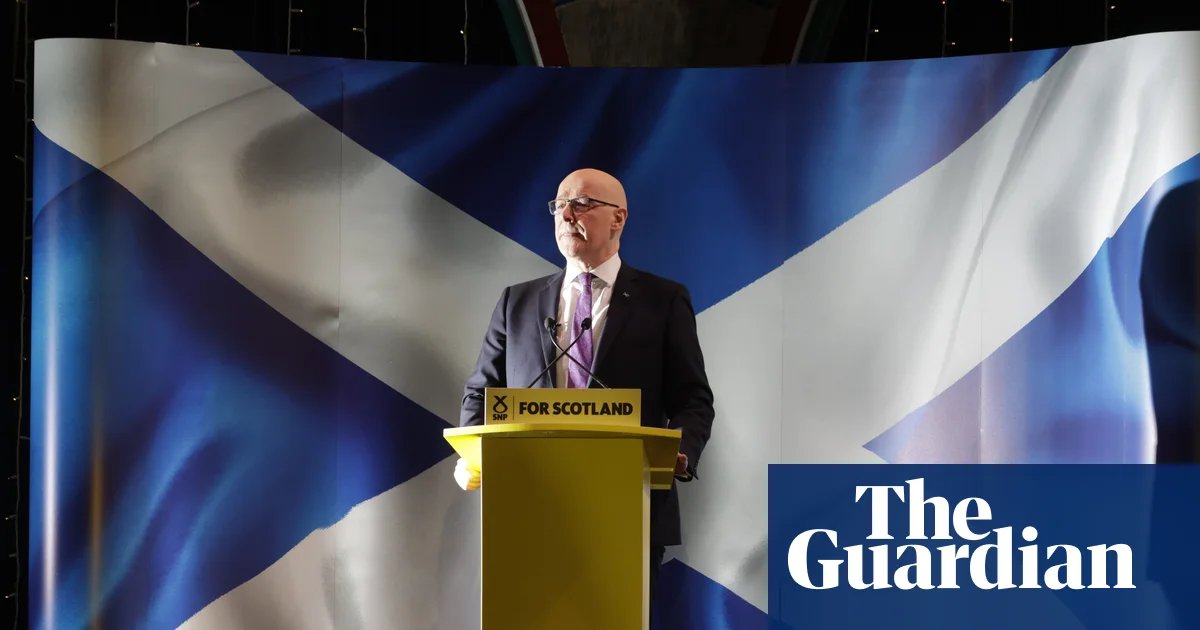
Good morning. The SNP has been in government since 2007, a phenomenal 19-year run, but polling suggests Scottish voters’ trust in its ability to deliver is weakening. In May, Scotland goes to the polls for the seventh Holyrood election since devolution in 1999 – a contest that could significantly realign the nation’s politics.
In what some viewed as a desperate attempt to capitalise on the moment, Labour’s leader in Scotland, Anas Sarwar, called on Keir Starmer to resign last week, possibly trying to paint himself as his own man, not attached to a deeply unpopular Westminster government that currently polls third in the run up to May’s elections. Meanwhile, Reform UK’s steady polling numbers show them second to the SNP, which they are hoping to turn into a meaningful elected presence at Holyrood for the first time.
With so much in the balance, I spoke to our Scotland correspondent, Libby Brooks, about the prospects for the main parties, the challenges they face, and what could still make the difference between now and polling day. First, here are the headlines.
Five big stories
-
UK politics | Ministers have dropped controversial plans to delay 30 local elections this May after receiving legal advice that doing so might not be lawful.
-
Business | UK bank bosses will hold their first meeting to establish a national alternative to Visa and Mastercard, amid growing fears over Donald Trump’s ability to turn off US-owned payment systems.
-
Social media | Keir Starmer has pledged action on young people’s access to social media in “months, not years”, while saying this did not necessarily mean a complete ban on access for under-16s.
-
Sarah Ferguson | Six companies linked to Andrew Mountbatten-Windsor’s ex-wife, Sarah Ferguson, are being wound down in the wake of revelations about her relationship with Jeffrey Epstein.
-
Film | Robert Duvall, the veteran actor who had a string of roles in classic American films including Apocalypse Now, The Godfather, M*A*S*H and To Kill a Mockingbird, has died aged 95.
In depth: ‘Scottish voters don’t seem to think they have many decent options’
So far in the Holyrood election contest, no party is campaigning from a position of obvious strength. The SNP remains ahead despite nearly two decades in government, Labour is struggling to escape anger at Westminster, and Reform is polling strongly but with no clear sign it will be able to translate support into seats.
“You can’t help but feel that Scottish voters don’t seem to think they have many decent options at the moment,” Libby says. She suggests the election may be decided less by enthusiasm than by resignation – with voters thinking in terms of which parties they trust most not to make things worse.
The SNP | Dominance without enthusiasm?
After almost two decades in power, the SNP is fighting an election in which it is no longer judged on what it promises to do, but on what voters feel it has already done – or, more aptly, what it has failed to do.
And while the SNP’s campaign has focused on Scottish independence, their promises have been undermined by a failure to offer voters a plausible route to a second referendum.
Taken together, these challenges should place the party in serious difficulty. And yet somehow, the SNP continues to poll favourably. Libby is not convinced, pointing to the wider indicators suggesting declining confidence in the Scottish government. “You’re looking at polls suggesting they’re going to win comfortably,” she says, “at the same time as trust and satisfaction with public services are steadily diminishing.”
John Swinney’s arrival has stabilised the parliamentary party after Nicola Sturgeon and Humza Yousaf resigned in quick succession. But enthusiasm on the ground appears thinner than in previous campaigns. “My sense is that only the very hardcore people are going to be out leafleting,” Libby says – a telling detail for a party once defined by its activist energy.
Labour | Opposition in Scotland, government in London
Scottish Labour’s problem is simple to describe and hard to solve. It is an opposition party at Holyrood, but it carries the brand damage of a Westminster government.
Libby says that when she is out on doorsteps, the anger is “palpable” – directed at Keir Starmer and Rachel Reeves, and at decisions around winter fuel payments, the two-child benefit cap and disability benefit cuts. Subsequent U-turns on some of those policies do not appear to have cut through, prompting Sarwar to make his extraordinary cross-border red-on-red attack last week. The fact that no other senior Labour figure joined his call – Starmer’s cabinet instead circled their wagons around the embattled prime minister – has, as our Scotland editor, Severin Carrell, put it in this analysis piece, risked Sarwar looking disloyal and isolated.
Where Labour may take comfort is in its organisation. Unlike the SNP, it has money – and a well-honed constituency-by-constituency ground operation. Libby points to the Hamilton byelection as a case study: Reform’s presence felt strong on the ground and frustration with Westminster was obvious, but Labour’s campaigning machine was “really, really well organised”, and it ultimately beat both the SNP and Reform.
Reform | Making moves in Scotland
One early cluster of defections from the Scottish Conservatives to Reform came in the north-east of Scotland – an area with a strong Conservative tradition, farming communities, and Aberdeen as the centre of Scotland’s oil and gas industry. These are not the disaffected faded coastal towns or lapsed Labour voters of the so-called red wall in England. It is, though, the only part of Scotland that voted for Brexit in 2016, and Reform believes it can make gains there, as well as across the post-industrial central belt where they gained their first Scottish electoral success in December, on West Lothian council.
Libby also points to focus-group findings suggesting that some voters feel they have been “talked over” by mainstream politicians on issues such as immigration and gender recognition – a sense of grievance Reform is seeking to exploit.
Reform has installed a new Scottish leader, the multimillionaire financier Malcolm Offord, who was born in Greenock – an attempt to bolster its Scottish credentials while building an operation capable of campaigning at scale. Libby says the party has earmarked £1m for its Scottish election campaign, and has been hiring staff and mailshotting across the country. The unanswered question is whether that investment converts into seats.
Smaller parties, bigger leverage?
The Scottish Greens are a separate party to their counterparts in England and Wales, and Libby says there has been little sign north of the border of a “Zack bounce” following Polanski’s election.
They now have co-leaders, Ross Greer and Gillian Mackay, two MSPs in their early 30s who were elected in August on a promise of fresh ideas and renewed energy. But the party’s difficulty is that their old positioning has become harder to sustain after a spell in government. The Greens cast themselves as radicals holding the SNP’s feet to the fire on climate when they entered their governing partnership, the Bute House agreement, after the last Holyrood election in 2021. But the SNP ditched key climate commitments, Green members revolted and the agreement collapsed, leaving that relationship less clear, and the compromises of power easier for opponents to attack.
The Scottish Conservatives, meanwhile, are fighting both a long-running identity crisis and the growing threat from Reform on their right. Libby describes leader Russell Findlay as “an interesting individual with a great backstory” – a former journalist who was once attacked with acid – but argues he has struggled to persuade voters who he is, beyond a politician reacting to Reform. She also notes that it was Ruth Davidson’s centre-right positioning that took the party to its electoral high point in Scotland, a strategy Findlay has not followed. And without the threat of another referendum, they have also lost their appeal as the “stop independence” party – a position that won them consistent electoral gains in recent years.
The Liberal Democrats may be watching the arithmetic as much as the atmosphere. In a proportional system, small gains can matter, and there has been speculation they could increase their number of MSPs. If Scotland ends up with another SNP minority government, their leverage – and the shape of any future deals – could become part of the story.
Tactical voting and the politics of prevention
One of Libby’s most striking observations is on the country’s sophisticated electorate, shaped by decades of referendums, different voting systems and tactical behaviour.
She points out that the historical structure of its politics matters because, if Reform is seen as a disruptive force, the incentive to vote tactically increases. Libby points to a recent Norstat poll suggesting majorities of both Labour and SNP supporters would be willing to vote against their usual preference – or even for a party they do not naturally align with on the constitution – if it helped keep Reform out.
In other words, the most consequential dynamic in the final weeks may not be what parties are selling, but what voters are trying to stop.
May’s election is shaping up as a contest in which almost every party is burdened by something – incumbency; Westminster unpopularity that has clearly developed into infighting; organisational weakness; ideological confusion; or a brand that does not quite fit Scottish politics.
Between now and polling day, the question is not only whether any party can make a persuasive affirmative case to the electorate – but whether the result will end up being defined more by fear, fatigue and tactical calculation than by hope.
What else we’ve been reading
-
I loved Nadia Khomami’s take on the Wuthering Heights debate – particularly her description of the audience around her when she went to watch on Friday night. Poppy Noor, newsletters team
-
In her weekly column, Nesrine Malik congratulates Keir Starmer on his unique political talent: alienating absolutely everyone. Losing staff left and right, losing votes to the left and right … Nesrine asks: what does a Starmer voter look like any more? Charlie Lindlar, newsletters team
-
Maybelle Morgan’s One change that worked, on how finding a £20 note reframed her negative thinking, is a good lesson to us all. Poppy
-
Hawaii’s Kilauea volcano erupted on Sunday, the latest event in a series of intermittent eruptions that kicked off in 2024. Our video team have some truly awe-inspiring clips here. Charlie
-
Emma Beddington’s piece on benches being a great act of civic kindness surprised me, in the best of ways. Poppy
Sport
Winter Olympics | After Switzerland’s Loïc Meillard took gold in the men’s skiing slalom on Monday, Norwegian hopeful Atle Lie McGrath processed his grief in a novel way: hiding in the woods.
Football | Brentford ended Macclesfield’s fairytale run in the FA Cup, winning 1-0 after an unfortunate own goal from Sam Heathcote in the 70th minute.
Tennis | Emma Raducanu lost the final six games to fall to a 6-1, 5-7, 6-2 defeat to ‘lucky loser’ Antonia Ruzic in the opening round at the Dubai Tennis Championships.
The front pages
“Anger as PM abandons plans to delay May elections” leads the Guardian this morning. “Starmer’s plan to delay elections abandoned” is the splash of the Times, while the Telegraph has “Starmer U-turns on cancelled elections” and the Mail says “Starmer forced to face wrath of voters”. The i paper has “Farage forces elections U-turn – triggering next threat to Starmer leadership” and the FT has “Starmer abandons delay of 30 council elections after Reform legal challenge”.
The Mirror leads with “Save our next generation”, and calls for Keir Starmer to crack down on social media giants. “Line of Duty ‘H’ bomb” is top story for the Sun, which reports that the BBC drama’s new series will reopen the hunt for the villain.
Today in Focus
The rise of the cocaine submarine
The Guardian journalists Sam Jones and Tom Phillips chart the rise of the narco-sub after a record seizure in the Atlantic.
Cartoon of the day | Ben Jennings
The Upside
A bit of good news to remind you that the world’s not all bad
Our recurring series on the pets we’ll never forget is a weekly dose of wonder. This week, Clara Mead-Robson uses the column to tell us about Otto: a cocktail sausage fiend, friend to strangers, and, above all, a very, very good boy.
“When he wasn’t acting like a loon, he was also utterly sweet and incapable of walking past a stranger without befriending them,” she writes. “Nothing gave me more immediate happiness than opening the front door to see him thundering down the stairs, tail thrashing vigorously and knocking down countless items in his haste to reunite with me.”
Sign up here for a weekly roundup of The Upside, sent to you every Sunday
Bored at work?
And finally, the Guardian’s puzzles are here to keep you entertained throughout the day. Until tomorrow.