dailynewsnblog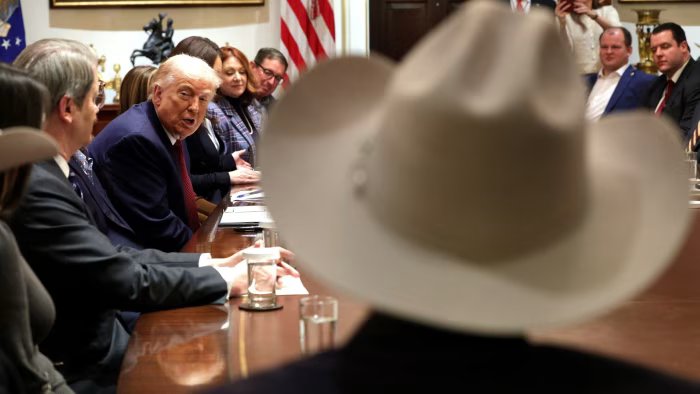
Jerrel Bolton, a 75-year-old Texan rancher, is scrolling through cattle prices on his phone as he eats breakfast tacos outside a barn where animals will soon be auctioned off to the highest bidder.
Just months ago, Bolton — who oversees six ranches across Texas — sold cows for more than $3,000 an animal at a nearby auction, a record high.
Today the animals are worth hundreds of dollars less after President Donald Trump cut his tariffs to reduce the cost of living by bringing more foreign beef to US dinner tables.
“I don’t really understand it politically, he has just alienated a bunch of ranchers,” said Bolton, who warned that allowing more foreign farm goods into the US would put Trump on a collision course with some of his most ardent backers.
“He would turn us against him,” Bolton said. “And we are his biggest supporters.”
Ranchers — most of whom live in states that voted overwhelmingly for Trump in 2024 — have in recent weeks found themselves at odds with their president as he has railed against the high price of beef on social media.

“If it weren’t for me, they would be doing just as they’ve done for the past 20 years — Terrible!” Trump wrote of US ranchers on his Truth Social platform.
“It would be nice if they would understand that, but they also have to get their prices down, because the consumer is a very big factor in my thinking, also!” he wrote.
The post underscores the shifting priorities of the president, who imposed sweeping tariffs on almost all US trading partners earlier this year, but in recent weeks has been forced to roll them back on goods such as coffee, fruits and beef as discontent over high prices threatens to become a political landmine.
The price of regular ground beef in American supermarkets rose to more than $6.31 a pound in August, a 13 per cent increase from a year ago. A sirloin steak, meanwhile, jumped 24 per cent to $14.31 per pound, up from an average of $11.54 a year earlier.
In October Trump announced he would allow Argentina to export more beef to the US at a reduced tariff rate, telling reporters that he hoped it would bring beef prices down.
More recently, his administration has rolled back the 50 per cent tariff he imposed in August on Brazilian imports for beef and other foods, giving one of the top sellers of beef into the US better market access.

Although cattle prices remain high, so does anxiety in rural America that Trump is willing to abandon US ranchers over an affordability crisis that has sapped his approval ratings and threatens to damage his party’s prospects in next year’s midterm elections.
More than 100 miles north-west of Houston in Caldwell, Hank Herrmann, a Texan rancher in his late thirties, was preparing to oversee a cattle auction at a barn his family has run for more than 20 years.
Although ranchers were making money now, he said, people felt defensive. “We feel attacked. People are suddenly looking at ranchers like we’re the bad guys.”
“We’re only just getting a price that makes ranching economical,” he added. “Very few people make much money ranching, right now we’re at a spot where it’s paying some bills.”

According to US Department of Agriculture data, farmers received between 37 and 50 per cent of the amount consumers paid for beef in supermarkets between the years 2019 and 2024. So far in 2025, their share has risen to between 53 and 56 per cent.
Milton Charanza, who has been breeding Brahman cattle for five decades in Caldwell, is adamant that Trump’s tariffs are needed to protect American beef.
Speaking at the Hungry Heiffer diner, where the clientele were festooned in cowboy hats, he said: “There is nobody that has been taken advantage of more than the American rancher.”
“Rural America expects America first in this country. We are not anti-business with other people but we have to take care of farmers and ranchers here,” Charanza added.

Others are cautiously supportive of the Trump administration’s policies. “I’m not totally against trade with Argentina, we have a legitimate shortage of cattle in this country,” said Keith Schroeder, a part-time rancher and part-time county judge in Burleson County. “But it should have been done in a way that doesn’t undercut the ranchers.”
The size of the US cattle herd has been slowly declining for the past five years, after recovering from a record low of 88mn in 2014 following a period of prolonged drought and high feed costs.
In 2024, the number of cattle in the US dipped to just 87mn animals, leaving the country with its smallest herd since the 1960s, according to records from the Department of Agriculture.
Several ranchers accused American meatpackers, which are responsible for bringing beef to the supermarket shelves, of unfairly profiting from cattle farmers.

In November, Trump delighted them by ordering the Department of Justice to investigate Tyson Foods, JBS USA, Cargill and National Beef, accusing them of collusion.
Bill Bullard, the chief executive of R-Calf, a group representing US cattle producers that has filed a lawsuit against the packers, said the companies were also using imports to suppress prices paid to ranchers.
“They can simply bring in more imports . . . causing the cattle rally to subside,” said Bullard.
Although ranchers say they support Trump’s tariffs, they are also wrestling with the inflationary pressures of the broader economy and have seen the cost of inputs from land to fertiliser rise in recent years.
“What a tractor costs is crazy!” said Doug Bass, a rancher from Columbus, Texas. “The parts, the repair bills. Your feed costs are higher. Your fuel is high. There’s a whole lot that goes into the ranch and into the cow that people don’t realise.”
In Caldwell, Charanza lamented the high cost of trailers and the trucks needed to pull them, recounting the tales of “old-timers” he got chatting to in the Hungry Heifer.
“One of them told me that in 1984, he loaded his longhorns up into a 24-foot gooseneck trailer and sold them all,” he said. “Then he walked across the way and bought a brand new three-quarter-ton pick-up truck from Ford and still had money left over.
“My point is yes, beef prices are high, but you couldn’t do that today. People can’t easily afford the trailers, the trucks are 70 or 80 thousand.”
Despite the challenges he and other ranchers are facing, Bolton said for now he would continue supporting Trump. “He is putting downward pressure on the beef price, but it’s not a forever deal,” he said. “I think he will adjust.”