

 dailynewsnblog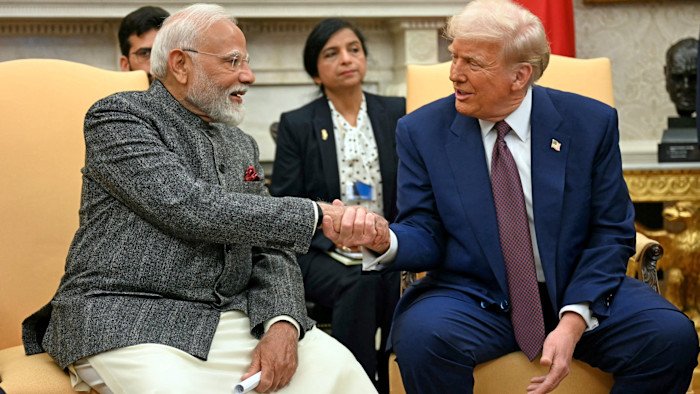
Good morning and welcome back to FirstFT Asia. In today’s newsletter:
-
Trump and Modi cut a deal
-
Inside Indonesia’s market meltdown
-
Wall Street and crypto companies battle over the future of money
Donald Trump said the US would lower its tariffs on India to 18 per cent after Prime Minister Narendra Modi “agreed” to halt purchases of Russian oil, ending months of trade friction between the countries.
What happened: The president said he spoke with Modi yesterday and had discussed “many things”, including trade, ending the war in Ukraine and the possibility of India buying more oil from the US and even Venezuela.
“Out of friendship and respect for Prime Minister Modi and, as per his request, effective immediately, we agreed to a Trade Deal between the United States and India, whereby the United States will charge a reduced Reciprocal Tariff, lowering it from 25% to 18%,” Trump said in a Truth Social post yesterday.
Trump also said that India would reduce its “Tariffs and Non Tariff Barriers” on the US to zero, while also committing to a “Buy American” policy worth “over $500 BILLION DOLLARS” of American goods.
Why it matters: Trump has accused India, which imports about 90 per cent of its crude oil, of helping fund Moscow’s war machine in Ukraine. In August, he slapped a 25 per cent punitive levy on India over its purchases of Russian oil on top of the 25 per cent “reciprocal” tariff, raising total duties to 50 per cent — among the highest levels in the world. US officials indicated that since India had agreed to stop buying Russian oil, the punitive 25 per cent levies would be removed, bringing down the overall tariffs on the country from 50 to 18 per cent.
Expert insight: Analysts were sceptical that India would buy as much from the US as Trump claimed. India bought just $41.5bn worth of goods from the US last year, said Pratik Dattani, founder of the Bridge India think-tank, “so there’s no way it’s going up to $500bn, particularly when Trump is only talking about goods trade”. He added that while India had already started to reduce oil purchases from Russia, they were unlikely to be eliminated entirely, given the country’s relationship with Moscow. Read the full story.
Here’s what else we’re keeping tabs on today:
-
Economic data: South Korea publishes January inflation data and Hong Kong reports December retail sales.
-
Monetary policy: Australia’s central bank is expected to raise its interest rate today. (Reuters)
-
Singapore: The Singapore Airshow begins at the Changi Exhibition Centre, continuing until Sunday.
-
Results: Nintendo, Mitsubishi Electric, West Japan Railway and Adani Ports and Special Economic Zone report earnings.
Five more top stories
1. The US government will launch a $12bn critical minerals stockpile as part of its efforts to counter Chinese dominance over strategic metals and support domestic manufacturers during shortages and emergencies. The US Export-Import Bank will provide $10bn in debt financing for the effort, named Project Vault, while an additional $2bn will come from private capital. Here are more details.
2. Toyota has said it has “no intention” of raising its ¥5.4tn ($34bn) offer to take its largest subsidiary private, setting up a showdown with activist investor Elliott Management, which has staunchly objected to the carmaker’s price. The deal could reshape Japan’s biggest business empire and set the tone for corporate governance across Tokyo’s stock exchange.
3. Jeffrey Epstein asked an unidentified woman to buy a Snow White costume just weeks before he and former Barclays chief executive Jes Staley had an infamous exchange in which they discussed the Disney character.
4. Ikea has shut seven large stores in China, as the furniture retailer’s strategic shift to smaller outlets takes shape. The Swedish group’s pivot comes as China’s consumer markets struggle to gain momentum amid a prolonged property slowdown that has weighed on sentiment. Read more about Ikea’s future in China.
5. Higher guest spending at Disney’s theme park and cruise ship business pushed the company’s revenues higher in the last three months of 2025, but the company warned of potential “international visitor headwinds” at its US parks. The earnings come ahead of a meeting this week of Disney’s board to decide on a successor to chief executive Bob Iger. Read the full story.
News in-depth

The volatile swings of some Indonesian shares have earned them the nickname saham gorengan, or “deep-fried stocks”, with their restricted floats and concentrated ownership contributing to rallies that can lift their tycoon owners into the ranks of Asia’s richest people almost overnight. But index provider MSCI’s recent threat to downgrade Indonesia has underlined the opacity of the market.
We’re also reading . . .
-
Chinese foreign policy: US aggression in the western hemisphere is opening new and unexpected avenues for Chinese access and influence, writes Isaac Kardon.
-
Nuclear proliferation: The era of nuclear arms control is set to end as the New Start treaty, which capped the number of missiles and warheads in US and Russian arsenals, expires this week.
-
Backbones wanted: The killing of Alex Pretti in Minneapolis is a moment for business leaders to challenge America’s direction, writes Rana Foroohar.
Chart of the day
Crypto companies and Wall Street banks are locked in a fierce battle over regulations governing stablecoins, reflecting a broader question about who will control the future of money.

Take a break from the news . . .
The popularity of streetwear exploded in the 2010s, with brands such as Supreme moving to the centre of the fashion industry. But as its rebellious cachet faded, how has the category evolved?


