dailynewsnblog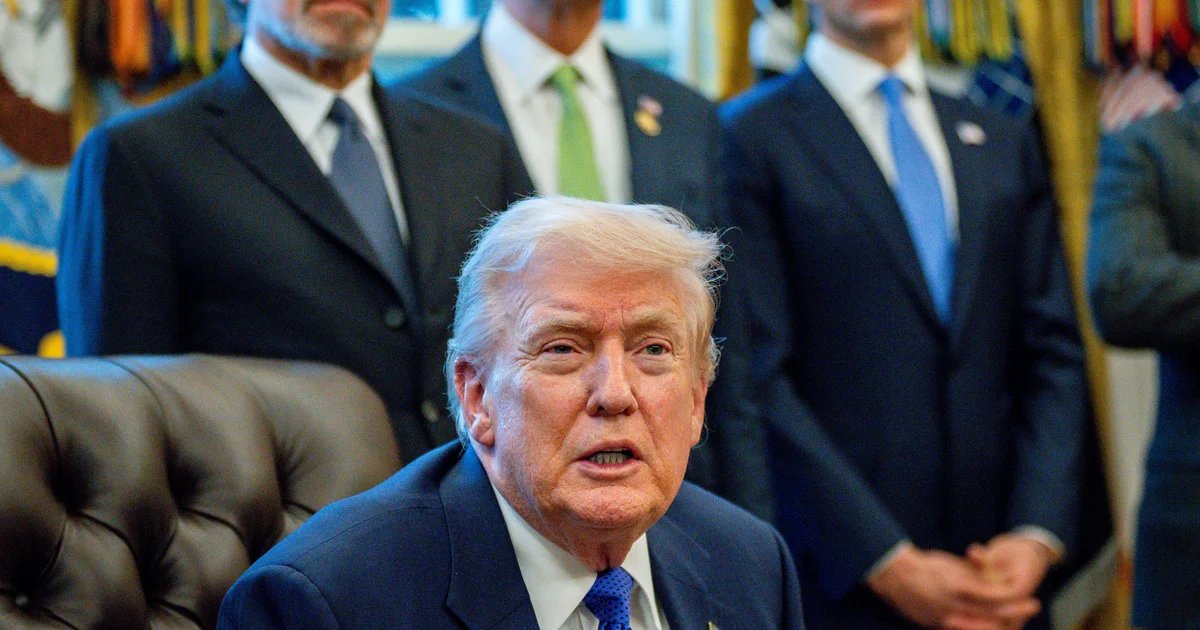
Washington — President Trump suggested Monday that Republicans should “nationalize” voting, the latest escalation in his and his administration’s efforts to step into federal elections ahead of the 2026 midterms.
During a podcast interview with former FBI deputy director Dan Bongino, Mr. Trump repeated his claims that people who are in the U.S. illegally are voting in federal elections and urged Republicans to “take over the voting” in at least 15 states.
“The Republicans should say, ‘we want to take over,'” Mr. Trump said Monday. “The Republicans ought to nationalize the voting. And then we have states that are so crooked, and they’re counting votes.”
A day later, Mr. Trump said in an Oval Office event, while flanked by lawmakers and members of his Cabinet: “I want to see elections be honest, and if a state can’t run an election, I think the people behind me should do something about it.”
Constitution gives states — not the president — the power to run elections
The Constitution’s Elections Clause gives states the authority to set the rules for federal elections, and offices at the state and local levels oversee their administration, though Congress can pass election regulations in certain cases.
As a result, the president has virtually no role in overseeing elections, said David Becker, a CBS News election law contributor and the executive director of the Center for Election Innovation and Research.
“The Elections Clause of the Constitution couldn’t be any more clear,” Becker said on CBS News’ “The Takeout with Major Garrett” on Tuesday. “It’s actually one of the areas the Founders carved out, specifically to exclude the executive from any power over elections.”
Asked by reporters Tuesday about those constitutional limits, Mr. Trump said states “can administer the election, but they have to do it honestly.” He also referred to states as “agents of the federal government” and argued that federal authorities should be more involved.
White House press secretary Karoline Leavitt told CBS News senior White House correspondent Weijia Jiang earlier Tuesday that Mr. Trump “believes in the United States Constitution,” but also believes there has been “a lot of fraud and irregularities.”
Trump moves to expand control over elections
The president has accused Democrats of allowing undocumented immigrants in their states to vote in order to bolster their support, and claimed repeatedly, without evidence, that the 2020 election was rife with fraud.
Dozens of lawsuits filed by his campaign and GOP allies that sought to overturn the 2020 election results were dismissed, and Bill Barr, who served as attorney general in Mr. Trump’s first term, said the Justice Department did not uncover any evidence of widespread fraud.
Still, Mr. Trump and his administration have undertaken efforts to exert more control over elections. The president signed an executive order last year that aimed to overhaul elections, including by requiring documentary proof of citizenship to register to vote. It is a crime for noncitizens to vote in federal elections and violators face up to a year in prison.
But the directive faced several legal challenges, and portions of it, including the proof-of-citizenship provisions, have been blocked by federal judges.
The Justice Department has also demanded complete voter registration lists from nearly every state and Washington, D.C., according to the Brennan Center for Justice. It has filed lawsuits against two dozen states and the District of Columbia for refusing to hand over the records, which include voters’ addresses, birth dates and partial Social Security numbers.
Mr. Trump also urged Republican state lawmakers to redraw their congressional district lines to help the GOP hold onto its majority in the House. After Texas adopted new voting boundaries that aimed to give Republicans five additional House seats, California approved its own plan to make five seats more favorable to Democrats. Several other states have also moved to recraft their congressional maps.
Then, last week, the FBI executed a search warrant at a Fulton County, Georgia, elections office and seized ballots from the 2020 presidential election. Mr. Trump has repeatedly claimed without evidence that the 2020 presidential election in Georgia, where he lost to former President Joe Biden, was “rigged” against him.
The president told Bongino that “you’re going to see some interesting things come in” regarding Georgia, and again asserted without evidence that he won the 2020 election.
The FBI’s search, as well as the presence of Director of National Intelligence Tulsi Gabbard at the scene, raised alarms among Democrats on Capitol Hill. Gabbard told lawmakers in a letter Monday that Mr. Trump requested she be at the search of the Fulton County elections hub. She also acknowledged facilitating a phone call between FBI agents in Atlanta and the president, and said Mr. Trump wanted to “thank the agents personally for their work.” Gabbard said the president did not ask any questions and did not issue any directives.
The New York Times had reported earlier Monday that Gabbard helped arrange the call between Mr. Trump and FBI agents after the search.
Mr. Trump has also backed the SAVE Act, a bill backed by congressional Republicans that would require state election officials to get in-person proof of citizenship from people registering to vote. Leavitt said Tueday the president’s comments on taking over elections referred to that legislation.
“President Trump cares deeply about the safety and security of our elections — that’s why he’s urged Congress to pass the SAVE Act and other legislative proposals that would establish a uniform standard of photo ID for voting, prohibit no-excuse mail-in voting, and end the practice of ballot harvesting,” Abigail Jackson, a White House spokeswoman, said in response to Mr. Trump’s comments.
Congressional Republicans push back on nationalizing elections
The president’s call to “nationalize elections” is facing pushback from Republican leaders on Capitol Hill. Senate Majority Leader John Thune told reporters that while he backs a plan to require photo identification to vote, he does not favor federalizing elections.
“I’m a big believer in decentralized and distributing power, and I think it’s harder to hack 50 election systems than it is to hack one,” he told reporters on Capitol Hill. “So in my view, that’s always a system that’s worked quite well.”
House Speaker Mike Johnson also defended the system of states administering elections and said Mr. Trump was “expressing frustration” about election integrity.
“It’s a system that works well, so long as the states make it a priority to ensure the integrity of our elections, and we have real concerns about some of the blue states, frankly, that have not been doing that well,” he told reporters. “So that’s the president’s — he’s expressing that frustration. We all have it. We’re looking for solutions.”