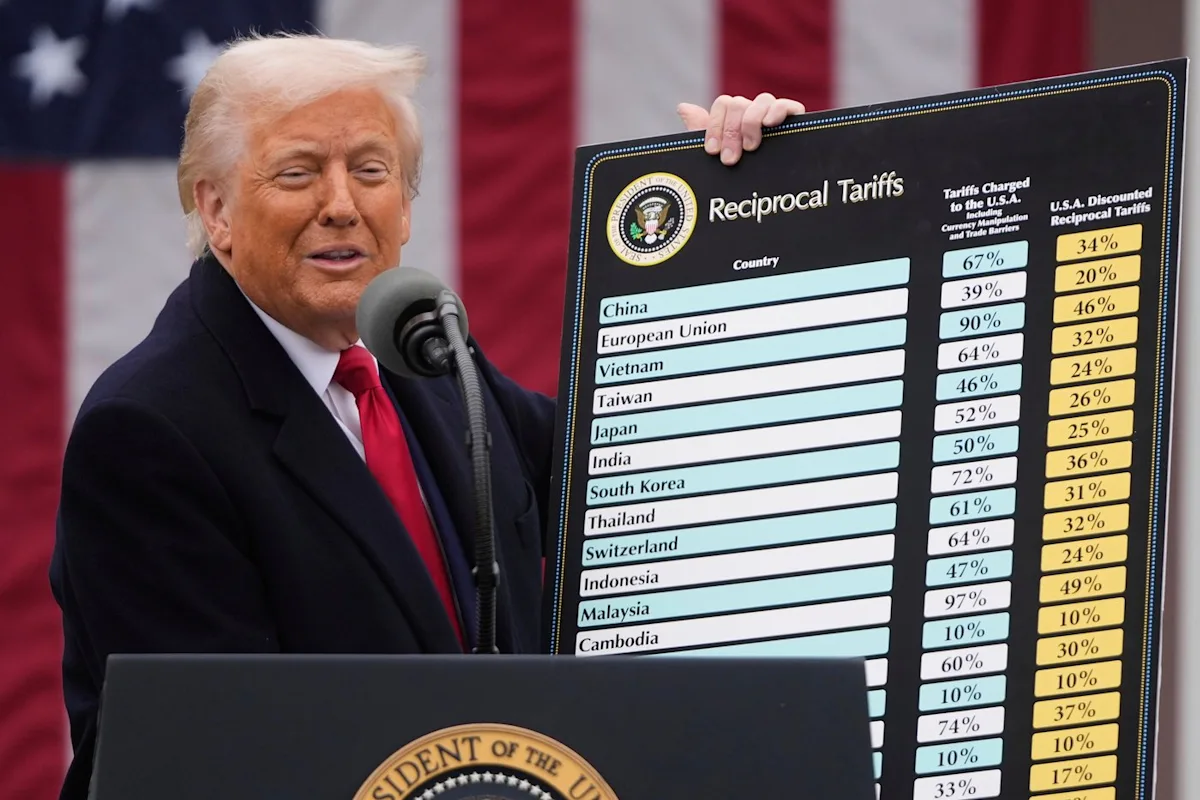
WASHINGTON — U.S. President Donald Trump said Friday he will sign an executive order imposing a 10 per cent global tariff — and lashed out at Supreme Court justices hours after America’s top court struck down his use of an emergency legal tool to realign global trade.
“Their decision is incorrect,” Trump said. “But it doesn’t matter because we have very powerful alternatives.”
Trump said he will use Section 122 of the 1974 Trade Act to hit the world with the tariff — but that duty can only stay in place for 150 days, unless Congress votes to extend it.
Trump said the new tariff will take effect in three days.
It was not immediately clear whether the new tariff will have a carveout for goods traded under the Canada-U.S.-Mexico Agreement on trade, better known as CUSMA.
It also was not clear whether the new 10 per cent levy would stack on top of Trump’s separate tariffs on steel, aluminum, automobiles, lumber and furniture.
Earlier Friday, the Supreme Court said Trump could not use the International Emergency Economic Powers Act, better known as IEEPA, to hit the world with tariffs.
In a 6-3 ruling, the court concluded it was not legal for Trump to use IEEPA for his “Liberation Day” tariffs and fentanyl-related duties on Canada, Mexico and China.
The court found that the U.S. Constitution “very clearly” gives Congress power over taxes and tariffs. Chief Justice John Roberts wrote “the Framers did not vest any part of the taxing power in the Executive Branch.”
The ruling did not say whether companies hammered by those tariffs should get refunds. As of December, federal data showed $133 billion USD had been collected through the levies.
The Supreme Court’s decision “reinforces Canada’s position that the IEEPA tariffs imposed by the United States are unjustified,” said Canada-U.S. Trade Minister Dominic LeBlanc in a post on social media.
“While Canada has the best trade deal with the United States of any trading partner, we recognize that critical work lies ahead to support Canadian businesses and workers who remain affected by Section 232 tariffs on steel, aluminum and automotive sectors,” LeBlanc said.
During a 40-minute press conference which also saw Trump denigrate Europe as too “woke,” the president took aim at Canada, saying the country ripped off the U.S. and stole car plants.
Trump claimed that “Canada” told him it hoped he would win at the Supreme Court “because if you don’t win you’ll actually be able to charge us, with additional work, higher tariffs.”
LeBlanc spoke with U.S. Trade Representative Jamieson Greer by phone recently. When asked for comment on Trump’s claim about Canada, LeBlanc’s office referred to his social media statement.
Trump declared an emergency at the northern border related to the flow of fentanyl in order to use IEEPA to hit Canada with 35 per cent tariffs. Those duties do not apply to goods compliant under CUSMA.
U.S. government data shows a minuscule amount of fentanyl is seized at the border with Canada. Last week, in a symbolic move, the U.S. House of Representatives voted to end the emergency at the northern border.
Friday’s ruling will have little effect on the Canadian economy since most of its exports to the U.S. were shielded by the CUSMA carveout, said CIBC chief economist Avery Shenfeld.
He later added that if Trump’s new 10 per cent tariff doesn’t get a CUSMA exemption, Canada could find itself worse off — at least for 150 days.
Canadian Chamber of Commerce president and CEO Candace Laing said it’s “not the last chapter of this never-ending story.”
“Canada should prepare for new, blunter mechanisms to be used to reassert trade pressure, potentially with broader and more disruptive effects,” Laing said in a media statement.
Trump’s tariffs and threats of annexation have rattled Canada ahead of a mandatory review of the CUSMA trilateral trade pact later this year. Trump has called the trade agreement “irrelevant” and said it may have served its purpose.
A successful CUSMA review must see Trump’s separate sectoral tariffs dropped, said Conservative Leader Pierre Poilievre in a social media post.
Poilievre criticized Prime Minister Mark Carney for not securing a deal with the Trump administration.
“The truth is no one can control what President Trump will say or do and so we must instead focus on what we can control,” Poilievre said. “We must unblock our energy and minerals, unleash our economy, and bolster our military and self-reliance for leverage to fight for tariff-free trade with the U.S.”
The Supreme Court’s decision is a win for U.S. separation of powers and the American and Canadian economies, said George Mason University law professor Ilya Somin, who represented small businesses pushing back on the tariffs.
“But also for the rule of law,” Somin told The Canadian Press. “The rule of law is at odds with a system under which the president can impose any tariffs he wants on any country for any reason at any time. That’s not the rule of law.”
This report by The Canadian Press was first published Feb. 20, 2026.
— With files from Craig Lord, Kyle Duggan and The Associated Press
Kelly Geraldine Malone, The Canadian Press


 dailynewsnblog