dailynewsnblog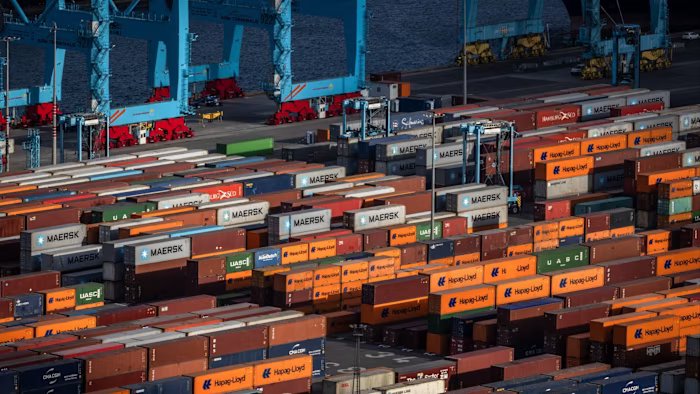
Stay informed with free updates
Simply sign up to the EU trade myFT Digest — delivered directly to your inbox.
Trade between EU member states has fallen for the first time in almost a decade outside of the pandemic, European Commission figures show, despite efforts to reboot the single market in the face of economic threats from China and the US.
Trade between member states as a share of EU GDP dropped from 23.5 per cent in 2023 to 22 per cent in 2024, according to a draft report of the bloc’s annual single market report, seen by the FT.
It is the first year-on-year first fall since 2016 if the effects of Covid-19 lockdowns are excluded. Meanwhile, the length of time it takes to draft and approve EU-wide standards for goods increased from 3.2 years in 2023 to four years in 2024.
The figures underscore warnings by leaders including European Central Bank president Christine Lagarde that the internal market “has stood still”, despite rising threats such as US tariffs and strengthening Chinese competition.
“The Single Market is our best asset to counter external pressure, and it is time to build on its strengths,” reads the report, which is due to be published later this month and could be subject to change.
While there have been improvements in some areas, such as EU-wide recognition of professional qualifications and the adoption of digital technologies, the report noted a “clear deterioration” in others.
The EU’s share of foreign direct investment has dropped 22 per cent over the past five years, the report shows.
“Fragmented” national legal rules “continue to make it complex and costly to establish and operate companies across the EU, with no progress to date”, it warns.
“Europe’s loss of competitiveness is largely self-inflicted,” said Francesca Stevens, secretary-general of the European packaging industry body Europen. “The problem is not only complex and burdensome regulation, but a false ideological divide between competitiveness and sustainability, the misguided belief that one can exist without the other.”
The Commission did not immediately reply to a request for comment.
Officials have suggested that the drop in trade between member states could be attributed to fluctuations in energy product prices following Russia’s full-scale invasion of Ukraine.
Lobby group BusinessEurope warned that European companies “increasingly find exporting to non-EU markets more attractive than trading within the single market”.
Better integration of the single market has become a linchpin of Brussels’ efforts to improve the EU economy in the face of US tariffs and Asian countries undercutting European manufacturers, which face structurally higher energy and employment costs.
Commission president Ursula von der Leyen published a single-market strategy last summer. A “roadmap” promising to set out how the bloc will reach full integration by 2028 is expected before September.
The Commission has published at least eight single market strategies since 2003.
The ECB estimates that the hidden costs involved in trading goods within the EU are equivalent to a 65 per cent tariff. That estimate increases to 100 per cent for services.