dailynewsnblog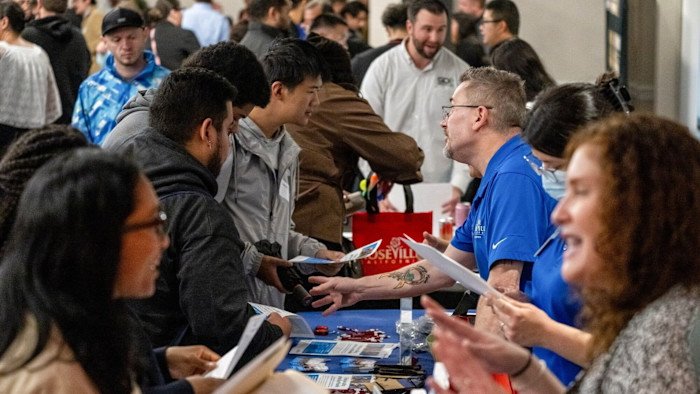
Unlock the Editor’s Digest for free
Roula Khalaf, Editor of the FT, selects her favourite stories in this weekly newsletter.
The writer is the Rene M Kern professor of practice at Wharton School, chief economic adviser at Allianz and chair of Gramercy Funds Management
Don’t be fooled. Last week’s better than expected US jobs report is likely to prove a head fake when assessing the divergence in the US between a cooling labour market and the country’s strong GDP growth.
This trend is likely to prove more unsettling than prior episodes of “jobless growth”. Driven by a mix of the impact of AI, post-pandemic structural employment shifts, and unusual general policy uncertainty, it could well prove longer and more consequential than its predecessors.
The headlines from last week’s US jobs report for January looked positive on the surface with 130,000 new jobs in January, almost double expectations. But the figures for December and November were revised down to 48,000 and 41,000 respectively. More importantly, the even larger revisions to 2025 as a whole resulted in the weakest year of job creation outside recessions in two decades.
Other data also suggests caution in over-interpreting January’s employment growth. Recent releases show job cut announcements have hit their highest levels since 2009, while vacancies plummeted in December to 2020 lows. With the vacancy-to-unemployed ratio now below 1.0, bargaining power is again shifting back to capital and away from workers.

This is a marked contrast with an overall economy that is running hot. GDP expanded by an impressive 4.4 per cent in the third quarter and the Atlanta Federal Reserve estimates that official data this week will show 3.7 per cent growth for the fourth quarter. This decoupling is likely fuelled by three catalysts:
First, there are signs of “AI front-running” as companies adapt workflows in anticipation of widespread AI adoption. Second, after “over-hiring” in 2021-2022, firms are no longer hoarding labour even though certain supply has been hit by immigration curbs. And third, general uncertainty about economic policies and the outlook could well be serving as a restraint on new hiring.
Needless to say, this is not the first time the US economy has experienced a decoupling of job growth from economic growth. We saw this in the early 1990s with greater office automation adoption; the early 2000s with offshoring and globalisation; and the post-2008 era (skill mismatches and general uncertainty). Yet each of these historical episodes occurred during an initial recovery from an economic turndown/recession and not in the midst of a prolonged period of robust growth such as the one we are experiencing today.
There are also reasons to believe that this period of decoupling of employment from growth may prove more persistent and more consequential.

This time around, it may well last longer because we are just at the start of the AI adoption process, with robotics just around the corner and quantum computing further behind. Moreover, the current mindset of many firms in their initial consideration of AI does not help. Too many executives seem to think of AI more in terms of its labour cost minimisation potential (doing the same with fewer workers) rather than the bigger productivity potential (doing more with the same or additional workers). The latter comes with increasing the capabilities of existing and new workers.
This decoupling of GDP growth and employment also comes at a time when affordability is already a big political and social worry. An intensifying gap between robust growth and a weak labour market would likely increase income and wealth inequality in an economy already featuring a large divide in the fortunes of the wealthier and less well-off.
This would undermine low-income household consumption as an important driver of growth. It is also taking place at a time when the US Federal Reserve, already under political scrutiny, now faces the prospects of a bigger conflict between the two components of its dual mandate — maximum employment and price stability.
The most dangerous four words in economic and investment analysis — “this time is different” — could well end up applying here. Rather than gradually slowing to a crawl as has happened in the past, we should expect this decoupling phase to accelerate absent any holistic mitigation by companies and the public sector. Indeed, part of the challenge for 2026 is managing a lot better the economic, political and social risks of an economy that, without corporate and policy adjustments, may no longer need as many workers to grow.