dailynewsnblog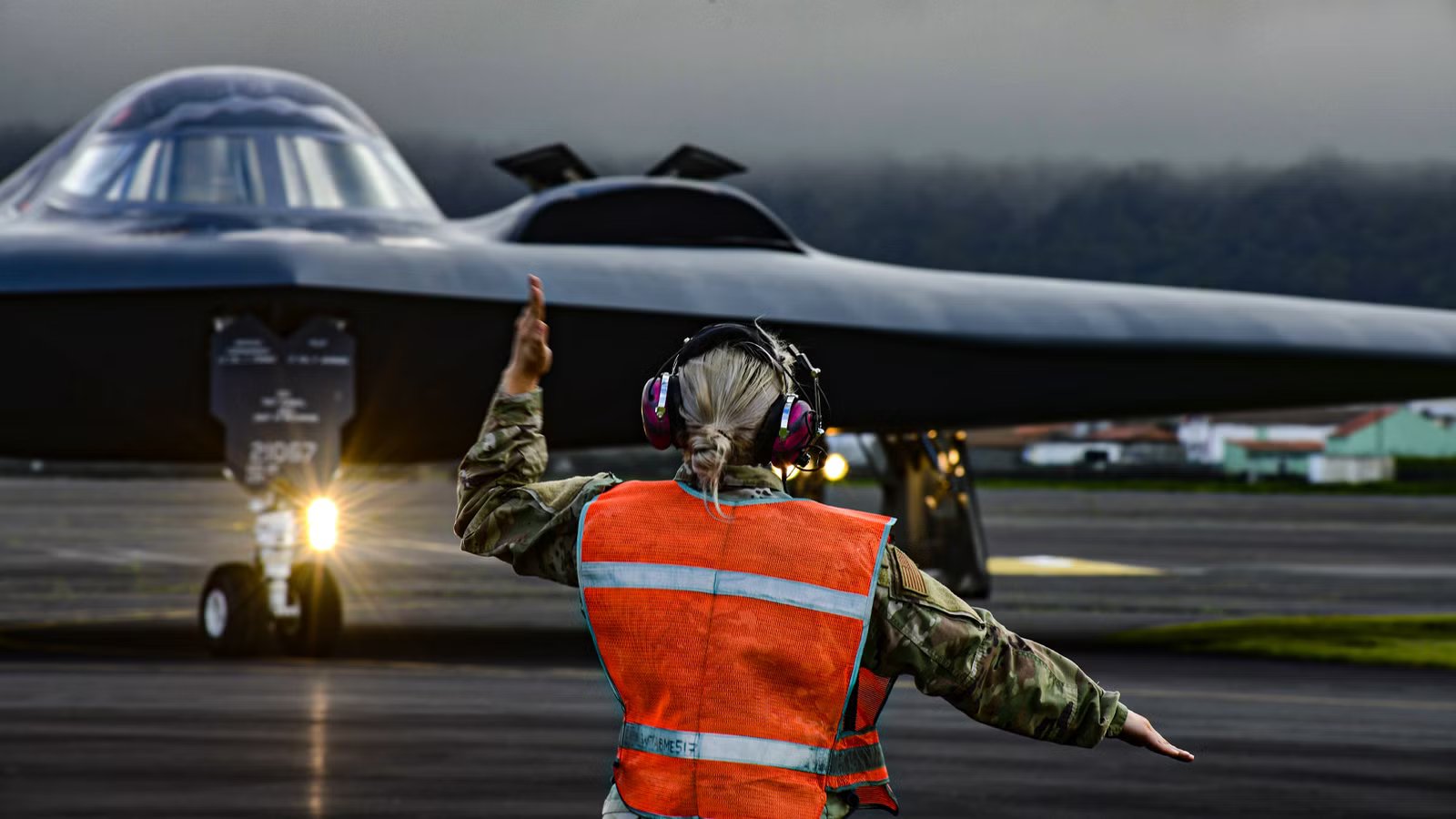
The Northrop Grumman B-2 Spirit stealth bomber is notoriously the most expensive warplane ever procured by the US Air Force on a per-unit basis. Although the actual cost of the program has been overshadowed by others such as the Manhattan Project, the Boeing B-29 Super Fortress, and more recently the Lockheed Martin F-35 Lightning II, that has never detracted from the fact that the standard airframe cost of over two billion dollars is one of the highest sticker shots ever seen in the defense aerospace industry.
The cause of this astronomical price tag per plane is due to the fact that the pioneering program, which developed the world’s first fifth-generation stealth bomber, only resulted in a production run of 21 bombers. The original contract estimate was somewhere north of 100 airframes, potentially as many as 200. However, Congress decided to cut back on defense spending at the end of the Cold War with the Soviet Union’s fall in the early 1990s, the B-2 got the axe.
Scope Creep In Epic Proportions

The B-2 program pushed Northrop to the brink of financial and reputational ruin. The B-2 Spirit’s immense development cost, secretly reaching $23 billion by 1989, stemmed from a perfect storm of radical mission changes and the creation of entirely new industrial capabilities. The financial burden contributed to the merger that formed Northrop Grumman in 1994, as the company sought to stabilize its business base following the B-2’s production curtailment.
As a flying wing with no vertical tail, the B-2 is aerodynamically unstable. It required a pioneering quadruplex computer-controlled fly-by-wire system to remain airborne, which had to be hardened against Electromagnetic Pulses (EMP) for nuclear missions. In the mid-1980s, the Air Force changed the B-2’s mission from high-altitude penetration to low-altitude, terrain-following flight. This required a massive structural redesign to strengthen the wing for denser air at lower altitudes, adding roughly $1 billion and two years to the schedule.
Development included surface-flush air sensors, which replaced traditional pitot tubes that reflect radar, semi-automatic celestial tracking, and unique Radar-Absorbent Material (RAM) coatings. These coatings were so sensitive that even small imperfections required touch labor after almost every flight, and the aircraft required specialized climate-controlled hangars costing $5 million each to prevent coating degradation.
Allegations of fraud and overcharging led to intense scrutiny and at least one out-of-court settlement. The poisoned relationship with the Air Force due to B-2 cost overruns is widely cited as a reason Northrop lost the Advanced Technology Fighter (F-22) competition to Lockheed.
Making the Spirit a Reality

B-2 production required unprecedented tolerances. The production of the B-2 Spirit was defined by extreme labor intensity and massive cost overruns, largely due to pioneering manufacturing technologies that had to be invented as the aircraft was built. Assembly workers had to follow strict protocols, even regarding where they could step or lay tools, to avoid microscopic dents that would ruin the aircraft’s stealth profile.
The B-2 required the first large-scale use of 3D computer-aided design and manufacturing (CAD/CAM). Because of the aircraft’s unstable flying-wing design and the need for absolute precision to maintain stealth, human-calculated engineering was insufficient. The aircraft used roughly 90 semi-rigid microwave signal cables, some over 44 feet long, which were jigged into complex shapes and integrated into the airframe. These were so difficult to manufacture and install that replacing a faulty connector later required cutting 40 holes in the airframe.
The aircraft is constructed primarily of carbon-graphite composites and specialized coatings. Integrating these into a seamless shape meant that sub-assemblies were built in different secret locations and brought together with microscopic tolerances. The labor intensity did not end at the factory. In service, the B-2 requires 119 hours of maintenance for every single flight hour. Much of this is touch labor to restore the delicate stealth skins after flight.
The production line at Northrop’s Palmdale facility consisted of 14 distinct workstations. Northrop converted a former Ford plant in Pico Rivera, California, into a massive, highly secure assembly line. Tooling was designed for a high-rate production of 132 aircraft; when the order was slashed to 21, the investment in these mass production tools became a massive sunk cost spread over a tiny fleet.

America’s 5 Stealthiest Military Jets Of All Time
The US was the first to develop stealth military jets and is now working to develop the next generation of ultra-stealthy jets.
B-2 In The Crosshairs

The B-2 program was a double-edged sword for Northrop, nearly putting the company at risk. Trap: Because Northrop had built a production base designed for 132 aircraft, the decision to cut the fleet to 21 made the per-unit cost skyrocket to over $2.1 billion. Northrop faced a massive financial challenge in maintaining a ready production line with almost no new orders.
If you build 132 planes, each plane carries about $174 million of that R&D cost. When you only build 21, each plane suddenly carries over $1 billion in R&D costs before you even buy the first bolt. In aerospace, the learning curve dictates that the 50th plane is much cheaper than the 1st because workers become faster and processes more efficient. By cutting the order to 21, the Air Force stopped production just as the learning was starting to pay off, leaving them with only the most expensive, early-build units.
It seems counterintuitive to pay $2 billion for one plane when you could pay $500 million for many, but several geopolitical and economic factors forced their hand. By 1992, the B-2 program was consuming a massive percentage of the Air Force’s total budget. With the collapse of the Soviet Union, lawmakers argued the B-2 was a ‘bomber without a mission.’ Thus, President George H.W. Bush claimed ending the program could save $50 billion over five years, making it a prime target for budget cuts.
Congress and the public were often shocked by the B-2’s $135,000 to $200,000 per-flight-hour operating cost, nearly double that of the B-52 or B-1. This led to frequent legislative attempts to cap the fleet, ultimately successful in limiting it to just 21 aircraft. The decision to stop at 21 planes fundamentally changed how the U.S. goes to war. Because the planes are so expensive and rare, the Air Force treats them as ‘Silver Bullets.’

Why This Stealth Bomber Is Nicknamed The ‘Flying Dorito’
A stealthy aircraft shaped like a Dorito chip was once envisioned to revolutionize naval aviation, but it never took flight. What went wrong?
The B-21 Raider

The successor to the B-2 Spirit is the Northrop Grumman B-21 Raider, which is built to be the world’s first sixth-generation bomber, building on a legacy of engineering excellence and unrivaled stealth technology. Notably, while these aircraft will be more advanced than technology, they will actually be lowering costs thanks to the fact that the program is anticipated to produce a minimum of 100 airplanes.
The US Air Force is also considering increasing total production to nearly 200 B-21 Raiders, but that is yet to be confirmed and the ‘Air Force of the Future’ model is perpetually in flux. No matter how many of these aircraft do eventually become a reality, the fact is that while they will be lowering costs, they will be a superior platform in many ways, which is in large part thanks to lessons learned during the development, production, and decades of flying experience from the B-2.
The B-21 is actually going to be a smaller airframe with a lower payload capacity. It will integrate more advanced technology that conceals it from more sensors than just radar and cameras. In fact, the aircraft is anticipated to be virtually invisible on a thermal sensor spectrum and on the emission spectrum, where electronic warfare is concerned, the new stealth bomber will be virtually untraceable.
The plane is expected to have a slightly longer range, or potentially a significantly longer range (as estimates are very unclear in the public sphere), but it will be able to forward-deploy with far less infrastructure, which limited the B-2 during its operational tenure. As the US Air Force looks to a more flexible strategic and tactical doctrine, agile combat employment (ACE) is a very high priority, meaning that the B-21 forward deploying to allied bases such as NATO or Japan is a critical strategic quality for the future.

B-21 Vs. B-2: Which Stealth Bomber Is More Powerful?
Comparing the world’s best strike jets.
Even More Pricey Jets Incoming

You may be aware that the Northrop Grumman B-2 Spirit stealth bombers are the most expensive aircraft ever required by the USAF. What you may not know is that the Boeing E-4B Nightwatch is the most expensive aircraft to operate per flight hour. Interestingly, the reason is not because of the technology on board the aircraft but largely due to its enormous crew of 112 personnel.
Sierra Nevada Corporation (SNC) secured a $13 billion contract to make eight to ten E-4C SAOC aircraft, increasing the fleet’s size from four. The Air Force’s budget for the SAOC program has increased by $217 million for 2026, totaling $1.83 billion, with additional funding allocated for military construction.
The E-4C SAOC initiative employs a digital development strategy alongside commercial off-the-shelf (COTS) components to modernize the fleet while reducing long-term lifecycle costs. A digital twin allows for simulations of various stress factors, mitigating expensive rework during physical testing. The modular open systems approach (MOSA) enables upgrades without vendor lock, facilitating quicker technology updates through the use of proven commercial components that comply with military standards.
The SAOC serves as a secure communication platform for the President and Secretary of Defense during emergencies, designed to withstand electromagnetic pulses and nuclear attacks, ensuring continued operability. In contrast to the outdated E-4B, the SAOC employs modern, digital systems resistant to EMP threats. With a significantly reduced mission-capable rate of 55.4% due to aging and maintenance issues, the E-4B has become costly to operate, unable to perform its dual role effectively.