dailynewsnblog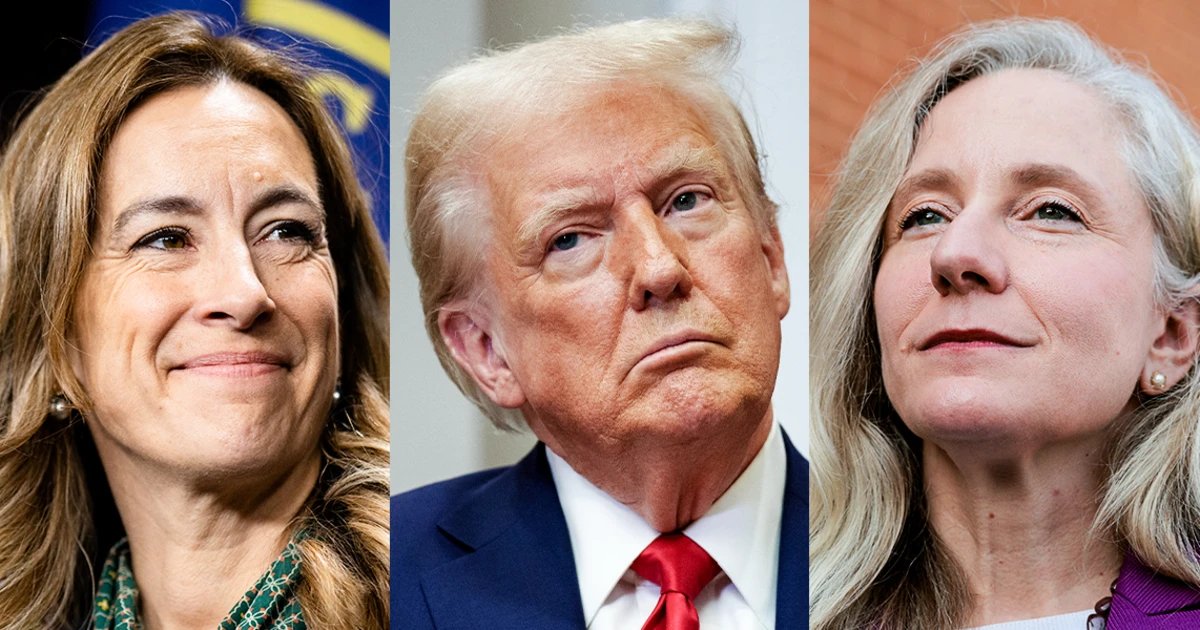
Voters who backed Democratic governors in New Jersey and Virginia this year after voting for President Donald Trump in 2024 have a message for both parties: reject your party’s extremes and run campaigns about more than just Trump.
In new focus groups, 14 swing voters from New Jersey and Virginia revealed sharply negative views of both parties — and of politicians broadly. They explained that they were drawn in last month’s elections in their states to Govs.-elect Mikie Sherrill and Abigail Spanberger, who cast themselves as moderates and transcended the damaged Democratic Party brand.
And while 10 of these voters disapproved of Trump’s job performance so far and voiced concerns about high prices, a majority said they did not view their votes for governor as a protest vote against Trump. An anti-Trump message alone may not be enough to sway them and voters like them next year in the midterm elections.

Instead, their consistent refrain serves as an important message to Republicans and Democrats as they look to sway swing voters in key races across the country next year: Candidate quality matters, ranging from positions on issues to personality to professional background.
“I mean, look, I’m a Republican, but let me tell you, if somebody is checking all the boxes for me, if they’re a Democrat, I’m going to go with my gut and what I feel,” Cynthia G., a 52-year-old from New Jersey, said of Sherrill, who served in Congress before she won the governorship.
“And Mikie is just proven to me. Naval officer, formal federal prosecutor, mother of four. She’s tough, but she’s like the quiet storm. She’ll get things done,” said Cynthia, who participated in the recent focus groups, which were produced by Syracuse University and the research firms Engagious and Sago and observed by NBC News as part of the 2025 “Deciders” series.
Exit polling from the New Jersey and Virginia gubernatorial races show Sherrill and Spanberger, another former House member, both had some crossover appeal as they sailed to double-digit victories, each winning 7% of voters who cast ballots for Trump in 2024.
Unlike a poll, which uses statistical methods to demonstrate the views of a larger population, focus groups dig deeper into how individual panelists view key questions facing the country and make decisions. These focus groups shed light on why some voters backed Democrats despite sharply negative views of the Democratic Party and illustrated nuanced views of Trump and how he now factors into their political thinking.
“The most important lesson for both parties in 2026 is to not run flawed candidates,” said Rich Thau, president of Engagious. “While affordability, political moderation, and President Trump’s job performance all mattered in Virginia’s and New Jersey’s gubernatorial races, what mattered most to swing voters was candidate quality.”
Candidates matter
These voters — including 12 self-described independents, one Republican and one Democrat — said they supported Trump in 2024 because they were optimistic he could better handle the economy. They also viewed then-Vice President Kamala Harris as unqualified and out of touch.
And while these voters view both parties negatively, they were especially critical of the Democratic Party, describing Democrats when asked to offer a brief assessment as “dishonest,” “weak,” “unfocused,” “self-serving,” “wishy-washy, and “ineffective.”
But Sherrill and Spanberger, a former CIA officer, were still able to win them over by casting themselves as pragmatic moderates and stressing their national security backgrounds.
Spanberger “was the closest thing to what you can call a moderate nowadays. She worked across the aisle. She wasn’t an extremist,” said Bruce L., 40, of Richmond, who noted that her congressional office also helped resolve issues for him and his family.
Michael C., 60, of Brick, N.J., said he backed Sherrill “because of her veteran status. Because being in the military, when you have a job that needs to get done, you get it done, you make sure you find a way to do it.”
Other voters described Sherrill and Spanberger as “sensible,” “pragmatic” and “down-to-earth.” None said they backed the Democrats solely because they would oppose Trump’s policies.
“It’s easy to see these Democratic wins in Virginia and New Jersey as a referendum on President Trump, but what these swing voters told us is not quite that simple,” said Margaret Talev, director of Syracuse University’s Institute for Democracy, Journalism & Citizenship. “Moderation, competency and personal appeal is the combination they crave.”
Some voters were turned off by the GOP candidates’ embrace of Trump, even though these voters supported him last year.
The president endorsed Jack Ciattarelli, a former state legislator, against Sherrill in New Jersey. And while Trump did not back Virginia Lt. Gov. Winsome Earle-Sears, she broadly embraced his policies.
“Winsome Earle-Sears just seemed to be an extremist who actually just kept defining herself in comparison to others than rather what she stood for, and would propagate the worst of the Trump policies,” said Robert L., a 54-year-old from Springfield, Virginia.
Christian G., 25, of Clifton, New Jersey, described Ciattarelli as a “phony” who was “piggybacking off of Trump a lot, or just utilizing Trump’s name in general.”
All but one of the New Jersey voters said their state has been going in the “wrong direction,” but they still voted for a Democrat after two terms of Democratic Gov. Phil Murphy.
Some saw Ciattarelli as part of the same “good old boys’ network” as Murphy. They viewed Sherrill as the candidate more likely to bring a change and were drawn to her proposals to lower the state’s rising utility bills.
Meanwhile, nine of the 14 focus group participants said their votes for Sherrill and Spanberger were not about protesting Trump. But the five voters who did view their votes as a protest against Trump voiced a wide range of concerns with his administration so far.
“Trump made a lot of promises, but most of them could not be delivered,” said Rebecca H., 52, of Falls Church, Virginia.
“For me, it’s kind of a testament to how I guess trust was lost over the year,” said Christian, the Clifton, New Jersey, resident. “Whereas I voted for him back in ‘24, now, a year later I’m feeling let down.”
Down on Trump
The former Trump voters have some significant disagreements with the president — including over health care, his immigration policies, the Defense Department’s attacks on suspected drug boats from South America, and the handling of documents related to the federal investigation into Jeffrey Epstein.
But the economy loomed especially large.

Some, like Cynthia G., the 52-year-old New Jersey Republican, believe that the economy is moving “in the right direction, to a degree.” She’s been heartened by seeing prices for goods like eggs going down, even though most of the groups said they’ve seen significant price increases broadly.
Others who feel the country is now more stable economically cited their view of Trump as a businessman with a plan or the strength of the stock market. And some see Trump’s aggressive tariff policy as an important way to eventually bring jobs back from overseas.
“I agree with the tariffs. I think, honestly, I wish it would force all manufacturing to come back to the United States,” said Ashley E., a 40-year-old Virginia independent.
But other participants were fiercely critical of Trump’s handling of the economy, particularly tariffs.
“People tried warning him before the elections that the foreign companies don’t pay them [tariffs], it’s reflected in the price. And he said, ‘Oh, that’s not true,’” said Robert L., a 54-year-old Virginia independent.
“If he’s such a great dealmaker, he should have used them [tariffs] as a potential stick,” Robert continued. “Instead, he’s a bull in a china shop and greatly impacted the economy and inflation. Presidents can affect inflation and the economy for the worse much more easily than for the better. And he’s done it for the worse.”
Some grounded their frustration with Trump’s policies in what they saw as a general abdication of his campaign promise to lift up everyday Americans.
“It’s a bait and switch with him where he said he was for the average person but he actually favors big business, and then just does whatever he wants and there’s no consequences,” said Justin K., a 39-year-old independent from Arlington, Virginia, who added that he thinks the “big tech companies” have Trump’s “ear.”
In total, the group was largely down on Trump’s actions on immigration, with just two of the 14 respondents saying they approved, on the whole, of the administration’s policies. Some who had positive things to say about the administration clamping down on illegal border crossings were still deeply critical of its mass deportation policies and the widespread arrests being carried out by Immigration and Customs Enforcement.
“He’s tightening the border control — I approve of that and I approve of restricting the refugees. But I don’t like how ICE is kidnapping people,” said Rebecca H., a 52-year-old independent from Virginia.
On the U.S. military strikes ordered by Trump on alleged drug boats from Venezuela, or Trump accusing Democrats of “seditious behavior” for making a video calling on members of the military to refuse illegal orders, those who had heard about the episodes largely disagreed with the president.
Only one participant backed using the military to strike suspected drug traffickers overseas, arguing America has a “right to defend ourselves from any country, or any person, who’s trying to bring in illicit substances that kill people.”
The others criticized the administration for exceeding its authority. Meanwhile, fewer had heard about Trump’s clash with Democratic lawmakers over their social media video about illegal military orders.
Some were skeptical about the Democrats’ move in the first place. One voter called it a “great political stunt,” another said it was “insulting” to troops who already knew the rules, and another hesitated because “it’s going to make people start to question everything that’s going on.”
But there was near unanimity in their belief that Trump’s response — posting social media messages labeling the lawmakers’ actions as “SEDITIOUS BEHAVIOR, punishable by DEATH” — was not appropriate.
“The last comment, punishable by death — I don’t think you should even go there, calling them traitors and everything like that,” Cynthia G., the 52-year-old New Jersey Republican, said. “He just has to word things a bit better.”