dailynewsnblog
After Mikel Wilham finished chemotherapy last spring, he and his wife decided to celebrate with a trip to Las Vegas. But their respite was ruined when their hotel, The Strat, charged them a $396 smoking fee at checkout.
The Wilhams found this particularly strange since they are both lifelong nonsmokers.
Despite that fact, the general manager explained that there was definitive proof of smoking in the air-quality report generated by a hidden sensor in their room.
“The data indicates that smoking occurred during this period,” the automatic printout from the sensor read.
Although the couple demanded that the room be inspected immediately, the general manager refused.
The celebratory getaway the Wilhams were hoping for instead morphed into an infuriating two-month battle to vindicate themselves and get their money back.
“My husband just finished chemo, after battling cancer for almost a year,” Christe Wilham told me in her request for help. “There is NO WAY either of us would endanger his health by smoking. But no one will even consider that the sensor was wrong in our case.”
Ultimately, the Wilhams shared their medical records with me, which proved their nonsmoking status. And only after I was able to reach executives at The Strat, who are generally not accessible to customers, did the hotel refund the fee.
As a consumer advocate and TPG’s ombudsman, my case files show that this couple’s ordeal isn’t isolated. Across the industry, hotel guests are being falsely accused of smoking — with the sole judge, jury and executioner being air-quality sensors.

Reward your inbox with the TPG Daily newsletter
Join over 700,000 readers for breaking news, in-depth guides and exclusive deals from TPG’s experts
These are some of those travelers’ frustrating experiences with Rest, the brand of air-quality sensor at the heart of many similar complaints.
Here’s what you can do to protect yourself from surprise smoking fees during your next hotel stay.
An expecting couple gets hit with a $500 hotel smoking fee

Last September, Joseph Tincher and his partner spent two nights at the Kimpton Palladian Hotel in Seattle. The property is smoke-free, which was just fine for the nonsmoking couple who are expecting a baby.
“We always stay in nonsmoking hotels as I have a history of asthma,” Tincher told me. “Also, my girlfriend is pregnant so we definitely try to avoid smokers.”
Their anti-smoking stance made what happened after they had returned home from their stay so shocking.
“When we checked out, I received a normal invoice,” Tincher recalled. “Two days later, I noticed an additional $500 charge on my credit card from the Palladian. I called the hotel and the front desk staff told me a sensor in our room had flagged cigarette smoke.”
Initially, Tincher assumed this was a simple case of a mixed-up report. He explained why it was impossible that the sensor could have detected smoke in their room. However, the employee remained unconvinced and transferred him to the general manager, who reiterated that there was no mistake.
Outraged by the false accusations and the substantial unexpected charge, Tincher offered to take a nicotine test. However, the manager declined, insisting that the sensor didn’t make mistakes — the smoking fee would stand.
Complaining to the Better Business Bureau
Tincher went to the Better Business Bureau and filed an online complaint against the Kimpton Palladian, which was visible to the public, as all BBB complaints are. The same manager responded via the BBB; in his publicly published rebuttal, he acknowledged that the couple claimed to be nonsmokers.
However, he clearly was not convinced that the Tincher was being truthful. “We [the Palladian management] reviewed the detection notes with the system vendor and they confirmed they were valid,” he wrote.
The back and forth between Tincher and the general manager went on for some time via the BBB, with neither willing to give in. Eventually, though, the hotel offered a goodwill gesture of a 50% discount on the smoking fee to close the complaint.
Tincher rejected the offer outright on principle; instead, he filed a credit card dispute.
Why a credit card dispute won’t make a smoking fee go away
The Fair Credit Billing Act protects consumers against fraudulent charges and billing errors on their credit card accounts. Tincher filed a dispute of the $500 smoking fee, calling it fraudulent. As is typical during chargeback investigations, the credit card issuer temporarily removed the amount in question.
But the hotel fought the credit card dispute, providing the official-looking printout from the air-quality sensor that showed a “smoking event” had occurred in Tincher’s room. There was no opportunity for the couple to share their doctors’ notes or take nicotine tests.
After the credit card issuer reviewed the air-quality report, it acted in the Palladian’s favor. The $500 smoking fee was recharged to Tincher’s card. After a similar rejection during his chargeback appeal, Tincher sent a request for assistance to my “Rescue Me” helpline at Consumer Rescue (my organization dedicated to defending troubled travelers).
Asking the Palladian about this nonsmoking couple’s smoking fee
By the time Tincher’s complaint had reached me, four months had passed since the couple’s ill-fated visit to Seattle. They had lost an additional credit card appeal and the case was considered closed.
“I am so angry that we have been charged for something we absolutely did not do,” Tincher told me. “We are anti-smokers. I offered to provide medical proof that we don’t smoke. This isn’t fair for a hotel to be able to steal $500 from us. Can you help?”
Of course, I don’t know the consumers who contact me personally, so I can’t vouch for anyone’s nonsmoking status — but a physician can. Yet the hotel had rejected any evidence the couple was willing to share that could cast doubt on the sensor’s findings.
After Tincher provided a statement from his doctor confirming his lifelong nonsmoking status (backed by years of medical records), I contacted the Kimpton Palladian on his behalf.
The good news for Tincher and his girlfriend came in the form of a new general manager at the hotel. The new manager was familiar with the Rest air-quality sensors and had been actively reviewing some of the recent complaints about surprise smoking fees at the property.
He told me that the sensors should be used in conjunction with other indicators and should not be considered as a standalone confirmation of a smoking violation. In reviewing Tincher’s complaint, he noted that there had not been an inspection of the couple’s room after the sensor’s alert.
The manager also agreed with me that guests should be promptly informed at the time of the sensor’s report — not two days after the customer has returned home.
In the end, the Kimpton Palladian reversed the $500 smoking fee. The new GM did not ask to see Tincher or his girlfriend’s medical report. There simply was no supporting evidence to charge them, he told me.
Tincher is thrilled that he and his girlfriend can finally put this situation behind them and turn their attention to more important things … like a new baby.
Rest sensor issues continue at Home2 Suites in Philadelphia
Next accused: Justin Hasty and his wife attended PAX Unplugged, a gaming show at the Philadelphia Convention Center last November. They checked into the nearby Home2 Suites Philadelphia City Center with the intention of spending very little time in their room.
After a three-night stay and an enjoyable conference, they checked out of the hotel without incident and went home. Several days later, however, the young couple got an unpleasant surprise: a $300 smoking fee charged to their credit card.
It was shocking on many levels, not the least of which was that the couple are members of the Church of Latter-day Saints, which ahs a covenant never to smoke, drink or vape, among other things.
“I don’t know what to do,” Hasty told me in his request for mediation assistance. “The hotel has rejected any possibility that we have been wrongly accused. Do you think getting a statement from my clergy to explain our religion could help?”
In Hasty’s case, his evidence included not only his religious background, but his wife also had time-stamped photos that they shared with me. Those pictures proved that at the moment the Rest sensor was alerting to smoking in their room, they were exploring various displays at PAX Unplugged at the convention center.
“Neither my wife, nor I, have ever smoked or vaped,” Hasty explained.”This is definitely a mistake to accuse us of this … it’s also embarrassing. We would never violate our promise.”
Asking the Home2 Suites about the results of its Rest sensor
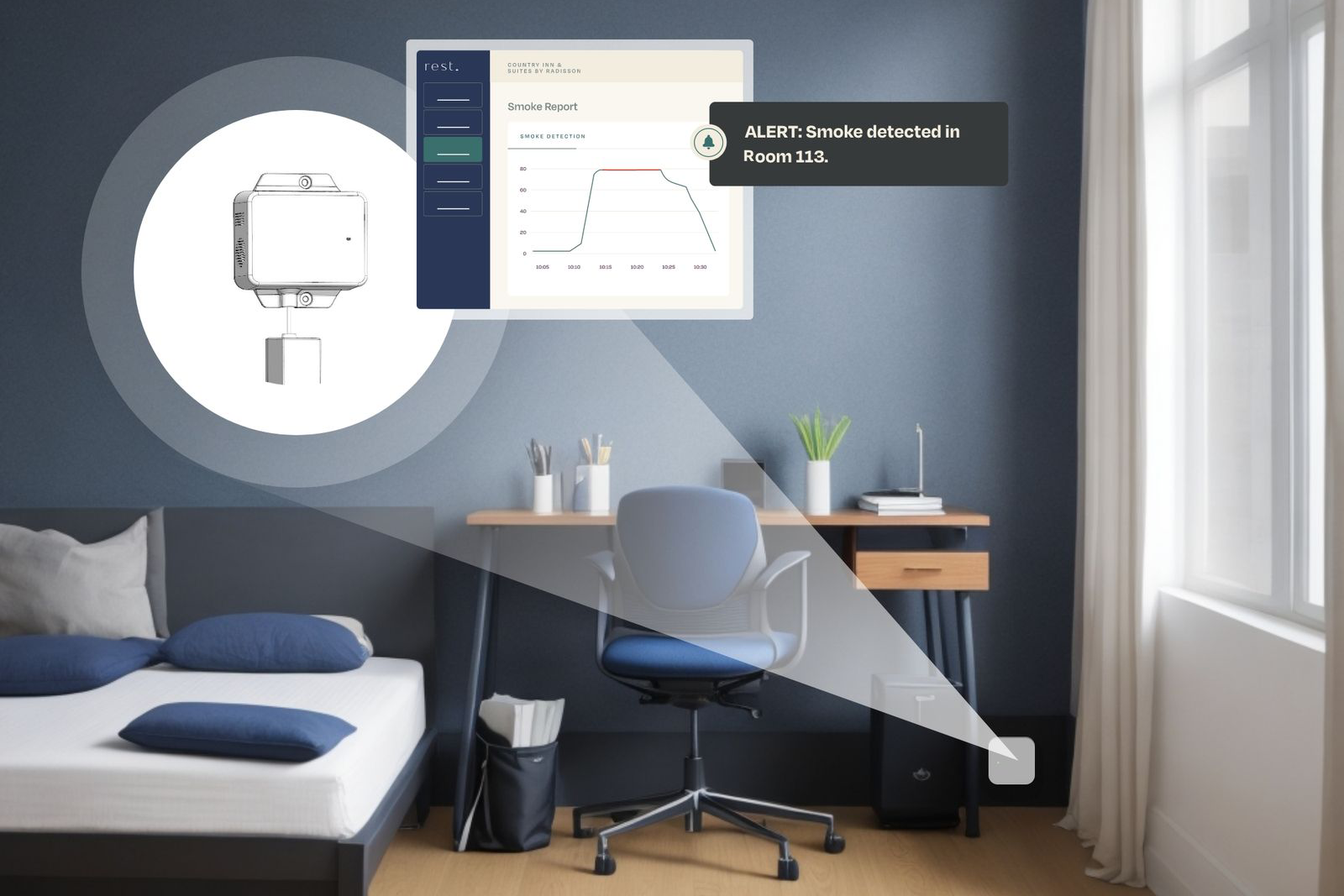
I first called the hotel and reached an assistant general manager, who was familiar with the Rest sensor. He was confident of the device’s accuracy, but told me that smoking fees were only applied after a secondary confirmation of a violation, like a room inspection. He was new to his position, with the Hastys’ experience predating his tenure, so I thought it best to speak to the general manager.
I soon received an email from the vice president of the Wurzak Hotel Group, the hospitality group that manages this property. He told me that he had reviewed the case and that the smoking fee would refunded. This executive also confirmed that the case was being forwarded to Rest for review and further explanation about what might lead to some false positives.
He explained in the following email:
“Good Morning Michelle,
Thank you for reaching out and for bringing this matter to our attention.
After reviewing this specific case, the hotel has removed the smoking-related charge from the guest’s account, which we understand addresses the immediate concern from the guest’s perspective.
With respect to the broader questions regarding the reliability or performance of Rest’s smoking detection technology, those concerns have been forwarded directly to the Rest team for their review and response. As the technology is developed and supported by a third-party provider, we are not in a position to comment on its design, functionality, or performance beyond how it is operationally used at the property.
We appreciate the opportunity to review the situation and to ensure the guest concern was addressed promptly. Please let us know if there is any additional information you may need from the hotel regarding this individual case.”
Back to The Strat — and another surprise smoking charge

Patrick Brown, his girlfriend and her 20-month-old toddler checked into The Strat last November for three nights. On their final evening in Las Vegas, they were going to an event at the Punk Rock Museum.
“My girlfriend spent a long time in the bathroom creating a standup mohawk,” Brown recalled. “She used egg whites, hair spray, gel, a blow dryer and a flat iron. Finally, she was ready.”
The trio headed over to the event and had a great time. But the next morning, as they were checking out, he was surprised to see a smoking fee of $566 on his invoice.
“The front desk staff told me the air-quality sensor had gone off in our room,” Brown says. “The staff were all polite and helpful and besides this, our stay was very pleasant. But none of us are smokers and I don’t want to pay a smoking fee! We did not smoke in the nonsmoking room that we specifically requested. That would make no sense.”
Brown spent two months unsuccessfully attempting to get someone at the hotel to agree with his logic.
At some point, he realized he needed additional assistance, and he reached out to me. He hoped I could contact someone at The Strat who could take a close look at this complaint and consider the sensor may be wrong.
As with all the other couples, Brown and his girlfriend were more than willing to provide medical documentation of their nonsmoking status. Their problem was that they couldn’t reach anyone at the hotel willing to look at that information.
So, I emailed the same public relations representative I had spoken to seven months previously about the Wilhams’ surprise smoking fee at The Strat. I explained that again we had a nonsmoking couple, this one with a toddler, who had been accused of lighting up in their room.
The good news for this couple came fairly quickly. Because they were willing to provide health reports from their doctors attesting to their nonsmoking status and because no one inspected their room after the sensor alerted to a smoking event, The Strat reversed the $566 smoking fee.
While Brown is pleased with the outcome, he does wonder why the hotel would risk alienating customers by relying on a machine that appears to be capable of sending false alerts.
That was a good question — and one I thought might be best answered by the company behind the Rest sensor.
Asking Rest about its inconsistent air-quality sensor
There are a variety of companies that market air-quality sensors to hotels. Based on my complaint files, the device that most major hotel brands seem to prefer — or at least, one of the top choices — is the Rest sensor.
The Rest sensor is installed at The Strat, the Kimpton Palladian and Hilton hotels, among others.
To get a better idea of what hotel guests and management should make of the sensor’s reports, I asked Rest’s company spokesperson. I was particularly interested to know about a blurb that appears at the bottom of each “Smoking Policy Violation Report” that the sensor creates, which implies its results are definitive. This report is then printed out at the hotel front desk. The report is supposed to generate at the time of the incident and alert front desk staff in real time so they can immediately contact the guest; however, that’s not what has been happening, based on the complaints outlined above.
Among other things the report states: “In summary: The data on this report indicates that the sensor in the specific room detected a smoking violation at or around the indicated time of day.”
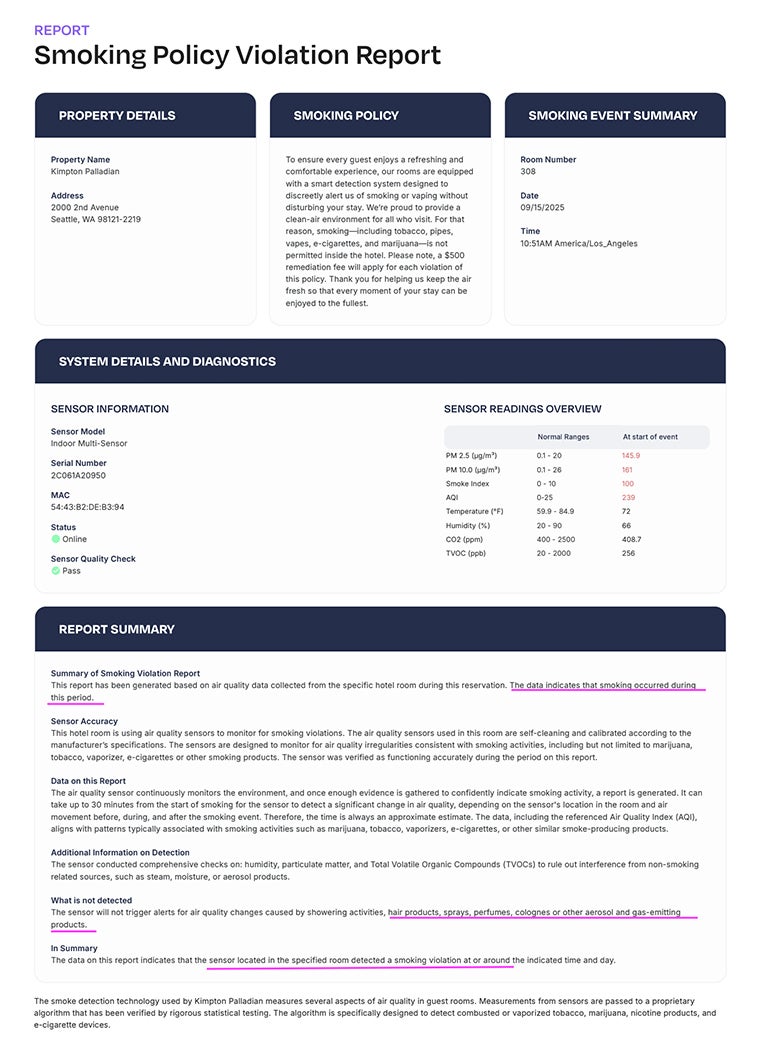
The Rest sensor sends a report like this to the hotel’s front-desk which states: “The data indicates that smoking occurred during this period.”
Additionally, the report rejects outright the idea that hair sprays or other aerosols can cause a molecular change in the air quality that triggers the sensor.
The report summary directly contradicts the real-life data I’ve seen.
Here’s a small excerpt from my inquiry to Rest:
“Of course, anyone who violates the smoking rules in a hotel should pay to remediate the room, but equally, nonsmokers who are simply flattening or curling their hair should not have to pay to remediate a room when none is needed.
“This sensor is being marketed as a foolproof way for hotel owners to easily catch smokers, but my case files show that it is not exactly foolproof. I hope that you might be able to address the growing evidence that these sensors can produce a false positive when grooming products are used in combination with a flat iron or curling iron. What can travelers do to protect against this type of surprise charge? What can hotel owners do to make certain they aren’t accusing a loyal guest of doing something they didn’t do — and of course losing that customer forever?”
Rest responds with guidance for hotel owners and guests
Soon, Rest’s company spokesperson had some insight into how the sensor should be used:
“At Rest, our mission is to support hotels in maintaining smoke-free environments through accurate, real-time air quality detection. Our technology is designed to identify the presence of combusted or vaporized substances, including tobacco, marijuana, and vaping products, using rigorous, field-tested detection algorithms. We take all feedback seriously and are committed to supporting our hotel partners in providing fair, transparent, and high-quality guest experiences.
“Rest does not issue charges to hotel guests or make enforcement decisions. We provide air quality data to our partner properties, which are solely responsible for interpreting that information and handling any guest communications or charges in accordance with their policies.
“We strongly encourage our partners to exercise discretion in enforcement and to be mindful of broader environmental factors and guest context when evaluating potential violations.”
I found the last part of the spokesperson’s statement about “potential violations” particularly telling. If the smoking violation reports included that same caution and advice instead of the current definitive language, it could greatly reduce the number of innocent guests getting charged hundreds of dollars based solely on sensor readings.
And that would be a very good thing for both hotel guests and the hotels.
How to avoid false hotel smoking fees (and how to fight back)
Although neither Rest nor the management of the various hotels involved had specific guidance as to how a nonsmoker can avoid getting falsely accused by this sensor, I have some ideas.
Read reviews of the hotels you’re considering
It’s always a good idea to search current reviews for a hotel before booking. The properties that have implemented these sensors with very little human oversight often have a high rate of complaints about false smoking charges. It’s a good idea to steer clear of these hotels until there is a better understanding of the limitations of the sensors.
Ask whether the hotel has installed in-room sensors (and where)
At check-in, you should ask the front desk if air-quality sensors are installed in the rooms and the location of the device. Hotels that are simply trying to maintain a smoke-free environment should be transparent about the system. It’s important for guests to know where the device is so that they can avoid using any items near it that might inadvertently trigger an air-quality change.
Report any hotel room that has a preexisting odor
When you enter a smoke-free room, make sure that the room is indeed odorless. Any kind of preexisting smell should be reported to the front desk immediately. Hotel managers have told me that sometimes the sensors take some time to “alert” and you don’t want a previous guest’s problem to become yours.
Additionally, if during your stay you smell cigarette smoke or other odors coming from nearby, it’s important to report that as well. My case files also suggest that some guests are getting dinged for their neighbors’ smoking violations.
Turn on the bathroom fan when using hair sprays and heating elements
In nearly all of the cases that I’ve reviewed, the nonsmoking guests who were charged smoking fees had been using hair products, like hair spray combined with a heating element of some type. It seems fairly clear, at least to me, that the odors from those items are capable can mess with the sensor. So, always make sure to use these products in a well-ventilated area (put the bathroom fan on) and be certain you are nowhere near the air-quality sensor when you curl or straighten your hair.
Carefully review final invoice and ask for a review of your room’s air quality report
When checking out of the hotel, carefully review the invoice for any surprise smoking fees. Remember, it is always best to correct these “misunderstandings” in person rather than days later.
If there are no additional charges at checkout, ask for confirmation that the final air-quality report from your room has been reviewed.
Insist on an immediate room inspection
If a hotel falsely accuses you of smoking in your room at check out, ask for an immediate inspection. Again, hotels that are simply wanting to ensure clear air should be willing to consider that the sensor has made a mistake. If the management of the property refuses your request, make sure to note the time and the name of each person who refuses. You will need this information later during your credit card dispute.
File credit card dispute
Unfortunately, in nearly all the false smoking fee cases I’ve reviewed that escalated to a credit card dispute, the hotel provided a copy of their air-quality report and the consumer lost. It isn’t impossible to win this type of credit card dispute, but it will be challenging.
Although you should not have to reveal your medical history, be prepared to provide evidence of your nonsmoking status from your health care provider.
File a complaint with the state’s attorney general
Air-quality sensors are fallible, just like any device. Yet nearly every hotel manager I’ve spoken to is under the impression that these devices don’t make mistakes. It is not customer-friendly for a hotel to rely solely on the results of a machine to accuse (and essentially convict and fine), guests of wrongdoing without giving them the chance to prove their innocence.
Hotels that engage in this practice should be reported to the attorney general in the state where the business is located. The more complaints the attorney general receives about a particular hotel, the more likely it will launch an investigation and force the property to change its policy.
You can locate contact information for all state attorneys general here.
These offices go through many complaints each week. To make sure that yours is most favorably received, keep your narrative concise, clear and cordial — stick only to the facts. I’ve written a guide to help you create the best possible consumer complaint.
Bottom line
The concept behind hotel sensors is not flawed, yet the results often can be. Travelers, and consumers in general, are becoming increasingly intolerant of exposure to secondhand smoke and vape products. And purifying a room after a guest has violated no-smoking rules is expensive for property owners.
However, just as with other automated programs (like AI-powered car rental scanners), hotel sensors can make mistakes. Human oversight and common sense are necessary components to make sure these tools are doing what they are meant to do — instead of targeting innocent hotel guests for giant smoking fees.
If you find yourself in a battle with a hotel, car rental company, cruise line, airline or credit card company, and you can’t solve it on your own, send your request for help to ombudsman@thepointsguy.com. I’ll be happy to investigate your problem and, if the facts are on your side, directly mediate your case too.