dailynewsnblog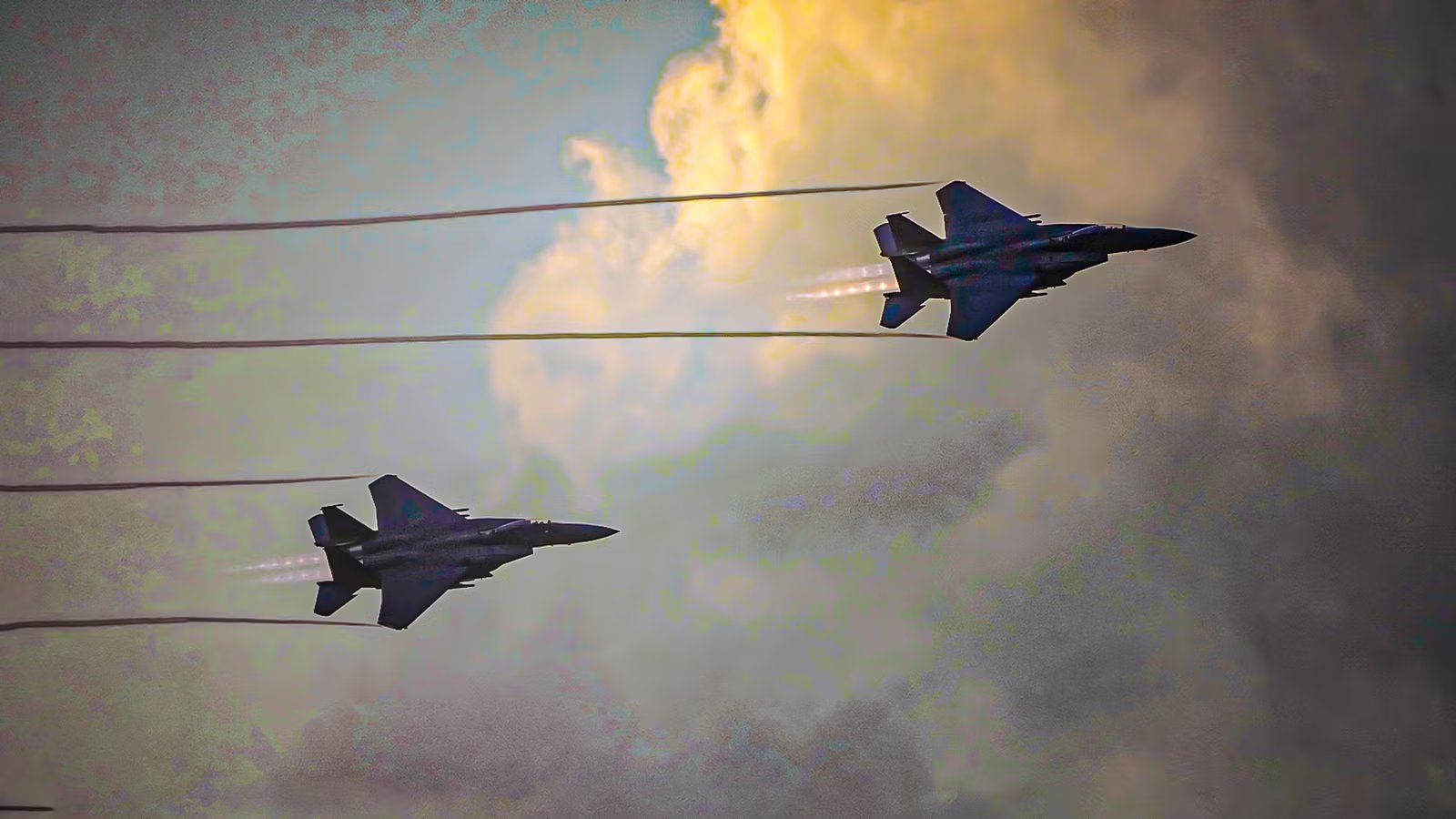
Every year, when the Super Bowl arrives, millions of fans turn their eyes skyward for halftime shows, fireworks, and patriotic flyovers. But beneath the spectacle lies something less visible but equally important: the unbroken, vigilant layer of airborne security designed to protect one of the world’s most-watched events. In 2026, the Super Bowl LX opening ceremony at Levi’s Stadium in Santa Clara, California, offered more than intense football — it saw a coordinated protective operation in the skies, where powerful F-15 Eagle fighter jets patrolled the airspace, ready to intercept anything that posed a risk.
This wasn’t an ordinary airshow performance. Classified as a National Special Security Event by federal authorities, the Super Bowl demanded an integrated aviation safety and defense architecture, blending military readiness, temporary flight restrictions, radar coverage, and quick-reaction alert aircraft, including California’s own F-15s. By exploring the aircraft, units, and missions that shielded the Super Bowl, this article will take you from the alert barn in Fresno to the spectacular eight-aircraft flyover above Levi’s Stadium.
America’s Shield Aloft: California’s F-15s on Alert

Before the game ever began, the skies above Santa Clara were tightly controlled. The FAA established a Temporary Flight Restriction (TFR), a protected airspace extending roughly 30 miles overhead — a zone monitored by NORAD and the FAA to keep unauthorized aircraft at bay. Within this invisible bubble, the highly trained air defenders we are going to talk about stood ready to act.
Leading that mission were F-15C Eagle fighter jets from California’s 144th Fighter Wing of the Air National Guard, based at Fresno Air National Guard Base, not far away. But the role of these fighters was not ceremonial: they were tasked with patrolling and guarding the restricted airspace around the event, ready to scramble at a moment’s notice if an aircraft or drone entered without clearance.
What makes this particularly fascinating is how the National Guard, which is often associated with local natural-disaster response and domestic missions, operates at the intersection of civilian and military responsibilities. As described by NBC News, during Super Bowl preparations, 144th Fighter Wing pilots and ground crews trained with simulated intercepts, flying with the Civil Air Patrol to practice detecting and responding to potential airspace violations well in advance of game day.
The main aerial protagonist of this event is often an icon of air superiority, but it’s also ideal for rapid-response alert missions: the F-15 Eagle. With a top speed of Mach 2.5, making it one of the fastest USAF planes, advanced radar, long range, and a reputation for reliability, the Eagle has never been shot down in air-to-air combat throughout its service history.
144th Fighter Wing pilots described to NBC News how they must be ready to go from a cold-alert barn (sometimes literally awaken from sleep!) to an airborne intercept in minutes. Once airborne, F-15 pilots use a combination of radio warnings, visual signals, and careful maneuvering to contact unknown aircraft. The goal is not armed confrontation, but clarification and de-escalation: flashing lights, wing rock, and voice radio contact over emergency frequencies are all part of the intercept playbook.
This mission mirrors broader NORAD missions conducted nationwide, in which intercept squadrons like those at the 144th respond to aircraft without transponders or to unresponsive traffic within restricted airspace. Training scenarios often involve partner forces, such as the Civil Air Patrol, simulating encroachments to test readiness, highlighting how real-world events demand precise coordination with civilian air traffic control.
The 144th Fighter Wing: Protecting The Skies Over California

To understand the significance of California’s role in Super Bowl LX, we have to look deeper at the unit behind the jets. The 144th Fighter Wing is a storied element of the California Air National Guard, whose primary federal mission is homeland air defense, extending from the Mexican border to Oregon, using the F-15 Eagle.
Located at Fresno Air National Guard Base, the wing operates a fleet of F-15C/D Eagles. This aircraft is specifically optimized for air dominance and defensive interception. Its federal tasking places it under Air Combat Command during national missions, while its National Guard status means it also responds to state-level emergencies when called upon.
Pilots and maintainers at the 144th train year-round on alert procedures, tactics, and intercept profiles. While the likelihood of taking action within a No-Fly Zone during a major public event is low, the discipline required to ensure preparedness is high. These drills serve both as real readiness training and as reassurance to civil aviation stakeholders that restricted airspaces are actively monitored.
Importantly, this mission highlights a shifting role for the National Guard. While Super Bowl flyovers and overseas deployments once made headlines, modern Guard units like the 144th now handle both local tasks, such as wildfire reconnaissance, and federal defense duties that can quickly catch national attention. Being in the national spotlight during the Super Bowl flyover underscores this dual responsibility.

How Many F-15s Does The United States Air Force Operate?
Unraveling the Numbers Behind the USAF’s F-15 Fleet
How Super Bowl Flyovers Become Choreographed Skies

For many millions watching television, the highlight of airpower during Super Bowl Sunday is not a defensive scramble, but it’s a traditional, patriotic flyover timed to the last note of the National Anthem. These flyovers are meticulously planned maneuvers involving precise navigation, timing, and inter-service coordination.
In 2026, planners elevated tradition with a first-of-its-kind joint Super Bowl flyover involving both Air Force and Navy aircraft, with participation from the Air National Guard as well.
The formation this year, showcased live over Levi’s Stadium in Santa Clara, included:
- Two US Air Force B-1B Lancer bombers from Ellsworth AFB, South Dakota
- Two F-15C Eagles from the California Air National Guard’s 144th Fighter Wing
- Two US Navy F/A-18E/F Super Hornets
- Two US Navy F-35C Lightning II fighters from Naval Air Station Lemoore, California
This joint formation was designed to commemorate 250 years of the US armed forces defending freedom and highlight cross-service teamwork and aerial precision.
The science behind the whole spectacle was also impressive. Flyovers, like airshows, require more than standard scheduled procedures. Pilots rely on GPS timing cues, synchronized altitude profiles, and precise formation geometry to appear at the perfect moment. The aircraft participating often conduct multiple rehearsal flights in the days leading up to the event, and each service’s flight leaders coordinate hundreds of mission-planning details with the FAA and military authorities to eliminate timing errors.
Unlike defensive patrols, flyovers are public missions, and their success is meant to be visible. They support the TFR enforcement mission by providing a striking visual display above the event, attended by thousands in person and millions online.
The Historic 2026 Super Bowl Flyover: A USAF–Navy Partnership

Super Bowl LX’s flyover was remarkable not just for its spectacle but also for the blending of aircraft that represented very different missions within the US military. The B-1 Lancer, a supersonic strategic bomber, shares a formation flight with two Air National Guard F-15s and two distinct Navy strike-fighter types (F-35C and F/A-18 Super Hornets), demonstrating interoperability across aviation communities. Despite the absence of the traditional Blue Angels or Thunderbirds flyby, the 2026 air display was still spectacular, featuring a variety of aircraft.
This joint effort represents decades of refined procedure. Air Force bombers, National Guard intercept fighters, and Navy attack aircraft are not usually aligned with the same training syllabus, yet here they were overhead in perfect echelon, demonstrating joint force planning.
This flyover was also part of high-level public engagement: demonstrating capability while boosting national pride during a major cultural and sporting event. For aviation enthusiasts, it was an exciting gathering of aircraft, and for pilots, a rare blend of operational practice and public celebration.

Why The F-35 Is The US Air Force’s Most Important Fighter Jet
Discover why the F-35 is the US Air Force’s most critical fighter — from stealth and sensors to strategy, readiness, and future upgrades
Why Air Defense Matters At Events Like The Super Bowl

Considering all the technology and planning, one might ask: “Why are fighter jets needed at a football game?” The straightforward answer is risk management. Large public events attract attention not only from sports fans but also from anyone operating nearby civilian aircraft. The presence of rapid-response fighters acts as both a deterrent and a safety measure, especially after the September 11 attacks, which reshaped safety protocols across the aviation industry, particularly at crowded events.
Airspace incursions often aren’t hostile. Private pilots sometimes inadvertently enter TFRs without realizing it, and commercial drones are a growing concern. Fighters like the F-15 respond to these situations by escorting unknown aircraft out of restricted airspace, opening radio contact, and minimizing confusion, all before it becomes a public safety issue.
This protocol mirrors broader NORAD air defense missions, in which unidentified aircraft near sensitive zones, whether military bases or national events like the Super Bowl, trigger rapid responses.
The Future Of Event Air Security

As aerial threats evolve, with more drones in the skies, advanced navigational systems, and autonomous aircraft, the way events like the Super Bowl secure their airspace will also continue to advance. Enhanced radar networks, coordinated AI monitoring, and integrated civil-military command systems promise tighter and more efficient protection in the future.
But one thing remains unchanged: the human element. Pilots and crews from units like California’s 144th Fighter Wing are the last line of airborne response. Whether standing alert at a Fresno base or flying in perfect formation over Levi’s Stadium, their role blends tradition, dedication, and operational excellence.
Together, evolving technology and seasoned aircrews ensure that event air security remains adaptable, making each Super Bowl a real-world test of coordination and readiness. It’s a reminder that behind the spectacle, disciplined professionals and proven systems quietly keep America’s biggest moments safe.