dailynewsnblog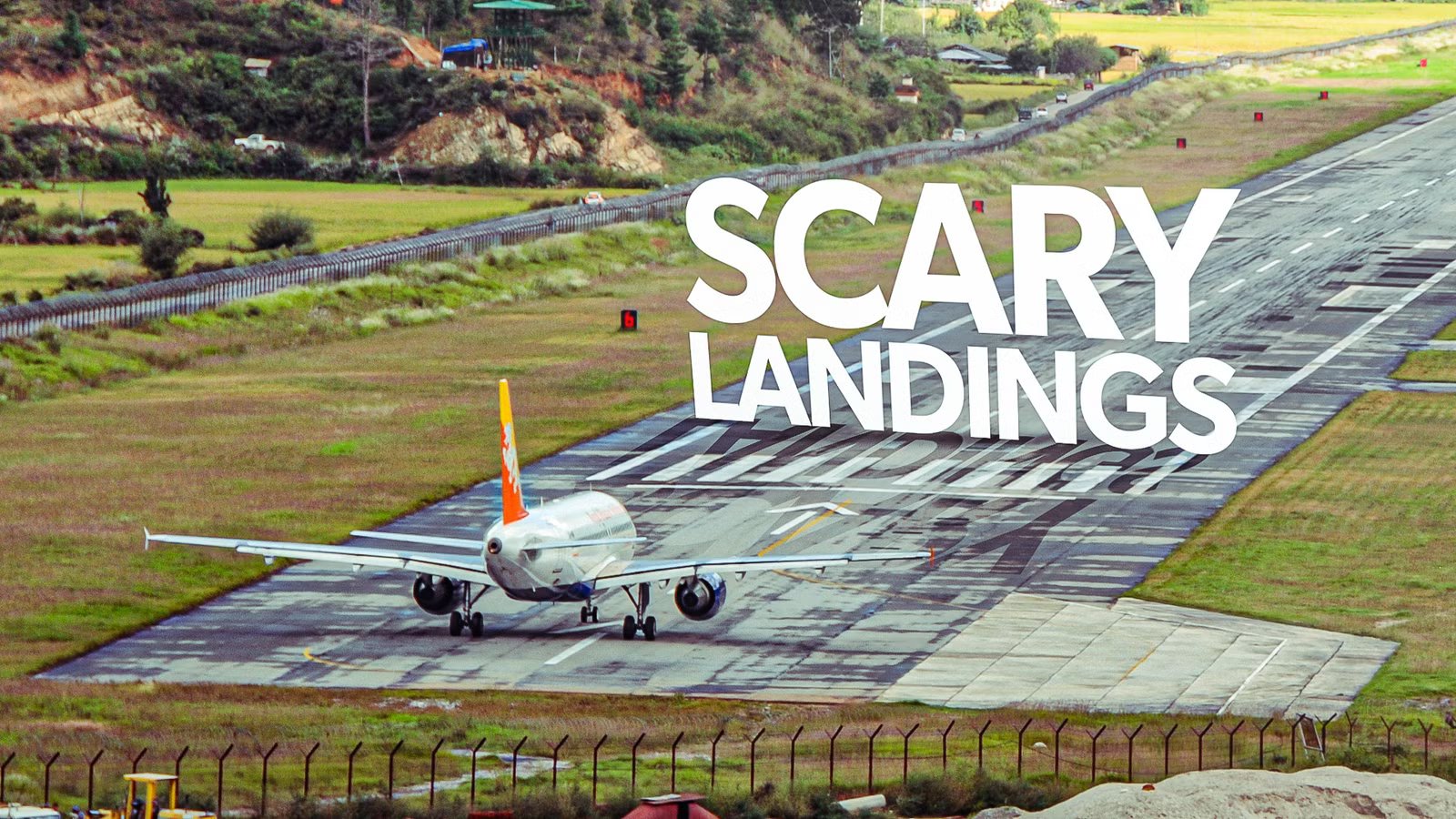
Paro International Airport is the busiest airport in the Himalayan Kingdom of Bhutan and is the only realistic gateway for international tourists visiting the country. Bhutan has land crossings with India, but international tourists rarely use these crossings. As all of Bhutan is mountainous, there is almost nowhere to build an airport.
I flew to Paro on March 1st, in the early spring, and out again on March 6th. I got to experience the airport both in poor visibility conditions and with good visibility. I have flown into airports nestled in mountain valleys before, but this was the most thrilling yet. Here is what to know about flying into Bhutan’s Paro International Airport.
An Airport Subject To Delays

Landing at Paro requires a minimum horizontal visibility of five kilometers (around 3.1 miles) as well as specific cloud ceiling requirements (generally above 5,000 feet). All landings must be done under visual, manual control with no Instrument Landing System (ILS). Operations are also restricted to daylight hours only due to the pilots relying entirely on visual. I boarded my flight at India’s Kolkata International Airport at 08:30 on-time. After boarding, the pilots announced that takeoff would be delayed by 30 minutes until the next weather update.
The visibility at Paro was below the minimum visibility requirements, but the weather was expected to improve soon. After waiting in the aircraft for 30 minutes, the pilots said the flight would wait for another 30 minutes for the next weather update. During this time, the flight attendants handed out a light breakfast and water. The flight was with Bhutan Airlines’ A319ceo. The small airline’s fleet is composed of just two Airbus A319s.
After around an hour of waiting in the aircraft, it pushed back and flew to Paro. Other flights were also delayed, with one having had to divert to another airport en route until weather conditions improved. There were five people on my tour from three flights. One flight had been scheduled to land at 07:30, but it was the last flight to arrive. For a while, it appeared that the flight would be delayed until the following day, but it finally arrived in the afternoon after visibility improved enough.
Landing & At The Airport

Having visited over 100 countries and flown through dozens of airports around the world, landing at Paro has to be the most extreme yet. While visibility was poor, meaning that the spectacular Himalayas were not visible, the nearer mountains and hills were visible. At times, it felt like the aircraft’s wings were almost kissing the crests of lesser mountain ranges as it navigated the valleys. Most impressive was an almost hairpin 180-degree turn the aircraft made in the mountain valley, as well as weaving around the ranges.
The aircraft landed without incident, and passengers were free to mill about on the tarmac in the area between the aircraft and the terminal, taking photos. Almost no one was in a hurry to get to immigration. The airport terminal is charming, having been adorned in the style of traditional Bhutanese architecture. All buildings: residential, commercial, and governmental, are required to have traditional Bhutanese architectural designs, even if superficial, and the airport is no different.
Immigration at the airport is simple. All foreigners are required to have a pre-approved visa obtained through a registered tour agency in advance. No questions were asked, just quickly stamped in. The airport also has new eGates, although I wanted the Bhutanese stamp, so I didn’t try using them. The airport has WiFi, and SIM cards are sold at the exit at a reasonable price. The airport also has a currency exchange booth offering good rates for major currencies, although Indian Rupees are interchangeable with the local currency, the Ngultrum, throughout Bhutan, and in any shop.

The 10 Airports With The Highest Elevation In The World
Several airports have been built over 4,000m from sea level.
Aircraft Serving Paro Airport

As there is no flat land around the capital, Paro is located around an hour’s drive from the country’s capital of Thimphu. Near the airport is a lookout where tourists can enjoy excellent views of Paro Airport and see aircraft take off and land. As there are only a limited number of daily flights at Paro, there were no flight operations when I was at the lookout.
Only two airlines operate commercial passenger flights to Paro: Drukair and Bhutan Airlines. The combined fleet is six A319s, one A320, and a single ATR-72, which is also used on the country’s one domestic route. Drukair also has a Pilatus PC-24. Apparently, Paro is able to operate larger aircraft. In 2024, Airbus reported it had “signed a Memorandum of Understanding (MoU) with Drukair for three A320neo and two A321XLR aircraft to expand its international network.” These are to be delivered from 2030.
|
Bhutan’s Paro International Airport |
|
|---|---|
|
Aircraft served |
A319, A320, ATR-72 (A321XLR future) |
|
Elevation |
7,332 feet (2,235 meters) |
|
Runway length |
7,431 feet (2,265 meters) |
|
Airlines served |
Bhutan Airlines, Drukair |
|
Combined fleet size |
8 (including one PC-24) |
Paro’s elevation is 7,332 feet (2,235 meters), making it almost the same altitude as the top of Australia’s highest mountain, Mount Kosciusko. Surrounding mountains rise as high as 18,000 feet (5,500 meters). While Paro is among the world’s highest airports, it is still significantly lower than those found on the Tibetan Plateau and the Altiplano in South America (mostly Bolivia).
Checking Back Into The Airport

Checking into the airport, I arrived before most passengers, and there was no queue whatsoever at check-in, security, or immigration. The airport has a couple of bakeries and coffee shops for passengers, as well as the typical souvenir, cosmetics, and bookshops. Buddhist art is everywhere around the airport, although perhaps most eye-catching is the free Bhutan Art Gallery in the waiting area.
The art gallery mostly features images of Bhutanese royalty as well as Buddhist-related themes. It is small, but well worth checking out. The terminal is at ground level and has large windows providing great views of the aircraft. While the airport does have the typical Spartan airport-type benches, it also has a number of comfortable couches for passengers to enjoy.
The airport’s design is similar to the concept found in Bhutan. It is intended to be modern, but also Bhutanese, not the large, showy, sterile, and generically international modern. In some ways, the airport terminal’s waiting areas feel as much like a hotel foyer as they do at a modern airport. That said, the airport doesn’t have anything like Somaliland’s Hargesia International Airport, which I flew through last year. That airport’s boarding gate is a literal garden/residential gate.

Drukair Signs MoU For 3 Airbus A320neo & 2 A321XLRs At Farnborough Airshow
Drukair’s order was the first for Airbus, with the Bhutan-based carrier ordering five aircraft by signing a preliminary agreement.
A Relaxing, Laidback Airport Experience

As I am a freelance aviation journalist, waiting time at airports is typically work time. I was busy typing until I heard the final boarding call for my flight. The airport is small, and there are only a couple of gates. The staff vaguely told me which aircraft to board, although I didn’t really hear. After walking through the gate and onto the tarmac, I was greeted by four flights, all Airbus A319s getting ready for their morning flights out of Paro.
The airport is so relaxed that I had a sensation I had never felt before. As all other passengers had boarded the aircraft, I had no one to follow; I was left standing on the airport tarmac staring at four primed aircraft, not knowing which one to board. It was something of a surreal experience, as in all my years of flying, I had never had the sensation of not knowing which aircraft to board before.
I took to asking security guards which aircraft my flight was, just like asking for directions on the street. Boarding the aircraft, I even asked the flight attendants if this was the flight to Kolkata. Again, no one was checking my boarding pass, and I wasn’t 100% certain I had boarded the correct aircraft. When I had booked the flight a month prior, it was 80% full; upon boarding, it was perhaps less than half full. I assume many European visitors had to cancel their flights to Bhutan due to the US air campaign over Iran that disrupted connecting flights through the Middle East.
Taking Off From Paro

Visibility was excellent, taking off that morning with blue skies and clouds hugging parts of the Himalayas. Take off feels like a race to accelerate and gain altitude, and clear the first mountain ridge. This first ridge is cleared with a minimal amount of clearance. There is a remote winding road to the top of it, and it must be excellent for aircraft watching.
As the aircraft gained altitude, there were glorious views of the snowcapped Himalayas that I was unable to see on the inbound flight. Passengers can see the mountains trapping low-lying clouds between the ranges. But it isn’t long before the clear skies and normal clouds give way to the haze and pollution that shrouds much of the Indian subcontinent.
This haze was so thick that it was impossible for me to see through it and see India below. Having visited the Himalayas in India’s Kashmir, Sikkim, and Uttarakhand regions, as well as in Nepal and Bhutan, I can say that visitors need to penetrate deep into the Himalayas to escape the thick pollution haze. Although this does vary by season and depends on what the weather is like at the time.