dailynewsnblog
The Boeing 757 remains a strategically important aircraft for connecting the United States and Europe, even in 2026. Based on recent route data and airline schedules, US airlines, predominantly  United Airlines, will operate thousands of transatlantic flights this year utilizing the 757. These include flights to destinations like Dublin, Porto, and Malaga, where the aircraft’s unique performance characteristics make it ideal for these “long and thin” routes across the Atlantic.
With a typical seating capacity of around 180 passengers and a range of nearly 4,000 nautical miles (7,400 km), the Boeing 757 continues to play an important role in connecting secondary markets on both sides of the Atlantic, even as newer narrowbody alternatives like the Airbus A321XLR slowly begin taking over some routes. Its combination of range, performance, and manageable capacity allows airlines to operate nonstop services that would require connections or larger widebody aircraft.
United Airlines’ Extensive Transatlantic 757 Network

United Airlines is the second-largest commercial operator of the Boeing 757, with 61 examples of the aircraft type in its fleet, according to planespotters.net. As such, among U.S. airlines, United operates by far the most extensive transatlantic 757 route network, primarily centering on its major east coast hub at  Newark Liberty International Airport (EWR). From Newark, which is located only a few miles from New York City, United serves a variety of smaller European markets where demand for a larger widebody, like the Boeing 767 or either the 787 or 777, wouldn’t be warranted. These destinations include Porto (Portugal), Edinburgh (Scotland), Dublin (Ireland), Reykjavik (Iceland), Bilbao (Spain), Faro (Portugal), Shannon (Ireland), and Malaga (Spain).
Looking more closely at United’s transatlantic 757 services in 2026, the carrier has 14 scheduled routes for the year, with three originating from both  Chicago O’Hare International Airport (ORD) and Washington Dulles International Airport (IAD), while the other eight depart from Newark. Both ORD and IAD have connections to similar destinations, with United serving Edinburgh and Reykjavík from both hubs, while O’Hare offers summer service to Shannon, and Washington has year-round service to Dublin. The full details of United’s 2026 Boeing 757 transatlantic network can be found in the table below:
|
Origin |
Destination |
Flights |
Available Seats |
Average Distance (Miles) |
|---|---|---|---|---|
|
ORD |
EDI |
177 |
31,152 |
3,713 |
|
ORD |
SNN |
125 |
22,000 |
3,591 |
|
ORD |
KEF |
134 |
23,584 |
2,944 |
|
IAD |
DUB |
529 |
93,104 |
3,405 |
|
IAD |
EDI |
280 |
49,280 |
3,478 |
|
IAD |
KEF |
125 |
22,000 |
2,799 |
|
EWR |
FAO |
75 |
13,200 |
3,494 |
|
EWR |
OPO |
407 |
71,632 |
3,340 |
|
EWR |
EDI |
365 |
64,240 |
3,269 |
|
EWR |
DUB |
319 |
56,144 |
3,193 |
|
EWR |
SNN |
205 |
36,080 |
3,096 |
|
EWR |
AGP |
146 |
25,696 |
3,677 |
|
EWR |
BIO |
50 |
8,800 |
3,557 |
|
EWR |
KEF |
90 |
15,840 |
2,601 |
By far the most operated route on this list is United’s service from Washington Dulles to Dublin, with 529 flights scheduled for 2026, offering over 93,000 seats. Newark to Porto also sees heavy 757 utilization, operating up to twice daily during peak seasons. On the other end of the spectrum, some routes, like EWR to Bilbao, Faro, and Reykjavík, will see fewer than 100 flights in 2026. EWR to Bilbao, for instance, sees just three flights weekly between June and September, while flights to Iceland are also only offered during the peak summer months, but at a once-daily frequency.
What Can Passengers Expect Onboard United’s Boeing 757s?

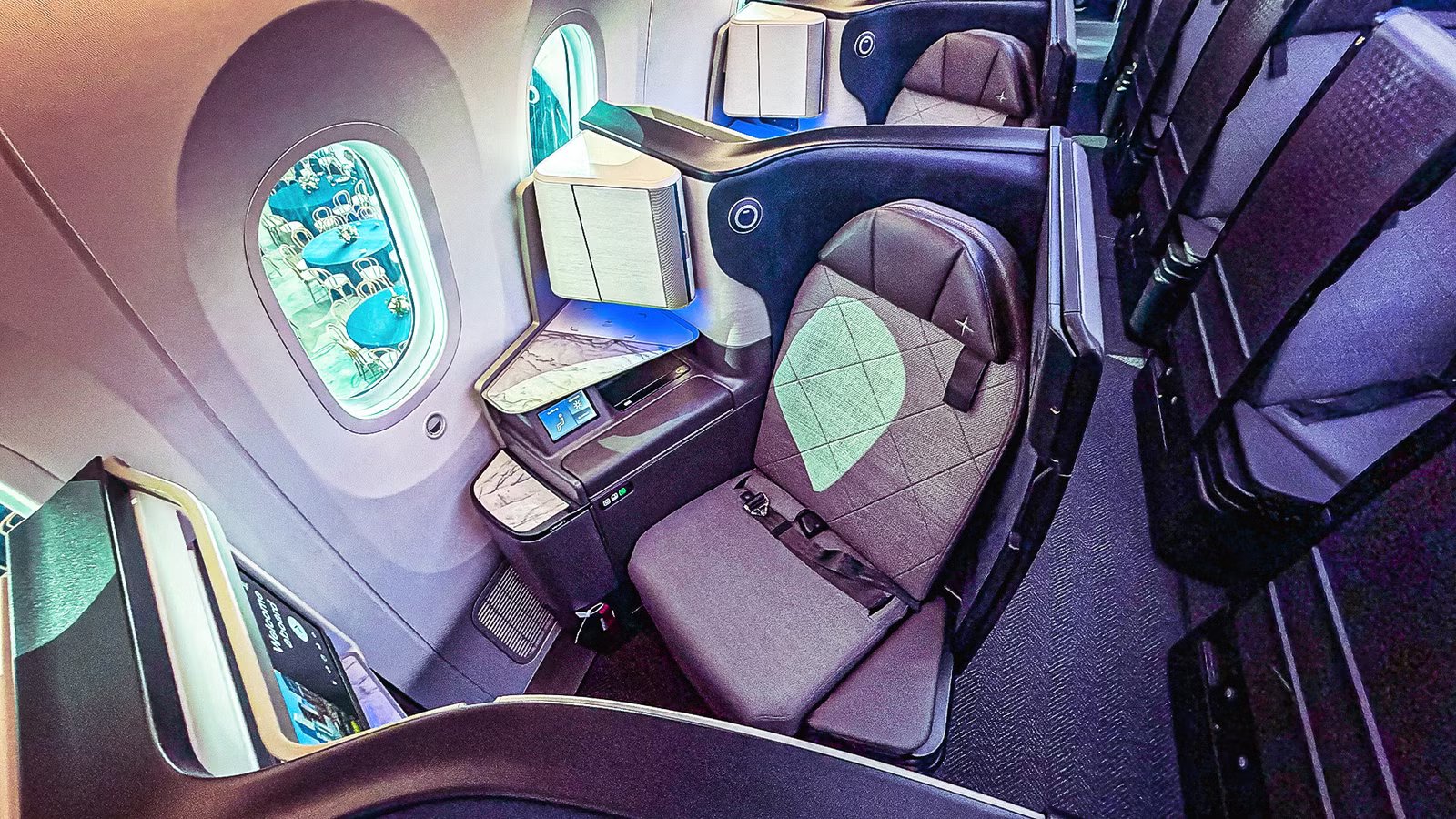
Although the 757 is a narrowbody aircraft, United’s fleet of 757-200s feature decently sized Polaris cabins with lie-flat business class seats. Passengers sitting at the front of the aircraft in Polaris can expect a two-two configuration, with each seat slightly offset from its neighbor and angled toward the window. As United’s transatlantic services are international flights, passengers in Polaris receive access to United’s award-winning Polaris lounges in Newark, Chicago, and Washington, as well as an elevated onboard experience in line with widebody aircraft.
For travelers in economy, the experience is relatively standard compared to other transatlantic or international travel on United. Passengers can expect 31 inches of seat pitch with 15 inches of width and a decent five-inch recline. In economy plus, United’s extra legroom offering, seat pitch is increased to 37 inches with the same width but an extra inch of recline.
However, since the 757 is an older narrowbody aircraft, some aspects of the experience may differ from a widebody service. For example, since the 757 only has one aisle, boarding and deplaning take longer than on a twin-aisle aircraft. Additionally, meal service is often slightly slower due to the smaller size of the onboard galleys and the single-aisle configuration. However, despite these trade-offs, the 757 allows United to serve unique destinations it likely would not be able to otherwise, either due to financial or technical constraints.

Delta Vs United: Which Boeing 757 Offers A Better Passenger Experience?
Delta and United offer similar experiences on their 757s, except for Delta’s long-range 757s in business class.
Just Two Routes: Delta’s Icelandic 757 Deployment In 2026

Unlike United’s broad network onboard the 757,  Delta Air Lines, also the world’s largest commercial 757 operator, employs a much more targeted strategy with its Boeing 757 fleet. In 2026, the majority of Delta’s 757s, of which the carrier has 90, are utilized on high-demand domestic services, operating flights as short as Atlanta to Orlando or transcontinental service from New York to San Francisco. On the international side, however, Delta plans just two seasonal transatlantic 757 routes, adding up to under 300 total flights.
The first of these two routes is Delta’s summer seasonal service between Minneapolis (MSP) and Reykjavík, with 151 flights scheduled for the season. Operating between May 7th and October 4th with daily service, Delta will deploy one of its 193-seat Boeing 757-200s, outfitted with 20 recliner seats and 173 economy seats. Interestingly, Delta has chosen to deploy a domestic-configured 757 on this six-hour overnight flight, marketing the traditional domestic first class recliners as Delta Premium Select, the airline’s equivalent to international premium economy. This means the MSP – KEF route will be operated with no lie-flat seat option, as Icelandair, the only other airline that serves the route, also only offers recliner seats as the most premium option onboard.
Delta’s second transatlantic route, onboard the 757, is also to Reykjavík, this time departing from Detroit, however. In total, Delta will operate 124 services on this 2,792-mile flight (4,500 km) onboard the same Boeing 757-200 as the MSP – KEF route. Given that, this route will not offer lie-flat business class options, although the relatively short distance to Iceland means flight times of around five hours for both routes. In comparison to United, Delta’s 757 fleet strategy is much more situational, with the aircraft filling niche seasonal demand rather than being an important part of yearly transatlantic networks.
What Makes The 757 A Good Aircraft For Transatlantic Operations?

The Boeing 757’s continued success across the Atlantic stems from the aircraft’s rare combination of range, size, and performance characteristics. With a maximum range of 3,900 nautical miles (7,220 km), the 757-200 can easily connect much of the U.S. East Coast with Western Europe. From New York, this is technically enough range to serve Rome, Helsinki, or Warsaw, although airlines rarely operate an aircraft up to its maximum range due to performance and safety reasons. This capability in range allows airlines to serve routes that would otherwise require stops on aircraft with similar capacity, opening up more nonstop options for passengers.
Another advantage of the 757 is its tremendous performance characteristics. Despite its relatively high maximum takeoff weight of 255,000 pounds (116,000 kg), the 757 has a high thrust to weight ratio, meaning it is capable of producing a lot of power for an aircraft of its size. In practice, the 757 has a takeoff distance of just 6,500 feet, allowing it to operate in smaller airports that would not be able to accommodate a widebody jet. These reasons make the 757 one of pilots’ favorite aircraft to fly, with some describing the aircraft as a “sports car” despite the plane’s older age.

Why Is The Boeing 757 Still Used for Transatlantic Flights?
The aircraft remains economically viable for some transatlantic routes even as it is progressively replaced by aircraft like the A321XLR.
The Airlines That Still Operate The Boeing 757

In 2026, only a handful of airlines worldwide will continue operating the Boeing 757 in passenger service. In total, 436 757s remain active, with just over 130 of those in passenger configurations. Delta is by far the largest commercial operator of the type, with 74 Boeing 757-200s and 16 Boeing 757-300s. United isn’t far behind, with a fleet size of 61 aircraft. This breaks down to 40 Boeing 757-200s and an impressive 21 Boeing 757-300s, which are used exclusively for domestic operations.
Outside the United States, the 757 is few and far between. French all-business class airline La Compagnie is scheduled to lease a former Icelandair 757-200 for several weeks during the summer as it looks to boost capacity, particularly around the 2026 FIFA World Cup. These aircraft will operate a total of 26 transatlantic flights, with 15 flights from Paris Orly (ORY) to Newark and 11 from Milan (MXP) to Newark as well. Onboard, all 20 rows will be configured with lie-flat business class seats, making it an exclusive experience onboard.
While the end of commercial 757 operations seems to be coming closer, especially with United expected to retire its fleet of 757s by the end of the decade, the 757 still sees significant action as a cargo workhorse.  UPS Airlines and Fedex Express, for example, each operate over 60 cargo-configured 757s, with 68 and 63 aircraft, respectively. With the 757’s operational characteristics, the aircraft remains extremely valuable in the cargo sector for its high load capacity and tested reliability.