dailynewsnblog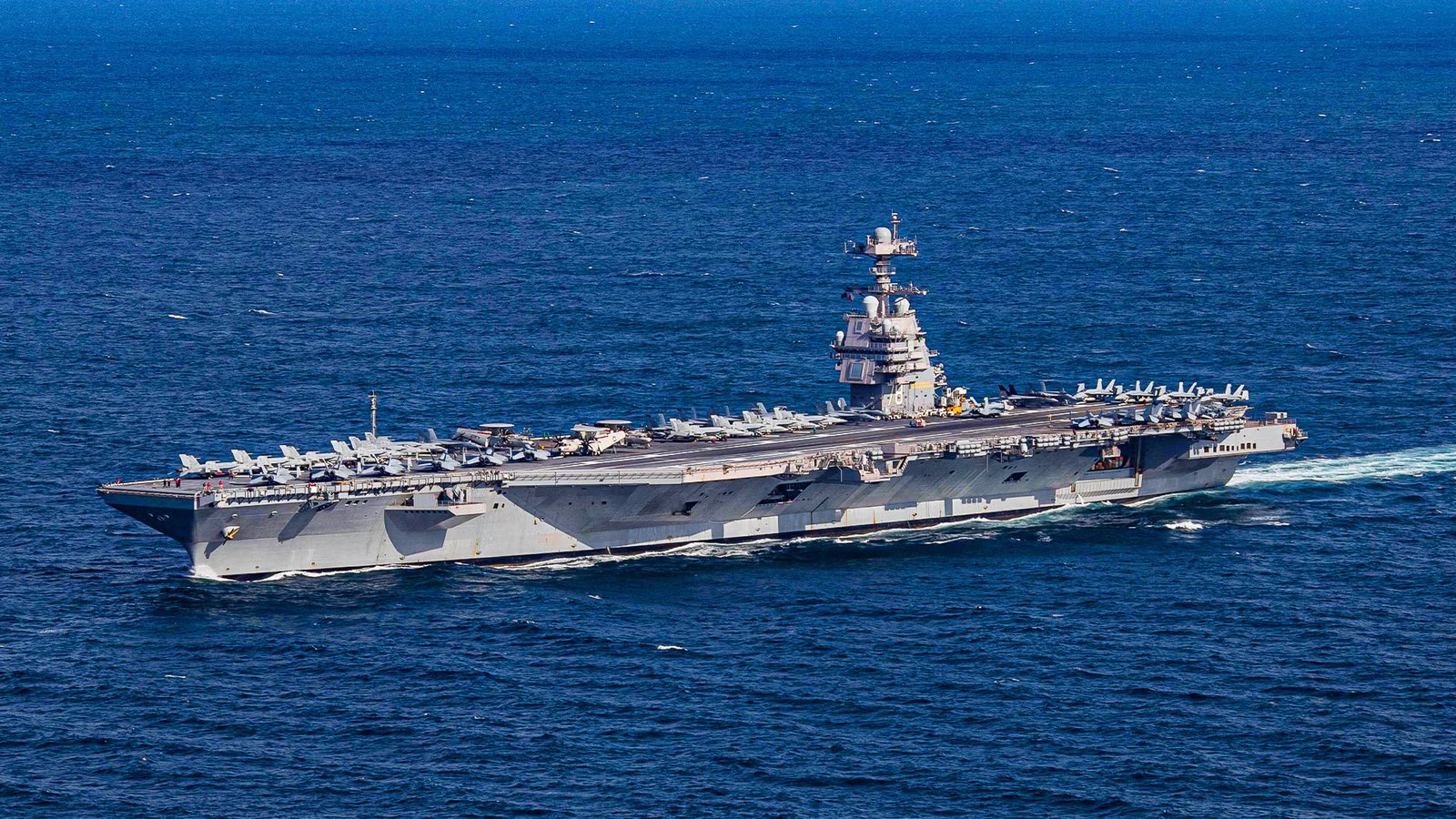
In early 2026, the United States Navy’s largest active aircraft carriers belong to two classes: Ford and Nimitz. These massive ships are designed to deploy US Military power across the globe. The largest Gerald R. Ford-class carriers (one operational, one undergoing testing) can carry up to 90 aircraft and generate 160 daily sorties (surging to 270), making them the most powerful naval air platforms ever deployed. Meanwhile, slightly smaller but more common and battle-proven Nimitz-class carriers (ten currently operational) typically operate 60–75 aircraft in real-world deployments, despite theoretical capacities of nearly 85. These differences in usable aircraft capacity, and not just sheer size, determine how effectively each carrier projects US military power globally.
Drawing on US Navy fact files, publicly available fleet specifications, and operational analyses from various Naval Aviation sources, this article ranks five of the largest active US Navy supercarriers by aircraft capacity, currently deployed or about to be deployed. This matters directly to US defense strategy, as carrier strike groups remain central to operations in regions such as the Indo-Pacific and the Middle East, where forward-deployed US airpower must operate without relying on allied airbases.
Below are the five largest active US Navy aircraft carriers, ranked by practical air wing capacity, taking into account actual deployment figures, surge capability, and sortie-generation efficiency.
USS George H.W. Bush (CVN-77)
Around 70 Aircraft

USS George H.W. Bush holds a unique position as the final Nimitz-class aircraft carrier, commissioned in 2009 at a time when the US Navy was already planning its next-generation replacement. While its aircraft capacity aligns with earlier ships in the class, typically carrying around 70 aircraft in standard deployments and surge capacity of 80 or more, it incorporates several transitional technologies that directly influenced the Ford-class design.
Unlike earlier Nimitz carriers, CVN-77 features a redesigned island structure placed further aft, improving flight deck flow and freeing up additional space for aircraft handling. These changes were aimed at increasing sortie efficiency and reducing congestion during high-tempo operations. According to naval sources, even marginal improvements in deck layout can significantly increase the number of aircraft that can be actively cycled through launch and recovery operations.
Operationally, USS George H.W. Bush has been heavily involved in US military campaigns across the Middle East, including missions against ISIS and support for coalition forces. Its embarked air wings have included F/A-18 Super Hornets, EA-18G Growlers, and E-2D Hawkeyes, forming a balanced strike and surveillance capability. Its ability to sustain a large and flexible air wing under combat conditions cements its place among the largest carriers by effective aircraft capacity.
USS Theodore Roosevelt (CVN-71)
60-75 Aircraft

Commissioned in 1986, USS Theodore Roosevelt has long been one of the most operationally active aircraft carriers in the US Navy. Like all Nimitz-class ships, it is designed to support up to 85 aircraft under ideal conditions, though real-world deployments typically involve 60–75 aircraft, depending on mission requirements.
Its long operational history includes participation in conflicts ranging from Operation Desert Storm to Operation Enduring Freedom. Notably, the carrier demonstrated the Nimitz-class’s endurance during extended deployments, including a 159-day period at sea supporting operations in Afghanistan after the September 11 attacks without refueling or port calls, as reported by the Naval AIRLANT. This ability to sustain both the ship and its air wing for prolonged periods is a key factor in defining its true capacity.
What makes this ship particularly notable is not just its capacity but its endurance—having demonstrated the ability to sustain combat operations for months in real-world combat scenarios. Its air wing usually consists of a balanced mix of F/A-18 Super Hornets, EA-18G Growlers for electronic warfare, E-2D Hawkeyes for airborne early warning, and MH-60 helicopters, ensuring both strike capability and battlefield awareness.
Following its midlife Refueling and Complex Overhaul, Theodore Roosevelt has been upgraded to operate modern aircraft, such as the F-35C Lightning II, according to the Navy League. These upgrades ensure that while the ship’s raw capacity remains similar, its effective combat output per aircraft has increased, making it one of the most capable carriers still in service.

5 Historic Carrier-Based Aircraft That Defined US Naval Air Power
From WWII dogfighters to supersonic interceptors, these iconic carrier aircraft forged the legacy of US naval air power as a premier strike force.
USS Abraham Lincoln (CVN-72)
Around 70 Aircraft

USS Abraham Lincoln, commissioned in 1989, represents another cornerstone of the Nimitz class, combining high aircraft capacity with remarkable operational flexibility. Like its sister ships, it typically deploys with an air wing of around 70 aircraft but can scale up significantly in times of crisis.
The carrier’s combat history spans decades, including operations in Iraq and Afghanistan, strategic deployments in the Pacific to counter emerging threats, and its current active deployment in the Middle East to support Operation Epic Fury during the 2026 Iran Crisis, as recently reported by Reuters. Its ability to rapidly adjust air wing composition by balancing strike fighters, electronic warfare aircraft, and early-warning platforms demonstrates that capacity is not just about numbers but about how effectively those aircraft are integrated into mission planning.
One of the defining aspects of USS Abraham Lincoln has been its adaptability to evolving naval aviation. With the integration of fifth-generation aircraft like the F-35C, the ship’s air wing has become more capable without necessarily increasing in size. This reflects a broader shift in US naval strategy, in which quality and per-aircraft capability increasingly complement raw capacity.
USS John F. Kennedy (CVN-79)
Up To 90 Aircraft

USS John F. Kennedy (CVN-79), the second Gerald R. Ford-class carrier, represents the future of US naval aviation. As of early 2026, it is undergoing testing and pre-commissioning trials, with full operational service expected soon. Designed to carry up to 90 aircraft, it matches the capacity of its lead ship while incorporating refinements based on early Ford-class lessons.
The Kennedy builds on Ford’s revolutionary technologies, including the Electromagnetic Aircraft Launch System (EMALS) and Advanced Arresting Gear (AAG). These systems replace traditional steam catapults and hydraulic arresting gear, enabling smoother launches and recoveries while reducing stress on aircraft. More importantly, they enable faster sortie cycles, allowing more aircraft to be launched and recovered in less time.
Nimitz-Class vs Gerald R. Ford-Class – Key Differences
|
Feature |
Nimitz-Class |
Gerald R. Ford-Class |
|
First ship commissioned |
1975 (USS Nimitz CVN-68) |
2017 (USS Gerald R. Ford CVN-78) |
|
Number in service (2026) |
10 active (gradually retiring) |
1 active (CVN-78), 1 in testing (CVN-79) |
|
Displacement |
~100,000 tons |
~100,000+ tons (slightly larger) |
|
Length |
1,092 feet (333 meters) |
1,106 feet (337 meters) |
|
Aircraft capacity (max) |
85 aircraft |
90 aircraft |
|
Typical air wing |
60–75 aircraft |
70–80 aircraft |
|
Sortie generation rate |
~120/day |
~160/day (up to 270 surge) |
|
Aircraft launch system |
Steam catapults |
EMALS (electromagnetic) |
|
Arresting system |
Hydraulic (Mk-7) |
Advanced Arresting Gear (AAG) |
|
Crew size (ship + air wing) |
~5,000+ personnel |
~4,500 (reduced crew) |
|
Radar systems |
Legacy radar systems |
Dual Band Radar (advanced AESA) |
|
Electrical capacity |
~3x less than Ford |
~3x more power generation |
|
Maintenance requirements |
Higher (manual-intensive) |
Reduced (automated systems) |
|
Operational lifespan |
~50 years |
~50+ years (designed for future systems) |
Source: US Navy
From a historical perspective, CVN-79 represents a critical transition point. Construction began in the 2010s, but delays and testing challenges pushed its timeline into the mid-2020s. Despite this, it is expected to play a central role in future carrier strike groups, particularly as older Nimitz-class ships begin to retire. Once fully operational, its combination of high aircraft capacity and improved efficiency will make it one of the most powerful carriers in the world.

New US Navy Aircraft Carriers Face Further Delays
The next ships in the Ford-class are facing stalled delivery times.
USS Gerald R. Ford (CVN-78)
Up To 90 Aircraft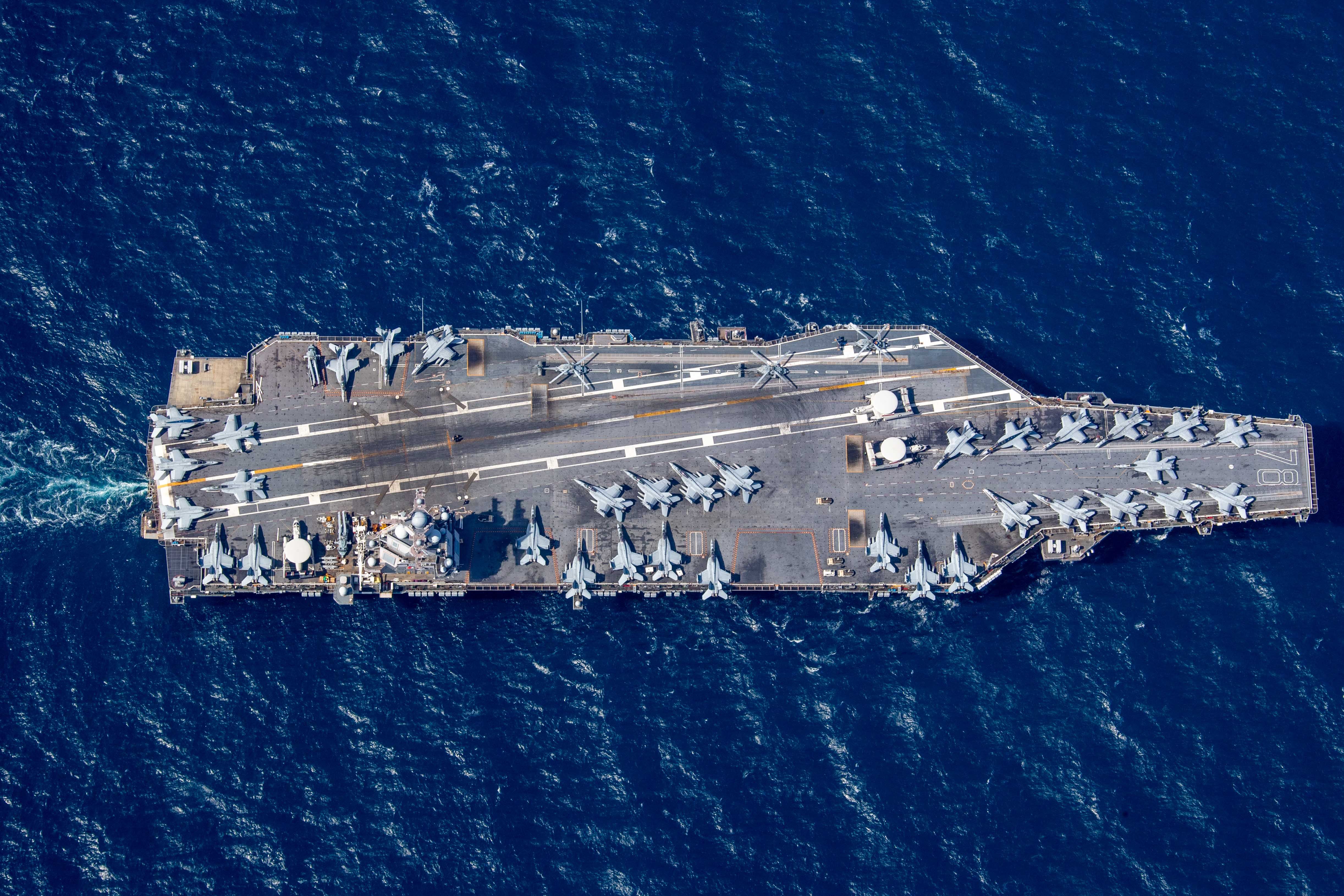
USS Gerald R. Ford stands at the pinnacle of modern naval engineering. Commissioned in 2017, it is not only the largest aircraft carrier in the world but also the most capable in terms of aircraft capacity and operational efficiency. Designed to carry up to 90 aircraft, it surpasses the Nimitz class in both size and the effectiveness of its air wing.
What truly distinguishes the Ford is how it uses that capacity. Its advanced flight deck design, repositioned island, and electromagnetic launch systems enable a sortie generation rate of around 160 sorties per day, with surge operations reaching up to 270 sorties. This represents a dramatic increase over the Nimitz class, which typically achieves around 120 daily sorties. And all is possible with a reduced crew on board, thanks to rapid technological advances and the automation of many processes.
USS Gerald R. Ford (CVN-78) – Aircraft & Roles
|
Aircraft |
Type |
Primary Role |
Secondary Roles |
Notes |
|
F/A-18E Super Hornet |
Multirole fighter |
Air superiority, strike missions |
Close air support, maritime strike |
Backbone of the air wing |
|
F/A-18F Super Hornet |
Multirole fighter (2-seat) |
Strike coordination, air combat |
Advanced targeting, mission control |
Includes weapons systems officer for complex ops |
|
EA-18G Growler |
Electronic warfare aircraft |
Radar jamming, electronic attack |
Escort jamming, suppression of enemy air defenses |
Critical force multiplier |
|
E-2D Advanced Hawkeye |
AEW&C (Airborne Early Warning) |
Airspace surveillance, command & control |
Battle management, network coordination |
Extends fleet radar coverage |
|
MH-60R Seahawk |
Naval helicopter |
Anti-submarine warfare (ASW) |
Anti-surface warfare, surveillance |
Detects submarines and surface threats |
|
MH-60S Seahawk |
Utility helicopter |
Search and rescue (SAR) |
Logistics, vertical replenishment |
Supports ship operations and personnel movement |
|
F-35C Lightning II |
5th-gen stealth fighter |
Stealth strike, intelligence gathering |
Electronic warfare support, deep strike |
Expands survivability and sensor fusion |
|
C-2A Greyhound (being replaced) |
Cargo/transport aircraft |
Carrier onboard delivery (COD) |
Personnel and logistics transport |
Gradually replaced by CMV-22B |
|
CMV-22B Osprey (increasing use) |
Tiltrotor transport |
Long-range logistics support |
Engine transport (F-35), personnel |
Extends carrier logistics reach |
|
MQ-25 Stingray (future) |
Unmanned aerial refueler |
Aerial refueling |
ISR (planned) |
Will extend range of strike aircraft |
Sources: USS Halford Official
The contrast between the Ford and Nimitz classes becomes even clearer when looking beyond deployed aircraft numbers and focusing on operational output. While the Ford class can carry up to around 90 aircraft compared to the Nimitz class’s roughly 85, the real advantage lies in sortie generation. USS Gerald R. Ford is designed to generate about 160 sorties per day under normal conditions and up to 270 during surge operations. In comparison, Nimitz-class carriers typically manage around 120 sorties daily under similar conditions. This gap highlights how newer technology allows the Ford class to extract significantly more combat power from a similarly sized air wing.
According to Naval Technology, the Ford has already demonstrated its capabilities during deployments in the Mediterranean and is currently operating in the war-torn Middle East, showcasing its ability to project airpower in real-world scenarios. Its air wing includes a mix of F-35C stealth fighters, Super Hornets, Growlers, Hawkeyes, and helicopters, with future integration of unmanned systems such as the MQ-25 Stingray.
In many ways, USS Gerald R. Ford redefines what “largest” means. It is not just about how many aircraft it carries, but how effectively it can deploy them. By combining the highest aircraft capacity with the fastest sortie generation rate in naval history, it represents the future of carrier-based warfare.