dailynewsnblog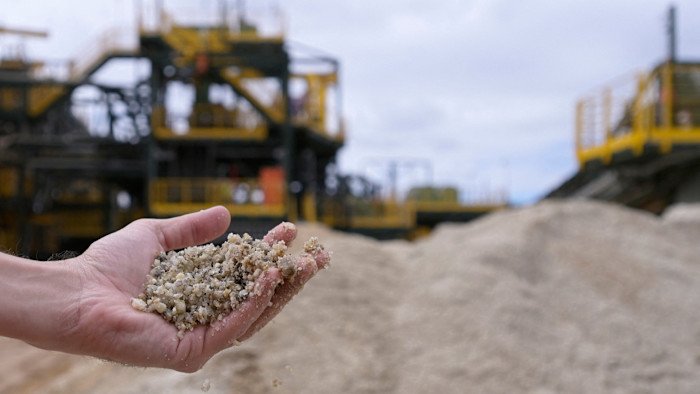
A global race for Brazil’s vast deposits of rare earths is heating up, with the US, China and EU all vying for access to the minerals that are vital for an array of 21st-century technologies.
The Latin American nation’s reserves of the metals, the second-largest in the world, are in the crosshairs of both Washington and Brussels as they try to reduce dependence on China, the dominant producer which has a chokehold on supplies.
The EU is in talks to reach an agreement with Brazil for joint investments into critical raw materials, European Commission president Ursula von der Leyen said last month in Rio de Janeiro.
Brazil’s export agency will hold an event next month where it expects EU-linked investors will unveil financial backing for five mining projects in the country, covering rare earths, nickel, lithium and manganese.
The bloc’s pursuit of deals puts it in competition with the US, which has privately made clear its own desire to access Brazil’s largely untapped deposits of rare earths to officials and industry figures, according to people with direct knowledge of the matter.

Meanwhile, China’s efforts to broaden its geographic grip over the global rare earths supply chain have opened up a three-way contest between the world’s top three economic powers.
At least six mining ventures are developing prospects in Brazil, and several said they had been approached by Chinese groups, including investment funds and carmakers looking to secure material.
Even without a government-to-government deal, Washington has committed more than half a billion dollars to Brazil’s only operational rare earths mine, operated by Serra Verde, making it a top investor in the nascent sector.
US financial firepower already appears to have gazumped European officials.
EU industry commissioner Stéphane Séjourné told Dutch newspaper NRC that he cancelled a trip to Brazil to discuss a rare earths mine late last year after learning of an American investment — an apparent reference to Serra Verde.
Nevertheless, Brussels hopes its recently signed trade agreement with the South American Mercosur bloc will aid its courting of Brasília.
Along with foreign ministers from US “allies”, Séjourné on Wednesday attended a critical minerals summit chaired by secretary of state Marco Rubio aimed at cutting dependency on China.
Rare earths are a group of 17 metallic elements used in vital components for high-tech equipment in areas such as renewable energy, defence and electronics.
The keen interest in Brazil’s mineral reserves should be a boon for the country. But analysts warn that given current geopolitical tensions over trade and natural resources, negotiations will involve a careful balancing act.
Mario Braga, at risk intelligence company Rane, said Brazil was likely to face American pressure to curb Chinese influence in the rare earths sector but its relatively low trade exposure to the US should allow Brasília to push back.
“The country’s large mineral potential will likely enable the presence of US, European and Chinese firms across the territory,” he added.
Amid mounting strains between China and the west, Beijing has restricted exports of certain rare earths.
Heavy rare earths, such as dysprosium and terbium, are especially challenging to obtain and have become more expensive after Beijing cut off access last year.
One executive at a company that has drilled for rare earths in Brazil, who asked not to be named, said the Chinese were focused on securing heavy rare earths. These go into high-temperature magnets used in electric vehicle motors, wind turbines and robotics.
But several projects in the country told the FT their preference was for western customers.
“We took a strategic decision to follow a western supply chain for our offtake and this has paid off in spades,” said Rafael Moreno, chief executive at Viridis, an Australian company developing rare earth assets in Brazil.
“We have been approached by Chinese entities interested in our rare earths and niobium in Brazil . . . We have also had discussions with potential investors from Europe,” said John Prineas, executive chair at St George Mining. “The US is more likely to be our strategic partner.”
Serra Verde initially inked a deal to sell most of its material to China but later amended the contract, shortening it to expire this year.
As they play catch-up with China, western nations are on the hunt for feedstock for planned factories that will process the coveted commodities.
Another Brazilian rare earths venture, Meteoric Resources, has nonbinding agreements to supply Neo Performance Materials, which has a magnet facility in Estonia, and Ucore Rare Metals, which is opening a US processing plant.
EU officials said the Commission is also aiming to sign an agreement with the US on critical minerals in the next month that they hope will align Washington and Brussels in their pursuit of the resources.

Rare earths projects in Brazil have secured about $700mn in equity and debt funding over the past couple of years, according to FT calculations, much of which is from western sources.
They include London-listed precious metals group Hochschild, private investors and wealthy individuals. The export banks of Australia, France, the US and Canada have expressed interest in financing.
In 2024, Beijing invested $556mn in Brazil’s overall mining sector, according to the latest report by the Brazil-China Business Council.
While the EU does not have the financing heft or speed of the US, it is touting its support for local employment and processing in Brazil. Terra Brasil Minerals, which is fundraising $500mn for rare earths, said investors with strong European ties had reviewed its business data.
The leftwing government of President Luiz Inácio Lula da Silva also wants to develop a domestic rare earths refining industry rather than just export raw materials.
“Friendshoring makes sense. We would be open to an agreement on that,” said a US official. “Brazil could be a great ally in this.”
Cartography by Steven Bernard