dailynewsnblog

 Humans have always been storytellers. From the time when humans first developed language around 100,000 years ago, we have been telling one another stories. Long before we could write, we left records of our stories in cave paintings, carvings, and rock art (petroglyphs).
Almost 70,000 years ago, humans painted with their hands on rocks. The Chauvet Cave in France has similar visual records painted by humans more than 30,000 years ago. The Lascaux cave contains more than 600 paintings of nearly 6,000 figures on the walls and ceilings, made around 20,000 years ago. We cannot know today what those stories were, but we can see the figures with bows and spears and the animals they hunted. Were they used to tell tales of the great hunts? Tales of battles with other tribes? Tales of tribes and their migrations against the backdrop of the great glaciers?
Humans — modern and Neanderthal — also and marked shells and bones with designs, and carved bone figures of people and animals. Some of the figurines date back almost 50,000 years. Were these made for religious rituals? Decorations? As part of their storytelling? Or all of them?
Storytelling is deep within our genes. Inerasable. Every human culture or civilization tells its stories, whether it be in plays, poetry, songs, art, religion, literature, or shared orally. But it wasn’t until we invented writing that we were able to record those stories and share them in an entirely new way that not only helped preserve them for the future readers, but also helped them spread further in stable form. The oldest one still extant is more than 4,000 years old: the Sumerian Epic of Gilgamesh, a tale that is still powerful and moving today; full of adventure, conflict, tragedy, love, and loss. The oldest books of the Bible contain stories that date as far back as the Sumerian flood myth, retold from Gilgamesh, and from later eras, including Egyptian and Greek.
A millennia after Gilgamesh, bards around the Aegean were telling the stories of Achilles, Odysseus, Hector, and the Trojan War, passing them down through generations of bards who learned to recall them aloud, often in ceremonies or at events. Homer’s version, the latest from a long line of bards, was finally written down, about 2,700 years ago when the Greeks developed their own alphabet to record these tales. As Ebsco notes:
The poem’s origins are rooted in a rich tradition of oral storytelling that dates back to the Mycenaean civilization, suggesting that its themes and characters were preserved through generations before being recorded.*
Since then, humans have never stopped telling such tales, sharing and recording them for for future generations. And with every advancement in technology, we gained new ways to create, share, and archive those stories: TV, radio, blogs, e-books and mass-printed books, magazines, newspapers, MP3s, CDs, streaming services, DVDs and Blu-rays, film, photographs, advertising, websites, social media, and video clips among them. Stories in all of those media have the power to move us, to change us, to awaken us, enlighten us, inform us, anger us, inspire us, and make us laugh or cry. With all the new stories emerging, we still have the deep well of past stories to call up, to share, to retell, to remake for our new world.
Johnathan Gottschall, author of The Storytelling Animal, writes on his website:
Humans live in landscapes of make-believe. We spin fantasies. We devour novels, films, and plays. Even sporting events and criminal trials unfold as narratives. Yet the world of story has long remained an undiscovered and unmapped country. It’s easy to say that humans are “wired” for story, but why?
Gottschall says we are less like “homo sapiens” — the rational animal we like to think of ourselves as — and instead that we are “storytelling animals” or homo fictus. In his book, he writes, “You might not realize it, but you are a creature of an imaginative realm called Neverland. Neverland is your home, and before you die, you will spend decades there … We don’t know why we crave story … nothing to central to the human condition is so incompletely understood.” (p. xiv). Perhaps that explains the popularity among some followers of Trump’s incessant storytelling (aka lies).**
Old stories made new
 Which brings me to the point of this post: my renewed musings on storytelling was sparked by a book I found at the local bookstore: a recent (first published in 1990, although this edition is from 2008) translation of The Arabian Nights by Husain Haddawy, one I didn’t know. These stories, many of them familiar to Westerners, are also known as The Thousand and One Nights. I knew some of them in my childhood — what kid doesn’t know of Sinbad, Ali Baba, and Aladdin, if not through reading them then from TV and movies? Aside, of course, from those raised by MAGA Islamophobes…
I remember reading these and some of the other stories back then, albeit not the specific books in which I found them (possibly in the Andrew Lang collection of tales). I remember how Sheherazade, the legendary narrator and concubine (a word whose meaning I learned somewhat later), kept herself alive by spinning tales nightly that never quite ended; each required another or more nights to complete, but before it ended, she always found the threads of another story to begin, keeping her king (and potential executioner) enthralled and staying his command to have her killed. She was both a trickster and a hero to admire.
I, too, was enthralled at the cliffhangers that led me deeper into the books; stories of a culture and lands so alien and distant to my comfortable suburban upbringing. In my head, I wandered among the crowds in the spice markets, I heard the melodic call of the muezzin at prayer time; I looked up at the soaring minarets, I trod the brocaded rugs in the palace, and smelled the incense burning as I walked with the sultan to his garden, and I skulked in the shadows as a thief in the alleyways of Baghdad. ***
One of the magical things that reading does is transport you to another place, another culture, another time, or even another world. The poet Samuel Taylor Coleridge called it “poetic faith” that our willing “suspension of belief” allows ourselves to be transported by stories, no matter how improbable or even implausible the narrative.****
About 15-20 years ago at a local library book sale, I acquired a 1951 four-volume, hardcover set of the English translation of the stories by Edward Powys Mathers, first published in 1923. After reading some of it over the years, I wanted to see other versions to understand how modern translators approached these stories. In 2013, I bought the three-volume paperback Penguin set, translated by Malcolm and Ursula Lyons in 2008 and have been slowing reading it since.
This week, while news of the Dictator Trump’s illegal war on Iran (formerly called Persia, the source of these stories, not that Trump would or can actually read them) filled the news, serendipity struck. By chance, while browsing the local bookstore for another title, I found the Haddawy edition of the tales. Of course I bought it, and that got me again interested in both the many translations of this collection of interlinked stories, and its history. Here’s a brief look…*****
 Sometime in the 8th or 9th century CE, a book written in Arabic contained a collection of tales from Persian and India wrapped in an overarching tale of a woman desperate to save her own life by spinning these stories. Its title was The Book of the Tale of a Thousand Nights. Only a scrap of that work has ever been found, but it was described by Ibn al-Nadim, a Persian writer in the 10th century CE. The book didn’t become known as The One Thousand and One Nights until it appeared in Cairo in the 12th century CE. Over the centuries since, the book was copied, shared, edited, added to, passed from hand to hand, translated, and collected in libraries.
Sometime between 1290 and 1450 CE, a copy was made that survived. It remains the oldest surviving manuscript (called the Syrian, or sometimes Galland manuscript after its early 18th-century French translator). It had 282 stories but the final one is incomplete. Galland wanted more, so he added “Aladdin and the Wonderful Lamp,” and “Ali Baba and the Forty Thieves” after Syrian writer Hanna Diyab told them to Galland.
Apparently other copyists and translators wanted to make its number of stories live up to its title, so they incorporated more tales from other books and traditions, including “The Seven Voyages of Sinbad the Sailor.” Longer versions of the collection, with content added along the way by various copyists and translators, appeared in Egypt, with stories being added, right through the 18th and even 19th centuries. In the 1780s, French priest Denis Chavis created a much enlarged version based on Galland’s earlier translation, but with even more additional material.
In 1882, the first complete version in English was published in nine volumes by John Payne (available online here). In 1885, English adventurer and translator, Sir Richard Francis Burton, published a ten-volume, unexpurgated edition called The Book of the Thousand Nights and a Night (available in PDF and ePub form online), followed in 1886-88 by a further six volumes of The Supplemental Nights to the Thousand Nights and a Night (also online). Burton’s version was, for prudish Victorian times, overly sexual and had to be were printed as private editions for subscribers only.
In a page on these early translations, Leeds Trinity University (the Leeds Centre for Victorian Studies) notes,
Ironically, neither Galland, Lane, Payne or Burton offered as authentic a translation as they claimed. The Arabic manuscripts themselves are translations and adaptations from older Persian manuscripts, which in turn were translations and adaptations from ancient Egyptian as well as other ancient cultures and languages. No one can offer an authentic translation of the original manuscript, no matter how hard they try, simply because the original manuscript does not exist and the sources of some stories are completely untraceable and unknown. Every culture and language that translated the book over time adapted it and adopted it as its own. Irwin explains that ‘nobody knows when The Nights began – or when they will end’; the ‘when’ here can be easily complemented with the ‘where’ also.
Like so many classics, what strikes the reader is that the themes in these tales are universal and not bound by any time or culture: love, jealousy, thievery, trickery, bravery, humour, loyalty, betrayal, pride… the gamut of human emotions is captured in them. Despite their setting distant in culture and time, they are no more alien than the emotions and behaviours captured by the tales published by Chaucer, Malory, and Boccaccio, or the poems of Horace and Catullus. They have religious references based on Islamic faith, but these are no more intrusive than references to any other faith in a story or novel.
Cicero theatrically said, “O tempora, o mores,” (Oh the times! Oh the customs!), decrying shame on his age and its lost principles, but human nature doesn’t change much if at all, regardless of the time or technology of the age. That’s why stories like those in The One Thousand and One Nights remain timeless and readable centuries, even millennia later; they are reminders that, politics and theology notwithstanding, we are all humans.
Notes:
* Wikipedia: Mycenaean Greece (or the Mycenaean civilization) was the last phase of the Bronze Age in ancient Greece, spanning the period from approximately 1750 to 1050 BCE… Mycenaean Greek was “the oldest known Greek dialect, elements of which survived in Homer’s language as a result of a long oral tradition of epic poetry.” If you have not yet read Homer (and you certainly should), I highly recommend Emily Wilson’s translations. Start with The Odyssey.
** As Medium notes in a review of Gottschall’s book: “Through fiction, humans are wired for empathy, cooperation, and understanding, effectively serving as a “rehearsal space” for the complexities of life. By engaging with narratives, we safely simulate dangers, challenges, losses, and joys, thereby practicing problem-solving skills and mental flexibility without real-world consequences. This revolutionary perspective elevates storytelling from a peripheral activity to a fundamental human need, suggesting that engaging with narratives is as essential for our psychological and social development as basic needs like sleep or food.”
*** In the early 1970s, when I was first exploring world religions and philosophies, I discovered the Sufi writer, Idries Shah, and his wonderful stories of the Mulla Nasrudin. Shah used stories in the same way Zen masters do: “to trigger insight and self-reflection in the reader.” I still have a few of those books and continue to find them entertaining and inspirational. For similar Zen tales, I recommend Paul Reps’ book, Zen Flesh, Zen Bones.
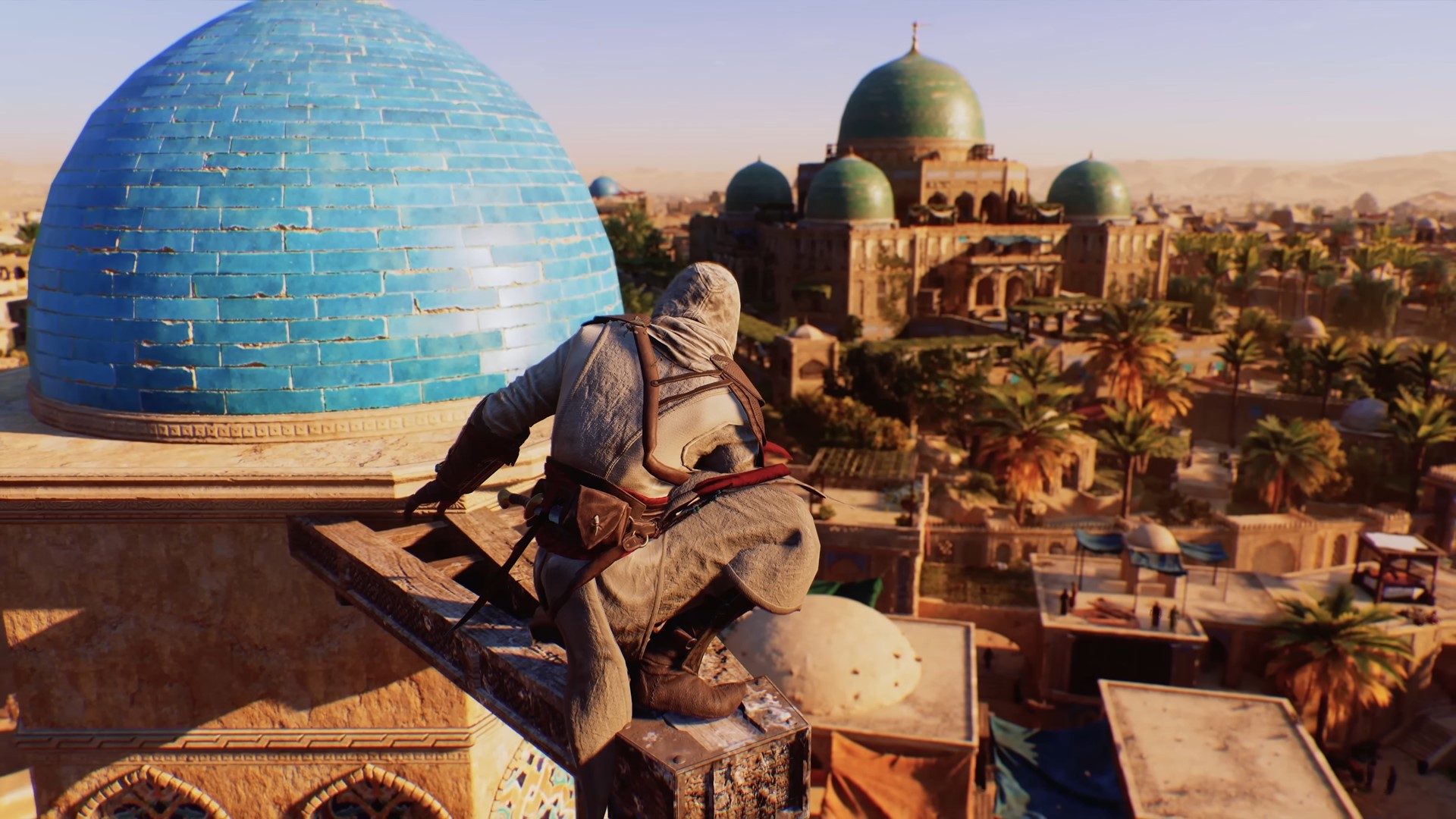 **** This is how many of my favourite computer games work as well: by immersing the player into a world that is so well-crafted and written that it causes a suspension of belief while playing. I have written about this in my posts on open-world games. But it works in other games, too: flying in a flight simulator or driving in a truck sim or a train sim provides the same immersive effect. But for roaming about a virtual Baghdad in the time when the Arabian Nights were set, I highly recommend playing Assassin’s Creed Mirage.
***** A second volume of stories, also translated by Haddawy, called Sindbad: And Other Stories from the Arabian Nights, was released in 2008. These are mostly stories added later by copyists or translators, and not found in the earliest manuscript he used for the first book. Norton also released a “Norton Critical Edition” that included 28 tales translated in his first book. A more recent translation (called a “retelling”) by the Lebanese author Hanan Al-Shaykh was published in 2013. I have both the second Haddawy book and Al-Shaykh’s retelling on order.
Words: 2,309