dailynewsnblog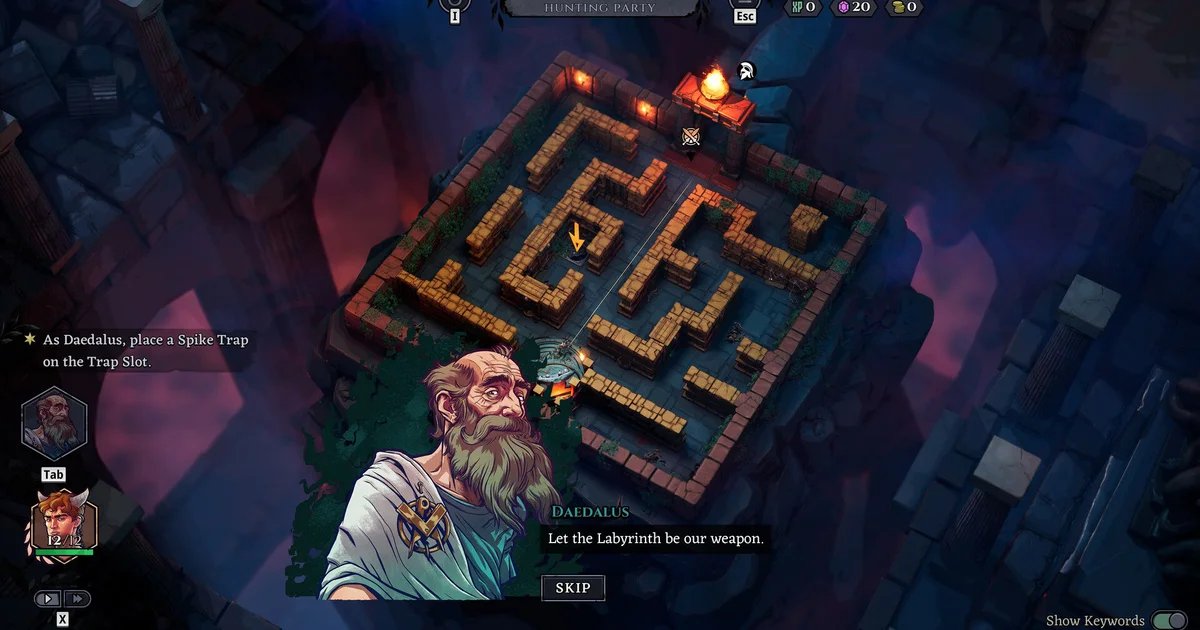
At the center of the labyrinth is a minotaur. He is bound with muscle. He is fearsome. He is… snoring. Asterion, bored with how long I am taking to place my traps, has gone to sleep. This is despite warriors armed with swords and bows lining up at the gates leading into the maze, itching for their chance to battle the bull-headed, human-bodied creature.
Still, even though he is in mortal danger, I, Daedalus, the labyrinth’s designer, am happy for him to sleep. If I do my job in roguelite tower defense game Minos right, my minotaur won’t have to lift a finger to defend himself.
Each level of Minos presents you with a small section of Crete’s famous labyrinth. At its heart is a lair where Asterion the minotaur has set up home. It is my job to reshape the walls of the maze and place traps to kill off any plucky Greeks trying to slay the beast at its center.
In the myths, these adventurers are teenagers, volunteered by their parents to please Minos, the king of Crete. The monarch is embarrassed by the minotaur and wants rid of it. After all, the creature is the only evidence that his wife, Pasiphaë, slept with a bull. It wasn’t just any bull, mind. By all accounts it was a beautiful creature gifted to the king by Poseidon on the condition that Minos would sacrifice it to the sea god. The equivalent of your friend giving you an olive tree as a house warming gift when they know you don’t have a garden, so you’ll have to give it back to them “for safekeeping”. Except, in this example, you decide to hold onto the tree and they cause your partner to get the hots for the shrub and… I don’t know if this analogy is really clearing anything up. Look, let’s just leave it at Minos wants the minotaur dead. You, Deadalus, are helping the minotaur stay alive, and let’s not get hung up on whether you’re killing press-ganged teenagers or not.
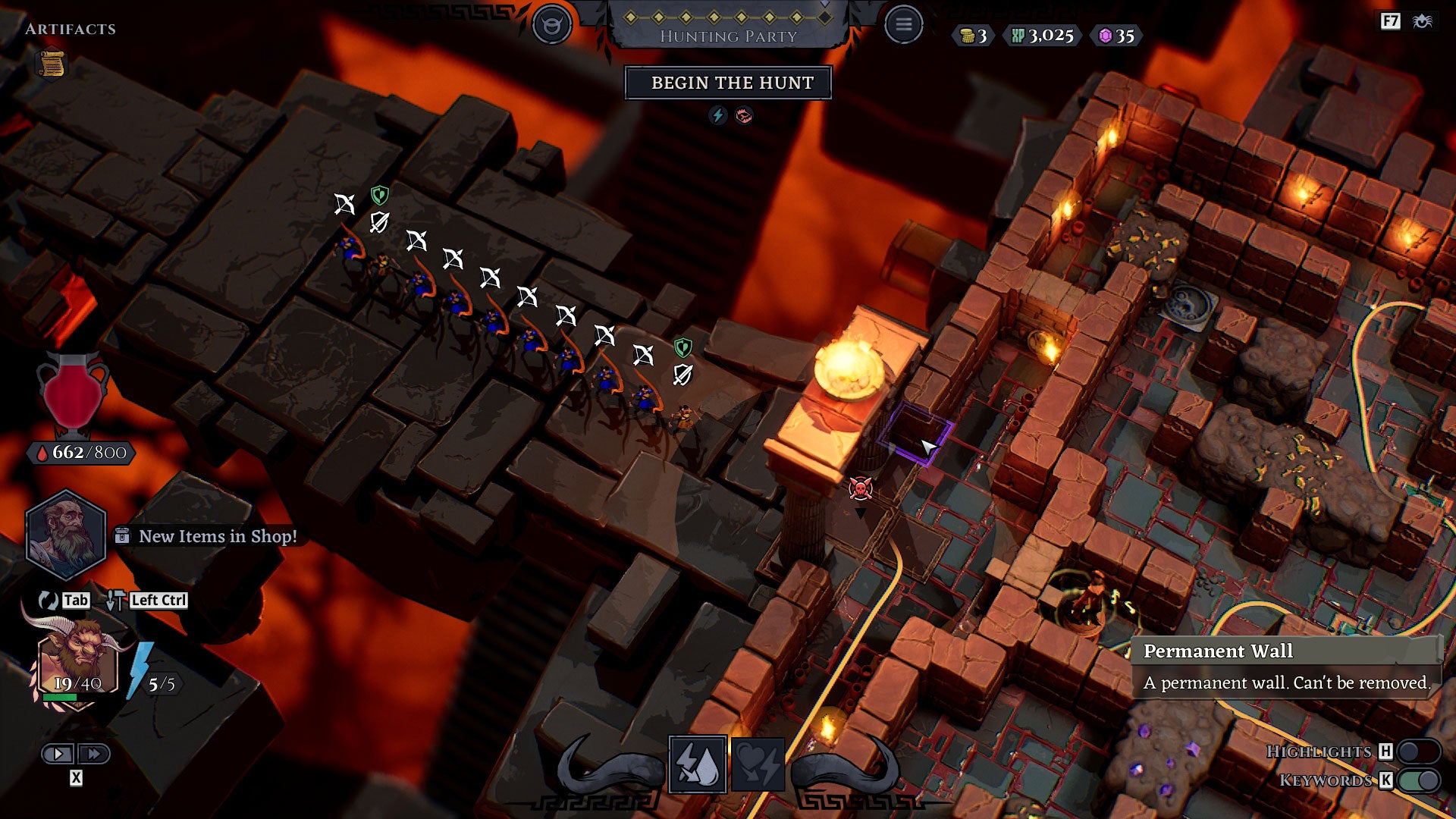
I was drawn to Minos as an Orcs Must Die fan. Any game that lets me fend off waves of incoming enemies with spike traps, fire pits, and deadly seesaws is a winner in my book. And Minos is exceedingly pleasing on that front. As the level starts, eager Greeks line up at the entrances to the labyrinth. A golden thread weaves from their doorway to the labyrinth’s centre revealing the route they’ll take. Dotted around the maze are trap spots where you can place one of the limited killing devices from your inventory. However, as is often the case with those wily Greeks, their initial route may not take them over all that many traps. Luckily, that is where your role as the labyrinth’s creator comes into its own, you can raise and delete most of the walls in the maze, shaping the invaders route to pass over more trap spots.

Say what you like about the Greeks, they’re very well-behaved, only entering the labyrinth when you give them the go ahead. At which point you can watch as they march over your traps, one-by-one, thinning out their numbers. Even if they manage to reach the labyrinth’s centre, Asterion, for all his sleepiness, is still a minotaur, and will easily tear one or two warriors apart. Though, there are bonuses you’ll only receive if you kill all the attackers with traps – so if you can wipe out a wave without Asterion lifting a finger, you should.
While this will all be familiar to Orcs Must Die fans, it builds to a very different experience. In Orcs Must Die, your traps are less deadly – dealing damage rather than outright killing your enemies – and, unlike Minos’s traps, they rearm after use. In Minos, each wave of enemies is more like a puzzle to be solved than a horde to be thinned. If there are six enemies invading the labyrinth, how can you ensure their route takes them over six traps on their way? This becomes much more complicated when you’re dealing with multiple entrances and separate paths to your lair. It’s complicated further still when you face enemies that have resistance to particular trap styles. A firepit will kill a swordsman outright, but it will only severely burn an archer. The main reason Asterion has to wait so long for me to make my move is I am often to be found working out whether an archer entering from one entrance will reach a firepit before the swordsman coming from a different gate. Get it wrong and the singed archer will trigger both the fire trap and the spike trap that follows, clearing the way for the swordsman to reach the lair; get it right and the swordsman will die from the firepit and the archer will be wiped out by the spike trap.
In later puzzles, these calculations can become significantly more complex. I found myself guessing if the burning attacker would survive long enough to walk over the next trap, a spike pit that would only spring after three invaders had passed over it. If the burning swordsman could hold on long enough to walk over the trap then they would prime it to spring when the trailing archer reaches it. Time it wrong and the archer will walk over the trap unharmed. I realise this makes me sound like a monster sat at my PC calculating the burn time of a Theban teenager, but, in my defense, they started it. Sure they were “volunteered” by their parents to be forced into a dark maze to fight a violent half man, half bull, but if we’re fine with Kevin McCallister burning, electrocuting, and crushing the defenceless burglars in Home Alone then we can’t get all high and mighty here…
(A connection developers Artificer already leaned into last December.)

What I’m most enjoying in Minos, however, is that because each new wave mixes up the number and type of enemies coming through each entrance, I am repeatedly pushed to tear up my traps and start again. ‘Now the archer is coming first through that entrance. I need to move the backstabbing spike here, which means the statue that lures people off the path and explodes in their faces has to go here.’ Each map isn’t just a puzzle, it’s a puzzle that reinvents itself before your eyes.
Much of this magic was evident when Mark played the last demo for Minos, but the latest Steam Next Fest demo also showed off the adventure that takes place between each maze level. Success in the labyrinth earns you gems and experience you can cash in to unlock new traps and abilities. Many of these can be paired in ingenious ways. For instance, you can build hidden doors into your mazes, which Asterion can use but the attackers can’t detect, and you can teach the minotaur to reactivate traps after they’ve triggered. In theory two unlocks can be used together by creating a little hidden chamber alongside the attackers’ path, next to a spike trap. After the spikes are triggered once, you can send your minotaur out to reset the trap, then duck back into the hidden chamber and wait for the next nervous teenager to come by.
I say in theory because I’m loving the challenge of completing each level of the labyrinth without moving the minotaur an inch. Let the boy sleep, he’s had a hard enough time after being cast out of the house by his step dad. Leave the home security to Daedalus. After all, I’m at least a smidge responsible for his current predicament, what with me making the wooden cow suit Asterion’s mother used to attract the bull in the first place. I could hardly look my son in the face if I left Asterion to his fate. That is, if my son, Icarus, weren’t already locked away in a tower working on a set of wax wings he’ll use to fly to freedom. I’m sure that’ll end well for him.
What’s that I hear? Another batch of teenagers has entered the maze? No time to talk, I need to sharpen the spikes on this trap and make sure the fire pit’s been topped up with kerosene.