dailynewsnblog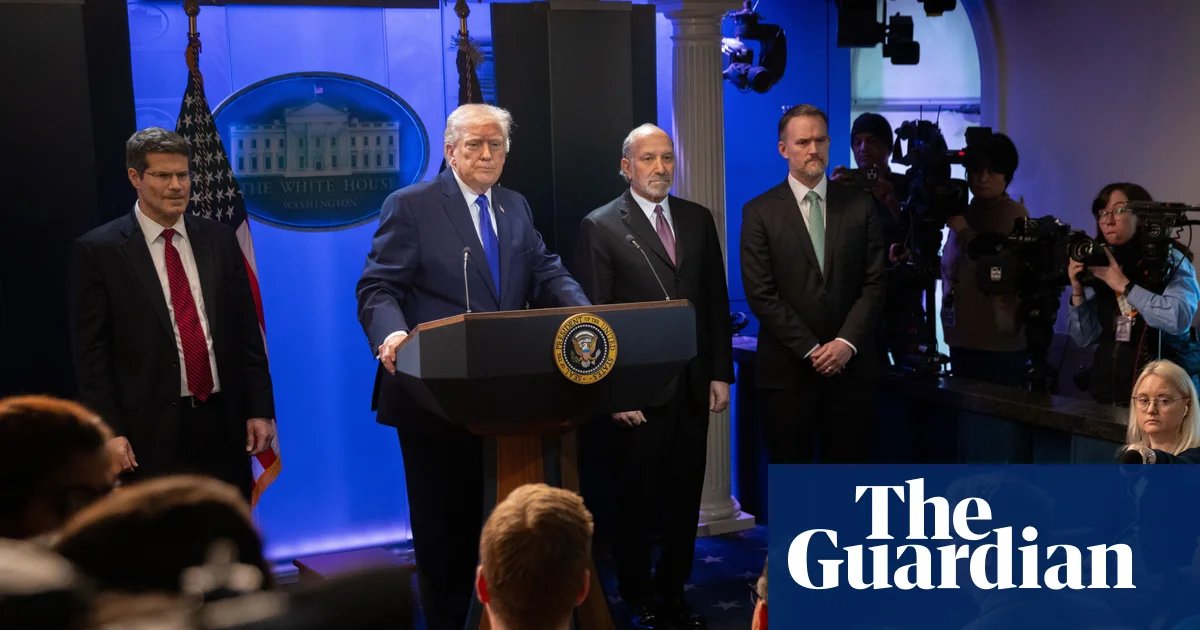
After an agonising year in which the US supreme court has stood aside and watched while Donald Trump has run roughshod over the constitutional separation of powers, the highest judicial panel has finally stirred itself to set boundaries on the president’s increasingly regal pose.
Friday’s supreme court ruling declared Trump’s sweeping tariffs unlawful, yanking from the president the bloodied cudgel which he has used to beat foreign friend and foe alike.
With midterm elections just nine months away, Trump has also been deprived of a key weapon in his second-presidency armory.
“At last,” exclaimed Barb McQuade, a law professor at the University of Michigan. The court had remembered “that Congress is a separate and co-equal branch of government … One of Trump’s favorite levers is removed from the arsenal of extortion.”
The ruling came as a jolt, and Trump wasted no time venting his fury against the justices who had defied him. He denigrated them on social media in an all-caps personalised attack that was extraordinary, even by his norm-shattering standards.
The three liberal-leaning justices who were part of the majority ruling were “FOOLS” and “LAPDOGS”, the six who had voted against his tariffs were universally beholden to foreign countries, while the three rightwingers who dissented were imbued with “strength, wisdom, and love of our Country”.
Trump’s rant belies the truth of the current supreme court – that so far into his second presidency it has largely given him everything he has desired. Over the past year the conservative justices who command a super-majority, dribbling out their opinions in bits and pieces, have provoked mounting alarm among constitutional jurists and democracy advocates.
Even before Trump had returned to the White House, they had granted him the authoritarian’s gift of Trump v US. The ruling gave him absolute immunity from criminal prosecution for official presidential acts, or as some observers framed it, the “power of a king”.
During his first year back in office, the court has issued 24 temporary rulings on its opaque “shadow docket”. Collectively, these emergency decisions have given the benefit of the doubt to Trump, overturning many brave efforts by lower court judges to contain him.
Several of those rulings allowed Trump, at least in the short term, to trample over powers reserved for Congress, such as restrictions on the president’s power to fire the heads of government agencies.
Friday’s tariff ruling pulls back from that abyss. Learning Resources v Trump dismisses Trump’s invoking of the International Emergency Economic Powers Act (IEEPA) as justification for his global tariffs.
The legislation did not give Trump the authority to impose tariffs, the ruling bluntly states. Tariffs are taxes, and the power of taxation, is solely bequeathed to Congress as the keeper of the nation’s purse.
Students of the top court will spend the coming weeks and months poring over the ruling’s finer details for clues as to the swirling currents of power among the nine justices.
Already, some pointers are clear.
First off, John Roberts is back. The rightward drift of the court, combined with critical rulings like the anti-abortion Dobbs in which Roberts found himself in the minority, led some to wonder whether the chief justice was losing his grip over his own court.
Friday’s ruling sees the chief justice back in the driving seat, both as author of the tariffs ruling and as architect of its unexpected 6-3 voting composition. Not the 6-3 to which America has grown painfully accustomed: six conservatives to three sorely-outgunned liberals.
It’s a 6-3 in which Roberts was joined by two fellow rightwingers, in an alliance with the three liberal-leaning justices, to deliver Trump a collective bloody nose.
Those two other rightwingers are boomingly significant. Both of the conservatives who followed Roberts into the majority were placed on the court by none other than Trump.
Neil Gorsuch took over the late Antonin Scalia’s seat in 2017 after almost a year in which senate Republicans held the position open, depriving Barack Obama of his pick. Amy Coney Barrett was chosen by Trump in 2020 following the death of the liberal icon Ruth Bader Ginsburg.
That two out of his three supreme court nominees turned their back on him inflamed Trump’s response to the ruling. In a White House press conference shortly after the judgment came down, he singled out his nominees who, from his narcissistic perspective, have betrayed him.
Trump is certainly not the only US president to have thrown a hissy-fit at supreme court justices who had the temerity to uphold the rule of law. But the way he expressed such thoughts openly and in public, pitched in such personal and vitriolic terms, that places him in a class of one.
“I think their decision was terrible,” he said, referring to Barrett and Gorsuch. “I think it’s an embarrassment to their families.”
Of the two, Barrett’s vote is the least surprising. Over the past five years, she has displayed an independent streak that has seen her forge agreement with the liberal-leaning justices on several occasions.
Gorsuch’s stance is more jarring, and will take time to process. In almost a decade on the top court he has been reliably conservative, forming a new wedge of hard-right jurisprudence along with those other crusty hardliners, Clarence Thomas and Samuel Alito.
His vote with the majority says more perhaps about Trump’s excesses than it does about Gorsuch’s brand of conservatism. The president’s disdain for constitutional inconveniences, his tendency to blow raspberries at the other supposedly co-equal branches of government, can rile one as avowedly committed to the original meaning of the constitution as Gorsuch.
“Whatever else might be said about Congress’s work in IEEPA, it did not clearly surrender to the President the sweeping tariff power he seeks to wield,” the justice writes in his concurring opinion.
How this new 6-3 configuration will play out in the longer term is another matter for scrutiny. Its existence does suggest that some of Trump’s other clearly unconstitutional actions are also vulnerable, notably his attempt to destroy birthright citizenship as enshrined in the 14th amendment.
Friday’s ruling puts Trump on notice. Though the president responded to the ruling as though he were impervious, immediately announcing a new raft of tariffs under different legislative authority, the court has made itself clear: there is a limit.
But those tempted to be starry-eyed about this juncture should also be put on notice. There is a limit too to the supreme court’s beneficence.
As Lisa Graves, an expert on the rightwing legal movement, put it: “This ruling is not judicial courage. This is the Roberts court doing the bare minimum to rein in Trump’s abuse of power.”