dailynewsnblog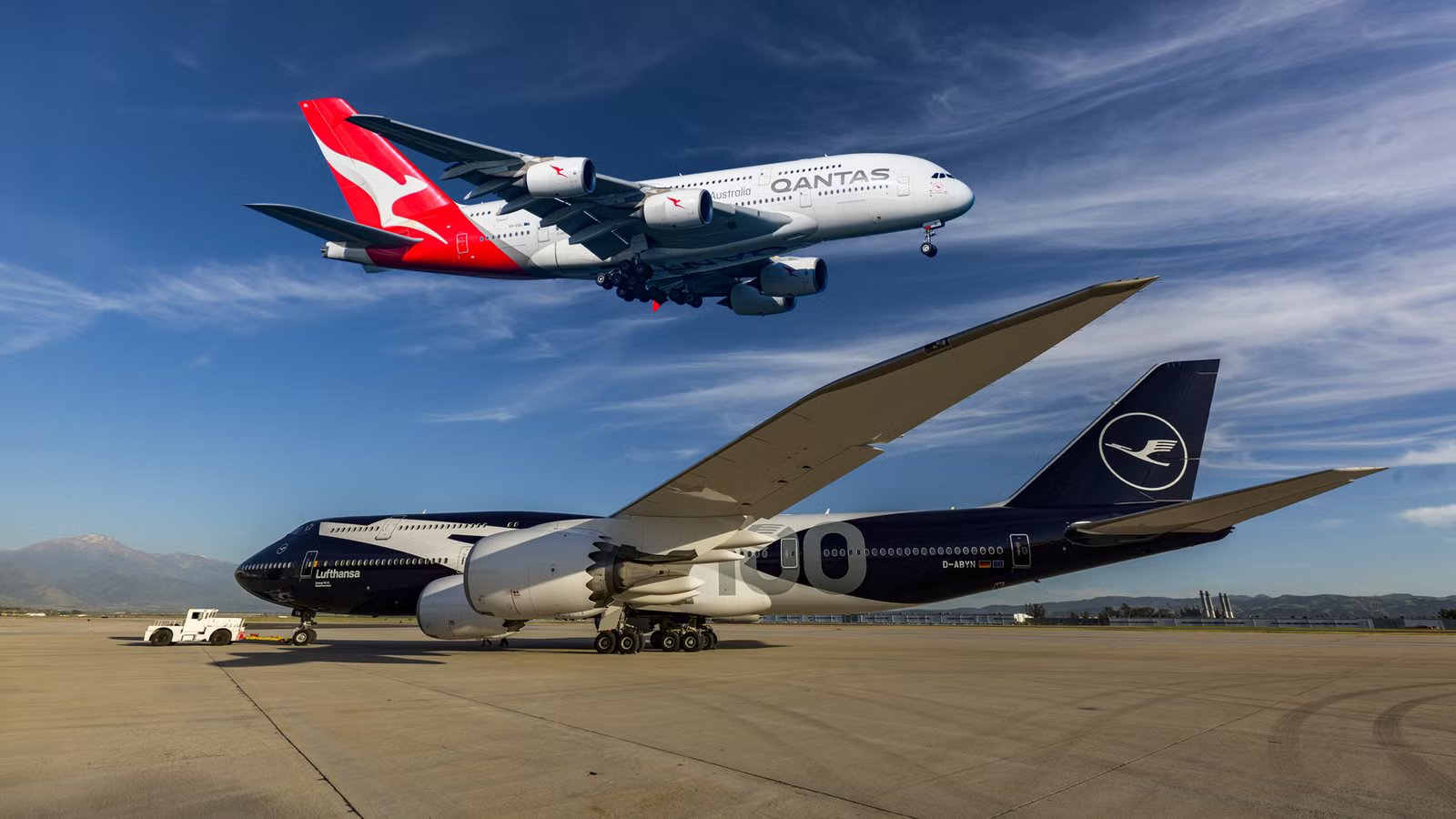
The Boeing 747-8 and Airbus A380 are both comparatively modern quadjets, regarded as the last laugh of the superjumbo. They brought unprecedented size and efficiency to a hub-and-spoke model that has been made obsolete by the emergence of incredibly efficient and long-range twin-jet widebody aircraft.
Below, we compare the two jets by a number of their characteristics. This includes their size, weight, capacity, engines, and pilot experience. This article concludes with reflections on why these aircraft are increasingly irrelevant in the post-pandemic aviation industry.
Weight & Payload

The clearest difference between the 747-8 and the A380 is that the latter is a larger and heavier aircraft. The 747-8’s maximum takeoff weight (MTOW) is an enormous 987,000 lbs (448 tons), and its maximum landing weight (MLW) is 688,000 lbs (312 tons). Its operating empty weight (OEW) is 485,300 lbs (220 tons). Airbus pushed aviation significantly closer to its limits, building an aircraft achieving an MTOW of 1,268,000 lbs (575 tons), an MLW of 868,000 lbs (394 tons), and an OEW of 610,200 lbs (277 tons).
The difference in size is reflected in each aircraft’s maximum payload, with the 747 able to carry 167,700 lbs (76 tons) compared to the A380’s 209,700 lbs (95 t). Similarly, the A380 can carry far more fuel at 572,700 lbs (323,546 liters), while the 747-8 can carry 422,300 lbs (238,610 liters). This extra fuel doesn’t translate to a higher range, given the far higher weight of the A380.
Despite the A380’s far bigger size and more recent release date as a clean-sheet airframe, the materials used are fairly similar. Modern aircraft like the Airbus A350, Boeing 787, and Boeing 777X use composites, greatly reducing weight and allowing the airframe to be more pressurized. Meanwhile, the A380, like the 747-8, is made largely of aluminum.
Aircraft Cabin And Capacity

As expected, the A380 has a much larger cabin that can carry more passengers. The A380 is actually a shorter aircraft at 238 feet and 7 inches (76.25 meters) compared with the 747-8’s 250 feet 2 inches (72.7 meters). However, the A380 is a true double-decker throughout the fuselage, while the 747 has a double-decker hump, accounting for 20-30% of the main deck’s length. This resulted in the 747-8 having a much lower capacity than the A380.
The 747-8 can carry up to 605 passengers, or 467 in a typical three-class layout, with the actual number of passengers carried closer to 365. Meanwhile, the A380 has an astonishing maximum capacity of 853 passengers, with 525 advertised for a three-class layout and an actual operational capacity of around 480.
However, carriers don’t fly their aircraft in layouts that match what manufacturers advertise is possible. Lufthansa flies its A380s with 509 seats available, compared to the 469 seats available on British Airways’ A380s. On the 747-8,  Lufthansa offers 364 seats, Korean Air offers 368, and Air China offers 365. The additional A380 space also allows carriers to be more ambitious with their premium products.

Is A Boeing 777X Bigger Than An Airbus A380?
The size of the Boeing 777X explained, and what it means for the “minijumbo’s” future.
The A380-900 Would Have Further Widened The Gap

When Airbus first proposed the A380, it never planned for all of the aircraft in the family to be A380-800s. The European manufacturer wanted to offer its customers a longer A380-900. This variant would have boosted capacity by being able to carry an extra 100 passengers. Rumors even circulated that an Airbus A380-1000 was on the cards, pushing the jet’s capacity up to 1,000 passengers.
The table below details the astonishing specifications that the A380-900 could have had:
|
Typical three-class seating: |
650 passengers |
|
Length: |
260 feet 9 inches (80 meters) |
|
Stretch over -800: |
21 feet (6.4 meters) |
Low orders and production difficulties led Airbus to shelve the A380 stretch plans in 2010. It had only been able to deliver 10-12 examples to its customers each year. The carrier’s engineers were already exceedingly busy working on the new A350, A320neo, and A400M Atlas, without the time to spend on a project that didn’t seem like it would be popular.
A380 Vs 747 Engines

Both the 747 and the A380 are powered by four huge jet engines. As expected, given its larger size, the A380 uses more powerful engines. The 747 uses four General Electric GEnx-2B67 high-bypass turbofan engines, producing 66,500 lbf (296 kN) during takeoff, with a bypass ratio of 8.0. That gives the aircraft a total takeoff power of 266,000 lbf (1,184 kN). Interestingly, the 747-8 engines are less powerful individually than the other GEnX variants, which are used to power the twin-jet Dreamliner. Meanwhile, the A380 has a max thrust per engine of 70,000-81,500 lbf (311-362 kN), giving the aircraft a total power of 280,000-326,000 lbf (1,244-1,448 kN).
Both the A380 and 747-8’s engines have significant advancements to make them more powerful and efficient than previous examples. The 747-8’s engines are 10% more powerful than the Boeing 747-400’s. After the GEnx achieved 70,000 lbf in testing, Ross R. Bogue, vice president and general manager, 747 program and Everett site for Boeing, commented: “The GEnx-2B engines serve a critical role in the efficiency gains offered by the 747-8 family… [to] provide our customers with improved fuel efficiency, reductions in emissions and noise, while allowing customers to generate additional revenue.” Both engines shared some features, such as nacelles designed and produced by Safran.
A notable difference between the two aircraft’s engines is that the 747-8 is powered exclusively by General Electric’s GEnx engine. Meanwhile, Airbus gave passengers a choice. Customers could choose between Rolls-Royce’s Trent 900 and Engine Alliance’s GP7200. The latter was created by a GE Aerospace-Pratt & Whitney partnership. Airbus made this decision to spread the risks attached to such a revolutionary aircraft. Problems with one type of engine wouldn’t derail the entire program. Offering two engines also gave the A380 a broader customer base, with the GP7200 offering immense power, while the Trent 900 had the edge in terms of reliability and maintenance. It is now uncommon for widebody aircraft to be built without an exclusive engine, due to the incredibly high costs of developing aero engines.

Airbus A380 Vs. Boeing 747: How Do They Compare On Ultra-Long-Haul Flights?
Does it make a significant difference to to choose one aircraft or another for a long flight? If so, that’s the thing, which is the best airliner?
The Pilot’s View: Sidestick Fly-By Wire Vs Yoke Conventional Systems

The experience of flying these superjumbos also comes with notable differences. The A380 has a sidestick control found on the outer side of the pilot’s seat. These sidesticks send electronic signals to the jet’s flight computer, which operates the controls. There is no mechanical link between the two sidesticks, so communication is essential to avoid giving the aircraft contradictory inputs.
The sidestick control philosophy is reflected across the entire Airbus fleet, while Boeing aircraft, including the 747, make use of a traditional yoke mounted centrally in front of each pilot. These yokes are connected to the jet’s control surfaces and to each other mechanically and hydraulically. That gives pilots a more direct connection to the aircraft that they are flying.
The A380 is also more advanced in how a pilot’s inputs translate into the aircraft’s movements. The A380 is a fly-by-wire aircraft. All control inputs are electronically transmitted to the flight computer and control surfaces. En route, the pilot’s commands are augmented by automation. This technology prevents the pilots from exceeding the jet’s limits, such as making it stall, banking excessively and going beyond the plane’s aerodynamic capabilities. The Boeing 747 connects the pilots to the control surfaces directly, allowing them to get better feedback on flying conditions. For example, turbulence that moves control surfaces will be reflected in the yoke’s position.
The Decline Of Quadjets

The A380 and 747-8’s success relied upon demand for hub-to-hub aviation, incredibly high passenger numbers, and cheap aviation fuel, given the vast amount of kerosene consumed by quadjet aircraft. Carriers could feasibly follow this strategy and profitably fly superjumbos before the COVID-19 pandemic.
The market space shrank enormously after the pandemic as efficient long-haul twin-jet widebody aircraft like the Airbus A350 became increasingly popular. These planes can land at smaller airports, yielding far higher flexibility through point-to-point operations. The A380 ceased production in 2021, and Boeing stopped building the 747-8 in 2017, while the last freighter variant rolled off the production line in 2023. It is notable that the next generation of these planes, the Boeing 777X, will remain a twin jet despite being enormous, indicating we have likely seen the last of the quadjet. Incredibly long ETOPS ratings have also eliminated the safety argument for flying superjumbos.
It wasn’t just the unfashionable nature of quadjets that pushed the A380 and 747 out of production. These aircraft were startlingly conventional, built from traditional materials like aluminum. The contribution of composite materials used by the current generation of twin jets was meager. Aviation Week reflected in 2021, “Airbus’ achievement in the A380 was mainly to be able to build something that big.”