dailynewsnblog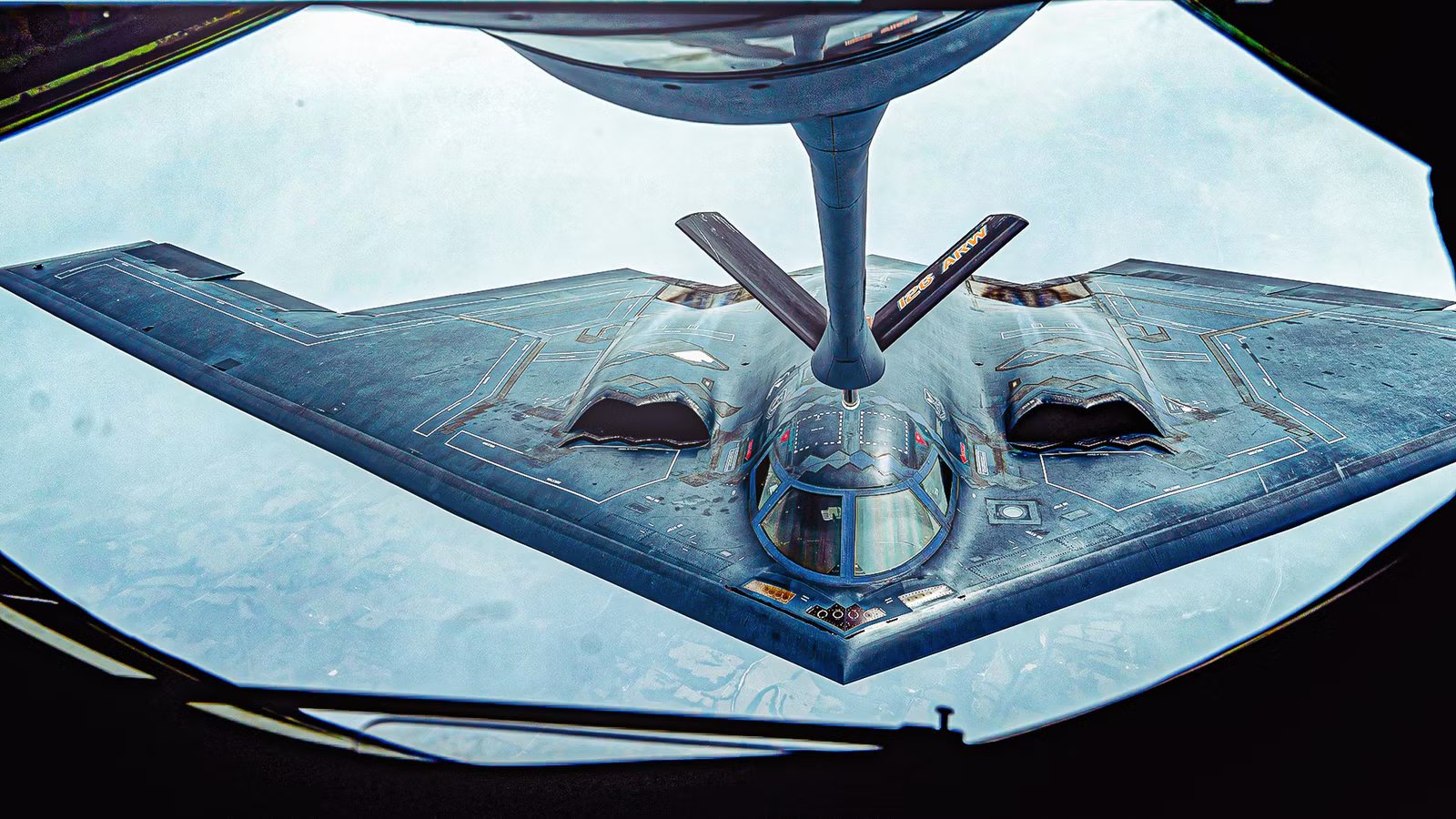
The Rockwell B-1B Lancer and B-2 Spirit bombers are designed with different design philosophies and mission sets, and this is seen throughout their designs. They are both built to counter the increase of Soviet air defenses in very different ways. It is often meaningless or misleading to focus on attributes like speed and payload without considering the wider context or how they can be used.
For example, Russia’s Tu-22M3 and Tu-160s are both capable of supersonic flight, but there is no evidence they are being used in that capacity at all in the current conflict. In the real world, they are both being used as subsonic missile trucks launching munitions from afar. This article will examine the B-1B Lancer and B-2 Spirit from the point of view of what they were intended to do and how they were to do it, and then how that relates to their physical design.
From The B-52 To The B-1A Lancer

To understand the B-1B and B-2, one must first understand the bombers that came before them and the problems they were designed to address. The B-52’s design commenced right after the end of WWII. It was built as a subsonic high-altitude bomber at a time when air defenses were limited or primitive. The Air Force acquired around 744 B-52s to provide the mass needed to sustain losses and brute force their way through airspace defended by enemy fighter jets. At this time, bombing was imprecise, and volume was needed.
The XB-70 Valkyrie first flew in 1964 and was built to overcome the vulnerability of the slow B-52. It relied on speed (Mach 3) and altitude (70,000 feet) to overcome the growing threat of enemy fighter jets. It was to fly higher and faster than the aircraft trying to take it down. However, by the time it was developed, it was already rendered obsolete by the development of Soviet radar-guided SAMs (SA-2s). Its speed and altitude were unable to save it.
The B-1A first flew in 1974 and was the first variant of the Lancer family. It was designed as a high-speed (Mach 2.0) terrain-following aircraft designed to carry out penetration strikes. Instead of flying high and out of reach of threats, it was to fly under the radar, dashing in and out before it could be intercepted. But it, too, became obsolete by the development of improved look-down/shoot-down radars. While its cost and the development of ICBMs made it less imperative.
B-1B Lancer Bomber: A Hybrid

As time went on, the Air Force looked increasingly to stealth for survivability, and it began work on what would lead to the B-2 Spirit. As an interim, the canceled B-1A Lancer was resurrected, but with major modifications. The B-1B first flew in 1984, and it was more of a hybrid that sought to combine emerging low observability with low altitude and a large payload. Its speed was reduced to Mach 1.25 with the design instead emphasizing low-observability.
The massive B-1B bomber was built with a radar cross-section of around one meter. It was designed to penetrate Soviet air defenses at low altitude and carry out very low altitude penetration missions. Later, it was adapted for precision conventional strikes. The logic behind its design was to increase survivability by delaying detection through its reduced radar signature, map-of-the-earth flight profile, and electronic warfare.
|
Rockwell B-1B Lancer |
Northrop B-2 Spirit |
|
|---|---|---|
|
Number produced |
100 (plus four B-1As) |
21 |
|
Number in service |
45 |
19 |
|
Top speed |
Mach 1.25 |
Mach 0.95 |
|
Radar cross-section (est.) |
1.0-10.0 m2 |
0.0001 m2 |
|
Payload (official) |
70,000 lbs (31,751 kg) |
40,000 lbs (18,143 kg) |
|
Primary initial role |
Low-level penetrator |
Stealth precision penetrator |
The B-1A Lancer never entered operational service; all four produced were used as testbed aircraft. The Air Force built 100 B-1B bombers as a stopgap until a proper stealth bomber could enter service. It should be noted that its role has since changed, as it would not be survivable in modern, highly contested airspace. Instead, it is used as a “heavy sniper” for close air support operating in permissive environments.

The Unique Jet Engines Powering The USAF B-2 Spirit
Much of the B-2 program is on a classified level, what we do know about the aircraft and the power plant driving this aircraft is truly remarkable.
B-2 Spirit: The First Stealth Bomber

The B-2 Spirit is subsonic and represents a fundamental break from older bomber designs. It is a true all-aspect stealth bomber designed to rely on its stealth, as well as advanced mission planning and electronic warfare, to penetrate air defenses, carry out its strikes, and leave without being detected. With the B-2, the Air Force sought to penetrate the most advanced integrated air defense systems and deliver precision strikes. It was also the first aircraft designed to operate at night.
This was on display in 2025 during Operation Midnight Hammer as the B-2s flew into the heart of Iranian airspace and struck Iranian nuclear facilities. Despite the mission’s name, the B-2 is to act more as a surgical scalpel, rather than the massed hammer offered by older aircraft like the B-52 (e.g., in Operation Linebacker II over Vietnam).
The B-2 not only abandoned speed, but also low-altitude flight. It is designed to strike high-value targets without being detected. The Spirit has a speed of around Mach 0.95. The incoming Northrop Grumman B-21 Raider is a next-generation evolution of this concept and is seen as the future of strategic bombing. Meanwhile, China is also developing its analogue, the Xi’an H-20 bomber, while Russia is unable to and is instead falling back on its old Tu-160 design.
The B-1B Lancer’s Heavy Payload

As stated, these design philosophies have resulted in radically different designs. The Lancer is supersonic, the Spirit is subsonic. The Lancer flies high, the Spirit flies low. Being a ninja designed to sneak in and take out high-value targets with precision munitions, the B-2 also doesn’t require the same payload.
The B-2 has an official payload capability of 40,000 lbs (18143 kg), while the B-1 can carry 70,000 lbs (31,751 kg). However, there is some nuance to these numbers. The B-2 is able to carry two GBU-57A/B MOPs (~30,000 lbs each) for a payload of around 60,000 lbs (27,215 kg). The trade-off is likely that the aircraft is unable to carry its full load of internal fuel, meaning it will need to conduct in-air refueling more often. The 70,000 (31,751 kg) lbs payload is likely close to the B-1’s structural limit.
The high payload of the B-1B is still very useful to the Air Force, but how it is used and the missions it is suitable for are different from the B-2. The new B-21 is to be even smaller, with a reported maximum payload of around 30,000 lbs (could be higher in reality). The smaller profile of the B-21 highlights its role in performing surgical strikes.

How Many B-2 Spirit Bombers Does The US Air Force Fly?
The aircraft might be the Air Force’s deadliest weapon.
Variable Sweep Wings Vs Flying Wing

The B-1B Lancer is a variable-sweep wing aircraft, while the B-2 is famously the world’s first stealth flying wing bomber. These designs come with ups and downs. The B-1B was built as a variable geometry aircraft due to its mission requirements and the period’s aerodynamic limits, not so much the absence of fly-by-wire controls, which were already available when the aircraft was designed.
It was built with three mutually conflicting requirements, namely, long-range subsonic cruise, map of the earth penetration, and supersonic dash. This was not possible at the time with fixed-wing aircraft, particularly with a heavy payload. Today, this is having a negative effect on the airframes. The variable geometric design is wearing the airframes out, and the Air Force is struggling to keep them airworthy until the B-21 arrives.
As the Lancer airframes wear out after decades of use, the Air Force’s B-52 airframes have plenty of life left in them, and they are being upgraded to serve through the 2050s. By contrast to the B-1B, the B-2’s mission requirements are narrower as it did not need supersonic flight or low-attitude penetration and was able to penetrate at medium altitude. The B-2 fleet does not display the same level of airframe fatigue as the B-1Bs.
Unique Bombers & Evolving Roles

It is also worth comparing the B-1B with the world’s other two variable geometry bombers, the Soviet (now Russian) Tu-22M3 and Tu-160. The Tu-22M3 was designed as a maritime strike aircraft to deliver large anti-ship missiles against US carriers and the like. It was not designed as a strategic bomber in the same sense as the B-1B. The Tu-22M3 was designed for missiles, not bombs.
While all these bombers were designed for a nuclear mission as well as conventional, the Tu-160 was explicitly designed as a prestige strategic nuclear delivery system and operated outside of dense air defense with long-range missiles. Of the in-service US and former Soviet bombers, the closest mission match is the B-52 and Soviet Tu-95.
Today, the B-1B Lancer is no longer useful in its original role as a penetrator in a high-end, peer-on-peer conflict. Instead, it has become a missile truck (like the B-52). Its advantage is now its heavy payload and ability to operate with standoff missiles. It is also used as a testbed and in an anti-ship role. Only 45 B-1Bs remain in service with retirements expected to start in fiscal 2028 and complete by fiscal 2032. Meanwhile, the B-2 remains the only bomber realistically able to carry out penetration missions, even if its advantages have eroded over time. The B-21 is intended to restore the B-2’s former “impunity.”