dailynewsnblog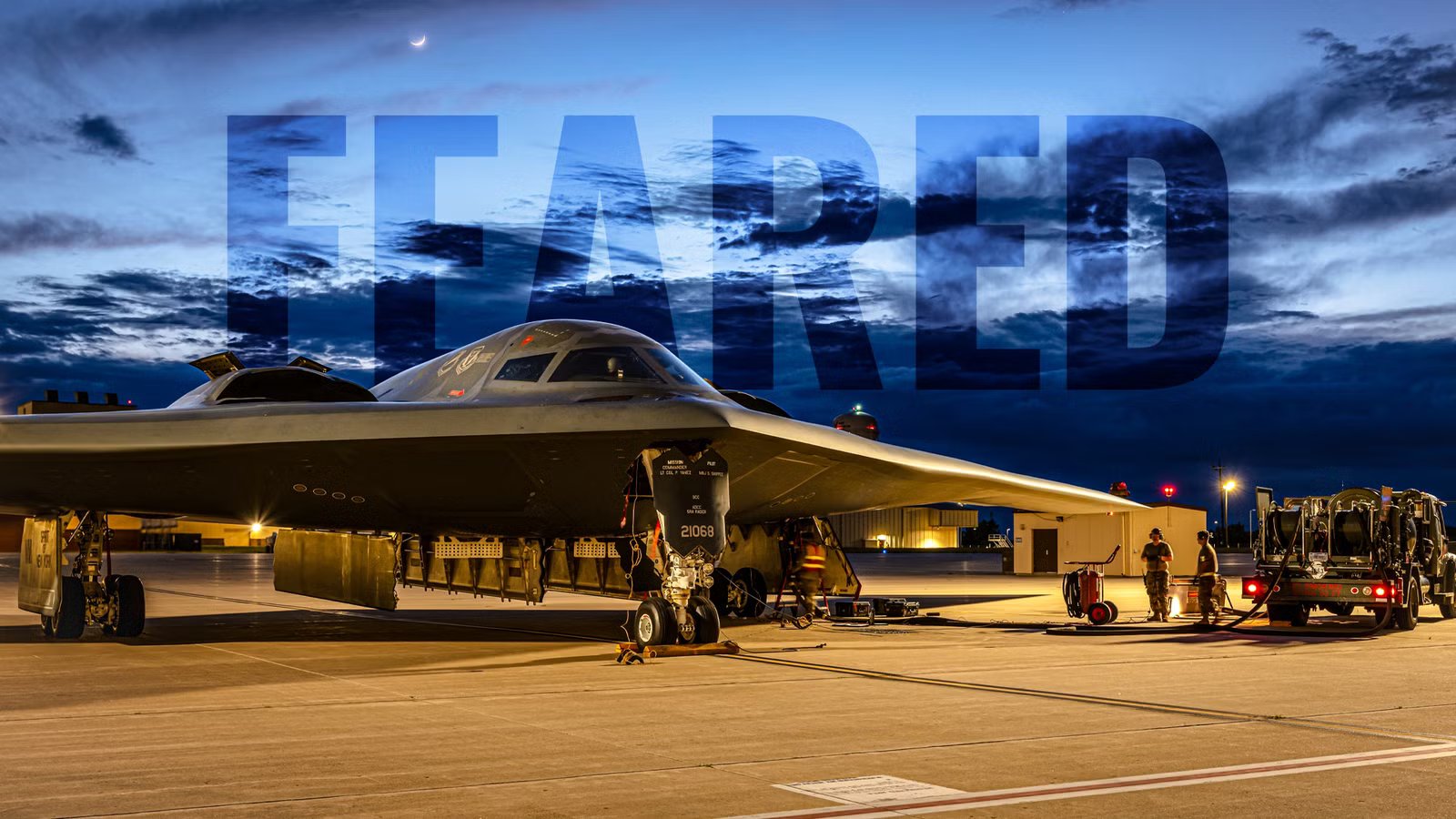
The Northrop Grumman B-2 Spirit is one of the most recognizable and enigmatic aircraft ever built. More than three decades after it first entered service, the stealth bomber continues to attract global attention whenever it deploys or appears in official imagery. Unlike most military aircraft, the B-2 is rarely seen and rarely discussed in detail. Despite not being that new, the B-2 remains one of the most closely watched military aircraft in the world.
This guide examines why the B-2 Spirit Bomber has earned its reputation as the most feared aircraft in the world. Rather than focusing on the mythology around it or costs, we will look at the aircraft’s design philosophy, operational use, and strategic impact to explain why it remains such a powerful tool in modern airpower. The B-2 is feared not because it is fast or heavily armed in a conventional sense, but because it represents something far more unsettling in modern warfare: the ability to strike anywhere, at any time, with little warning and limited opportunity for defense.
Cold War Origins Of The B-2 Spirit

The B-2 Spirit was conceived during the final decades of the Cold War, when strategic airpower faced the United States faced a very real strategic problem. By the late 1970s and early 1980s, the Soviet Union had developed dense, layered air defense networks at a level of sophistication that seriously threatened the survivability of existing US bombers and reconnaissance aircraft.
Platforms like the  BoeingB-52 Stratofortress initially relied on altitude, and later on low-level tactics, electronic countermeasures, and standoff weapons to survive. However, advances in radar technology, surface-to-air missiles, look-down/shoot-down interceptor aircraft, and integrated command and control networks meant that these advantages were steadily eroding.
US defense planners concluded that future bombers could no longer rely on speed, altitude, or electronic warfare alone. To survive against modern air defenses, an aircraft would need to avoid detection altogether. This realization led to the launch of the Advanced Technology Bomber program, which placed low observability at the center of its design philosophy. Rather than attempting to defeat air defenses through brute force, the goal was to bypass them entirely.
The resulting aircraft, which would become the B-2 Spirit, was purpose-built to penetrate the most heavily defended airspace on the opening days of a conflict. From the outset, it was intended to strike targets that other aircraft could not reach, shaping the battlefield before conventional forces ever entered the fight.
B-2 Stealth: A System-Level Design

What truly distinguishes the B-2 Spirit from other military aircraft is its approach to stealthiness. The aircraft doesn’t rely on a single technological solution, but its low observability is the result of a system-level design philosophy that influences its shape, construction methods, materials, and even how it is operated.
The B-2’s distinctive flying- wing layout eliminates vertical stabilizers, minimizes sharp edges, and aligns surfaces to scatter radar waves. Engine intakes and exhausts are embedded within the wing to reduce heat and radar signatures. Radar-absorbent materials cover much of the airframe, and seams, access panels, and control surfaces are precisely aligned to prevent radar reflections. Engine intakes and exhausts are buried within the wing to reduce both infrared and radar signatures. Even maintenance procedures are adapted to preserve stealthiness.
According to Stealth Warplanes by Doug Richardson, the B-2’s radar cross-section equals roughly 1.1 square feet (0.1 square meter), comparable to a small bird, though the Air Force keeps exact figures classified. Infrared suppression further reduces the aircraft’s visibility to heat-seeking systems. Electronic countermeasures are also integrated to complicate tracking by modern air defense networks.
|
Category |
Details |
|
Crew |
2 (pilot and mission commander) |
|
Length |
69 feet (20.9 meters) |
|
Wingspan |
172 feet (52.4 meters) |
|
Height |
17 feet (5.1 meters) |
|
Empty Weight |
~158,000 lb (71,700 kg) |
|
Max Takeoff Weight |
~336,500 lb (152,200 kg) |
|
Powerplant |
4 × General Electric F118‑GE‑100 turbofans, ~17,300 lbf each |
|
Maximum Speed |
High subsonic (~Mach 0.95) |
|
Service Ceiling |
~50,000 ft (15,200 meters) |
|
Unrefueled Range |
~6,000 NM (11,100 kilometers) |
|
Global Reach |
Extended with aerial refueling |
|
Payload Capacity |
40,000 lb (18,144 kg) |
|
Primary Radar |
AN/APQ‑181 multimode radar |
|
Armament: Conventional |
JDAMs (GBU‑31/GBU‑38), cluster bombs, JSOW, JASSM-type missiles |
|
Armament: Specialized Munitions |
GBU‑57A/B Massive Ordnance Penetrator (up to two) |
|
Armament: Nuclear |
B61 and B83 gravity bombs (internal) |
Sources: US Air Force Fact Sheet, Airman Magazine, Global Supply Chain Council
Modern integrated air defense systems struggle to reliably detect, track, and engage the B-2 Spirit, especially when the aircraft operates at night and at high altitude. This level of survivability allows the bomber to fly directly over heavily defended territory rather than avoiding it, significantly reducing the need for escort fighters, dedicated electronic warfare platforms, and the large support packages typically required for conventional strike aircraft.

Trump Orders “Large Number” Of Enhanced B-2 Bombers
A bold move that could reshape America’s long-range strike power. What’s behind this unexpected order?
Global Reach And Intercontinental Range

Stealth alone does not explain why the B-2 Spirit is such a feared strategic asset. Its ability to reach targets anywhere on Earth is equally central to its role. From the outset, the aircraft was designed for global operations, capable of launching intercontinental missions directly from the continental United States without relying on forward bases.
The B-2 has an unrefueled range of approximately 6,000 nautical miles (11,112 kilometers). When supported by aerial refueling, its operational reach becomes effectively global. In combat operations, B-2 crews have flown missions lasting more than 40 hours, among the longest sustained sorties in military aviation, with multiple refueling events conducted en route. These ultra-long-range missions have been flown from Whiteman Air Force Base in Missouri to targets in the Balkans, the Middle East, and Central Asia. In several cases, the aircraft struck targets and returned to the United States without landing at overseas bases, demonstrating the bomber’s ability to project power independently across continents.
This global reach eliminates many of the political, diplomatic, and logistical challenges associated with forward basing. It also reduces the vulnerability of host-nation facilities, which can become targets themselves during a conflict. As a result, the B-2 allows US planners to retain strategic flexibility while minimizing exposure to regional constraints.
Precision Strike Capabilities And Ordnance

Although the B-2 Spirit was originally designed as a nuclear bomber, its conventional strike role has become increasingly prominent. The aircraft is capable of carrying up to 40,000 pounds of ordnance within two internal weapons bays, allowing it to retain its stealth profile while delivering significant firepower. The B-2 routinely employs GPS-guided Joint Direct Attack Munitions, enabling it to strike multiple targets with high accuracy during a single sortie.
The bomber can engage fixed targets such as airfields, command centers, and infrastructure nodes, reducing collateral damage to a minimum. One of the most powerful weapons in the B-2’s arsenal is the GBU-57 Massive Ordnance Penetrator (MOP), a 30,000-pound bunker buster designed to destroy hardened underground facilities, including underground bunkers protected by reinforced concrete and rock. The combination of stealth and precision allows the B-2 to operate deep within contested airspace, striking strategic targets that would otherwise require dozens of conventional aircraft and support assets.
Mission planning for the B-2 is highly sophisticated, integrating GPS/INS guidance, threat mapping, and target prioritization software. The aircraft can adjust flight paths and targeting in real time, maximizing mission effectiveness while preserving survivability.
The combination of stealth, precision, and penetrating firepower allows the B-2 to hold targets at risk that would otherwise require large strike packages involving escorts, electronic warfare aircraft, and extensive support.

Why This Long-Range Bomber Will Likely Be The 1st Jet Aircraft To Reach 100 Years Of Continuous Flying
Continuous upgrades, new engines, and modern radar are keeping the B-52 Stratofortress on track to become the first jet aircraft to reach 100 years!
First-In Missions And Psychological Impact

The B-2 is often used during the opening phase of conflicts to strike high-value, heavily defended targets. Its stealth allows it to operate where conventional aircraft would face prohibitive risk, creating opportunities for follow-on forces. In Kosovo, B-2s flew from the United States to hit Serbian command centers, radar installations, and infrastructure during the opening nights of the campaign. In Iraq and Afghanistan, they targeted air defenses and leadership nodes early in operations.
Similar mission profiles were seen during operations in Iraq and Afghanistan, where the B-2 was used to neutralize air defenses, command nodes, and leadership targets early in the campaign. By doing so, the aircraft helped create safer operating conditions for non-stealth platforms that followed.
This “first-in” role is central to the B-2’s value. It is not designed to deliver mass firepower over extended periods, but to open the door for broader air operations by removing the most dangerous threats. Beyond its physical capabilities, the B-2 Spirit exerts a powerful psychological effect on adversaries. The aircraft’s stealth and long range create uncertainty that complicates defensive planning and decision-making.
Air defense operators cannot rely on radar warning alone to detect an incoming attack. Strategic planners must assume that critical sites could be targeted without warning, even if no aircraft are detected on sensors. This uncertainty forces resources to be spread more thinly and reduces confidence in defensive systems. From a deterrence perspective, this psychological dimension is critical. The B-2 does not need to be constantly visible or frequently deployed to influence behavior. Its mere existence, combined with limited public information about its missions and readiness, contributes to its deterrent effect.
B-2 Fleet Size, Strategic Weight, And The B-21 Transition

Only 21 B-2 Spirit bombers were built, each named after an American state, with the exceptions of Spirit of Kitty Hawk and Spirit of America, with fewer remaining operational today following accidents and retirements. Compared to legacy bombers such as the B-52 Stratofortress, this is a minuscule fleet. Even so, each B-2 represents a concentration of capability that would otherwise require a much larger force, with a single sortie often replacing what would traditionally demand numerous aircraft, escorts, electronic warfare platforms, and support assets.
The limited fleet size also amplifies the symbolic impact of B-2 deployments. When the aircraft are forward-deployed to locations such as Diego Garcia, the move is widely interpreted as a deliberate strategic signal rather than a routine operational adjustment, drawing close attention from both allies and potential adversaries.
The B-2 Spirit is expected to remain in service until the B-21 Raider reaches full operational maturity, at which point the newer bomber will assume many of its penetrating strike missions with improved maintainability and survivability. Until then, the Spirit continues to provide a proven and operationally tested stealth strike capability.