dailynewsnblog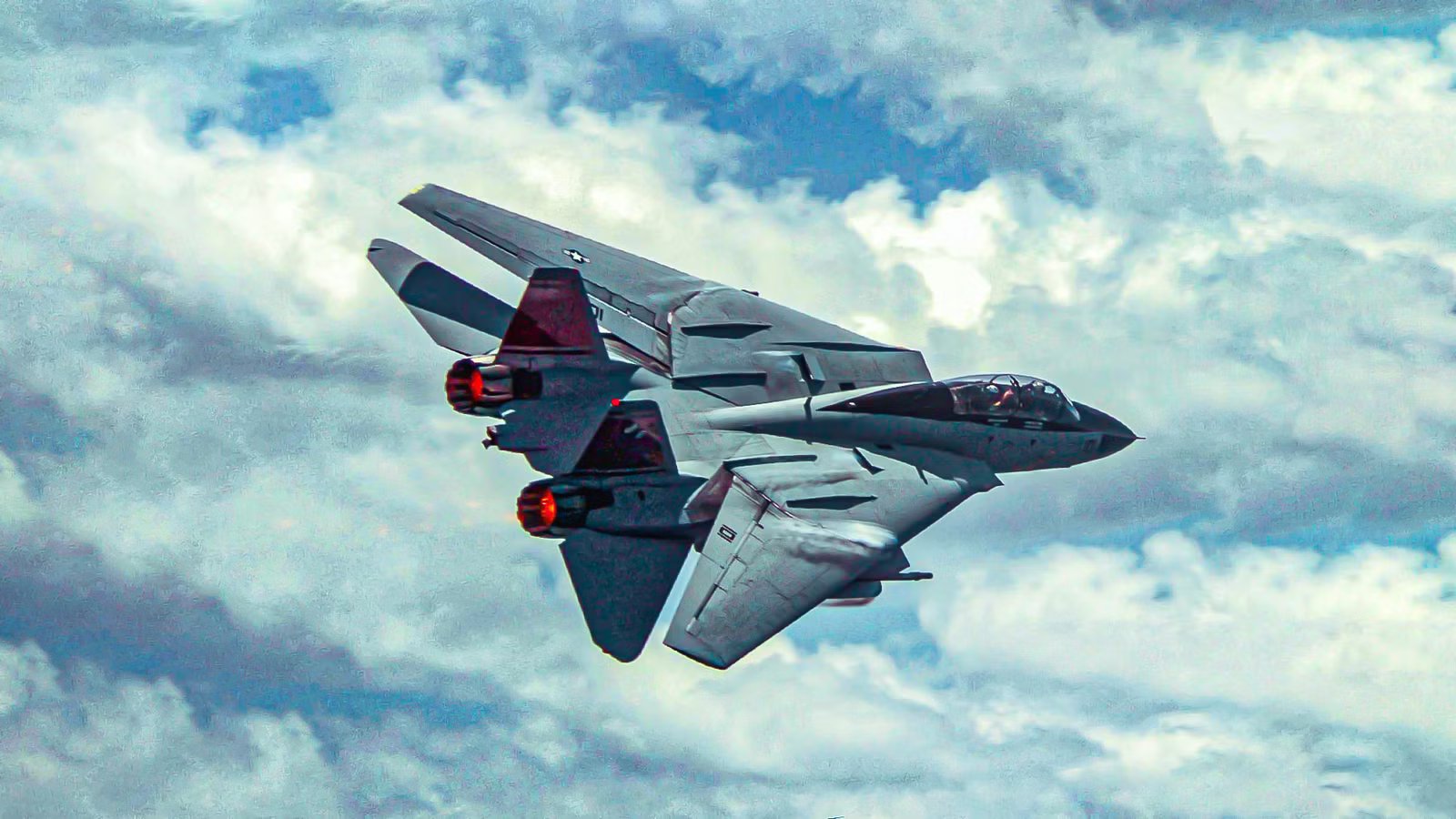
Most people believe that the Grumman F-14 Tomcat was the final US Navy fighter aircraft to use traditional ‘manual’ flight controls that rely on mechanical assemblies. Both the Lockheed MartinF-35C Lightning II and the more recent  Boeing F/A-18 Super Hornet use fly-by-wire systems with autopilot assistance during many flight phases. The pilot’s stick and rudder pedals were connected to the Tomcat’s flight surfaces via an intricate network of cables, pulleys, and pushrods.
Even as flight control computers advanced, the F-14 retained a physical linkage that allowed pilots to ‘feel’ the aircraft through the controls, a feature lost in fully digital systems. The F-14D was upgraded late in its service life with a Digital Flight Control System, which significantly improved handling at high angles of attack and helped prevent the Tomcat’s infamous flat spin. It was officially retired from service in 2006, bringing an end to the era of large, manual-control carrier fighters.
The Tomcat: A Pilot’s Fighter

The flight control system of the F-14 Tomcat was an advanced hybrid that integrated cutting-edge digital computing with bulky mechanical linkages. It was built with an automated system to control its special variable-geometry wings while giving the pilot direct physical control. The primary flight surfaces of the F-14 were moved by a hydro-mechanical system, where hydraulic valves were physically connected to the pilot’s stick and rudder pedals.
This was done through a network of cables, pushrods, pulleys, and bellcranks, and the pilot was able to sense aerodynamic loads directly through the stick thanks to this mechanical linkage’s tactile feedback. The flight control actuators were driven by two separate hydraulic circuits that were powered by pumps on each engine. This heavy, manual jet was equipped with an Automatic Flight Control System to make it easier to fly.
The F-14 lacked traditional ailerons and instead used a variety of other surfaces to control roll and pitch. The entire horizontal stabilizer moved as one unit: for pitch (climb/dive), both moved at the same time, while, for roll, they moved in opposite directions.
Stability Augmentation functioned as a ‘dampener’ for pitch, roll, and yaw, reducing oscillations and making the jet feel more stable. At low speeds, wing-mounted spoilers aid in roll control. During carrier landings, pilots could use a thumbwheel to slightly deploy the spoilers, allowing for precise glide-slope adjustments without affecting the pitch or throttle.
Forging The Path For Modern Naval Aviation

The MP944 chipset, one of the earliest microprocessors ever created, controlled the wing-sweep system even though the flight surfaces were mechanical, as Hackaday describes. To select the ideal lift-to-drag ratio, the Central Air Data Computer (CADC) automatically changed the wing angle based on altitude and Mach number. The F-14’s ‘brain’ was the MP944-driven CADC, which processed data from static and dynamic pressure sensors, temperature probes, and pilot inputs.
Pilots could manually sweep the wings further aft than the computer-calculated position by using the throttle’s thumb switch or a mechanical emergency handle. The MP944 was a significant technical advancement, created expressly to perform the complicated, real-time computations necessary to maintain the F-14 stable in flight. It used a 20-bit architecture with technologies that would not be available in consumer computing for another decade.
It was far more powerful than the 4-bit Intel 4004, which was made for calculators around the same time. A CPU, RAM, and other specialized processors were part of the six semiconductor chips that made up the system. The CADC also controlled Maneuvering Flaps and Slats, as well as small retractable surfaces on the leading edge of the wing known as ‘Glove Vanes,’ which were used to maintain stability at high Mach speeds.
The MP944 was classified because it was a crucial part of the Navy’s elite fighter. In 1971, Ray Holt, the system’s developer, tried to publish a paper on the system, but the US Navy prevented its publication due to concerns about national security. Long after the F-14 had made a name for itself, it was finally declassified in 1998.
Automation In The Back Seat

All major US Navy aircraft after the F-14 were equipped with fly-by-wire technology, which substituted electronic impulses for mechanical connections, so pilot skill had to change significantly when switching from the F-14 to the F/A-18 Hornet. Indeed, while F-14 pilots had to manually monitor every input during the crucial carrier approach, the Hornet’s computer manages the majority of the stabilization and minor corrections.
During landings, the first-generation Hornet required a great deal of manual coordination, but that all changed in 2016. The Hornet was the first Navy fighter built with a digital flight control system and became the first equipped with automatic landing and takeoff assistance, dubbed the ‘Magic Carpet.’ Not only does it aid in holding a correct glideslope for carrier landings, but in catapult launches, it ‘flies itself’ at ideal angles to take off from the boat.
The Navy implemented the Magic Carpet (formerly known as Precision Landing Mode) through ‘g-command’ logic in the flight computers of the legacy Hornet and Super Hornet. This software upgrade automates glideslope changes, freeing up pilots to concentrate on small adjustments rather than continuous throttle and pitch control. The computer automatically modifies control surfaces to maintain a steady One-G flight path when the pilot neutralizes the stick, ‘trimming’ the aircraft for the pilot.

America’s 5 Fastest Fighter Jets Of All Time
The speed kings of TACAIR.
The Skunk Works Fighter

The F-35C is the most sophisticated version of computerized control in naval aviation, aimed at minimizing pilot burden even more. Unlike the F/A-18, the F-35 even has a side stick control yoke. This is an ‘active’ stick that gives electronic haptic feedback, imitating the feel of flying forces that are naturally present in manual systems like the F-14 but not in many digital fly-by-wire systems.
From the beginning, the F-35C was intended to have a landing mode akin to Magic Carpet, unlike the Hornet, which was retrofitted. The computer manages the intricate engine and flap changes required to maintain the aircraft’s three-degree glideslope as the pilot uses the stick to bring the flight path marker onto the target.
The F-35C is effectively a flying sensor node because of its highly integrated design, which replaces previous federated systems. A single computer handles the aircraft’s flight controls, sensors, and armaments. With the computer managing all of these integrated systems, it greatly lessens the training burden for rookie naval aviators. As such, the F-35C is said to be significantly simpler to land on a carrier than its predecessors.

How The Eurofighter Typhoon Stacks Up Against The US F-14 Tomcat In 2025
Can a Cold War icon beat a modern air superiority fighter?
The Future Of Naval Aviation

The combined advances that have been introduced between the F-35C’s Delta Flight Path technology and the Gerald R. Ford-class carriers represent the pinnacle of automated naval aviation. These systems work together to transform carrier landings from a high-stress, dangerous art form into a predictable, almost routine task that greatly increases safety for aircrew and increases readiness for embarked squadrons.
The aircraft also uses the Joint Precision Approach and Landing System, a GPS-based system that provides all-weather, high-precision guidance to the ship. Unlike the conventional hydraulic systems aboard Nimitz-class carriers, the Advanced Arresting Gear of the Ford-class uses electric motors to provide precise, adjustable resistance. This enables the ship to safely recover a wider spectrum of aircraft, from hefty stealth fighters to lightweight drones, while decreasing structural stress.
The Electromagnetic Aircraft Launch System replaces steam catapults and provides gentler acceleration, safeguarding the F-35C during launch. The Navy estimates that by streamlining the landing process, ‘boarding rates’ (successful landings on the first try) will rise to 100% if all goes to plan. Combined with Ford’s new flight deck, this allows for a 25% boost in sortie production, with up to 160 continuous sorties per day and over 270 during battle surges.

Why The US Navy Could Benefit From The F-14 Tomcat Right Now
The F-14 Tomcat’s unique capabilities may be more relevant today than when it was retired.
The Tomcat’s Legacy

Perhaps the most well-known fighter jet in history, the F-14 has a special place in history. It gained international recognition with the 1986 movie Top Gun, inspiring a new generation of pilots and serving as a symbol of US military might. It was a mainstay of 1980s and ’90s media, appearing in everything from video games to cartoons, thanks to its unique variable-sweep wings. However, the US Navy took the unprecedented step of shredding nearly all of its decommissioned Tomcats.
It did so in order to stop spare parts from getting to Iran, the only other country that has operated the F-14. Only roughly 150 aircraft were saved for museum exhibits, such as the USS Midway in San Diego and the National Naval Aviation Museum in Florida. As the first of the ‘Teen Series’ fighters (which also included the F-15, F-16, and F-18), the F-14 invented many of the integrated avionics and flight control concepts used in contemporary aircraft.
It was built as a ‘flying missile battery’ to use the AIM-54 Phoenix to stretch the interception horizon out against Soviet bombers. The F-35C uses stealth and sensor fusion to locate targets, whereas the Tomcat depended on a huge radar and a specialist back-seat officer. Furthermore, the manual nature of the F-14 made carrier operations a grueling physical and mental challenge for pilots and deck crews.
Instead of one jet carrying a single long-range radar, the F-35C acts as a node in the Naval Integrated Fire Control-Counter Air network. It can identify a target stealthily and pass that data to a Ford-class strike group’s Aegis destroyers, which then fire long-range missiles like the SM-6.
The Navy is preparing to deploy the F-35C alongside the upcoming Collaborative Combat Aircraft autonomous wingmen drones. This is the ultimate evolution of the F-14’s two-seat crew tactics, as the Tomcat required a human Radar Intercept Officer in the back seat. F-35C pilots will now manage a fleet of autonomous drones to provide the same long-range protection.