dailynewsnblog
This is today’s edition of The Download, our weekday newsletter that provides a daily dose of what’s going on in the world of technology.
Is fake grass a bad idea? The AstroTurf wars are far from over.
In 2001, Americans installed just over 7 million square meters of synthetic turf. By 2024, that number was 79 million square meters—enough to carpet all of Manhattan and then some. The increase worries folks who study microplastics and environmental pollution.
While the plastic-making industry insists that synthetic fields are safe if properly installed, lots of researchers think that isn’t so. Find out why AstroTurf has ignited heated debates.
—Douglas Main
This story is from the next issue of our print magazine, packed with stories all about nature. Subscribe now to read the full thing when it lands on Wednesday, April 22.
Mustafa Suleyman: AI development won’t hit a development wall anytime soon—here’s why
—Mustafa Suleyman, Microsoft AI CEO and Google DeepMind co-founder
The skeptics keep predicting that AI compute will soon hit a wall—and keep getting proven wrong. To understand why that is, you need to look at the forces driving the AI explosion.
Three advances are enabling exponential progress: faster basic calculators, high-bandwidth memory, and technologies that turn disparate GPUs into enormous supercomputers. Where does all this get us? Read the full op-ed on the future of AI development to learn more.
Desalination technology, by the numbers
—Casey Crownhart
When I started digging into desalination technology for a new story, I couldn’t help but obsess over the numbers.
I knew on some level that desalination—pulling salt out of seawater to produce fresh water—was an increasingly important technology, especially in water-stressed regions including the Middle East. But just how much some countries rely on desalination, and how big a business it is, still surprised me.
Here are the extraordinary numbers behind the crucial water source.
This story is from The Spark, our weekly newsletter on the tech that could combat the climate crisis. Sign up to receive it in your inbox every Wednesday.
The must-reads
I’ve combed the internet to find you today’s most fun/important/scary/fascinating stories about technology.
1 Meta has launched the first AI model from its Superintelligence Labs
Muse Spark is the company’s first model in a year. (Reuters $)
+ The closed model brings reasoning capabilities to the Meta AI app. (Engadget)
+ It’s built by Meta’s Superintelligence Labs, the unit led by Alexandr Wang. (TechCrunch)
2 Anthropic has lost a bid to pause the Pentagon’s blacklisting
An appeals court in Washington, DC denied the request. (CNBC)
+ A California judge had temporarily blocked the blacklisting in March. (NPR)
+ The mixed rulings leave Anthropic in a legal limbo. (Wired $)
+ And open doors for smaller AI rivals. (Reuters $)
3 New evidence suggests Adam Back invented Bitcoin
The British cryptographer may be the real Satoshi Nakamoto. (NYT $)
+ Back denies the claims. (BBC)
+ There’s a dark side to crypto’s permissionless dream. (MIT Technology Review)
4 Gen Z is cooling on AI
The share feeling angry about it has risen from 22% to 31% in a year. (Axios)
+ Anti-AI protests are also growing. (MIT Technology Review)
5 War in the Gulf could tilt the cloud race toward China
Huawei is pitching “multi-cloud” resilience to Gulf clients. (Rest of World)
6 Meta has killed a leaderboard of its AI token users
It showed the top 250 users. (The Information $)
+ Meta blamed data leaks for the shutdown. (Fortune)
+ It encouraged “tokenmaxxing,” a growing phenomenon in Big Tech. (NYT $)
7 Did Artemis II really tell us anything new about space?
Or was it primarily a PR exercise? (Ars Technica)
8 Israeli attacks have brutally exposed Lebanon’s digital infrastructure
It’s managing a modern crisis without modern technology. (Wired $)
9 AI models could offer mathematicians a common language
They hope it will simplify the process of verifying proofs. (Economist)
10 A “self-doxing’ rave is helping trans people stay safe online
It’s among a series of digital self-defenses. (404 Media)
Quote of the day
“I feel like anything that I’m interested in has the potential of maybe getting replaced, even in the next few years.”
—Sydney Gill, a freshman at Rice University, tells the New York Times why she’s soured on AI.
One More Thing
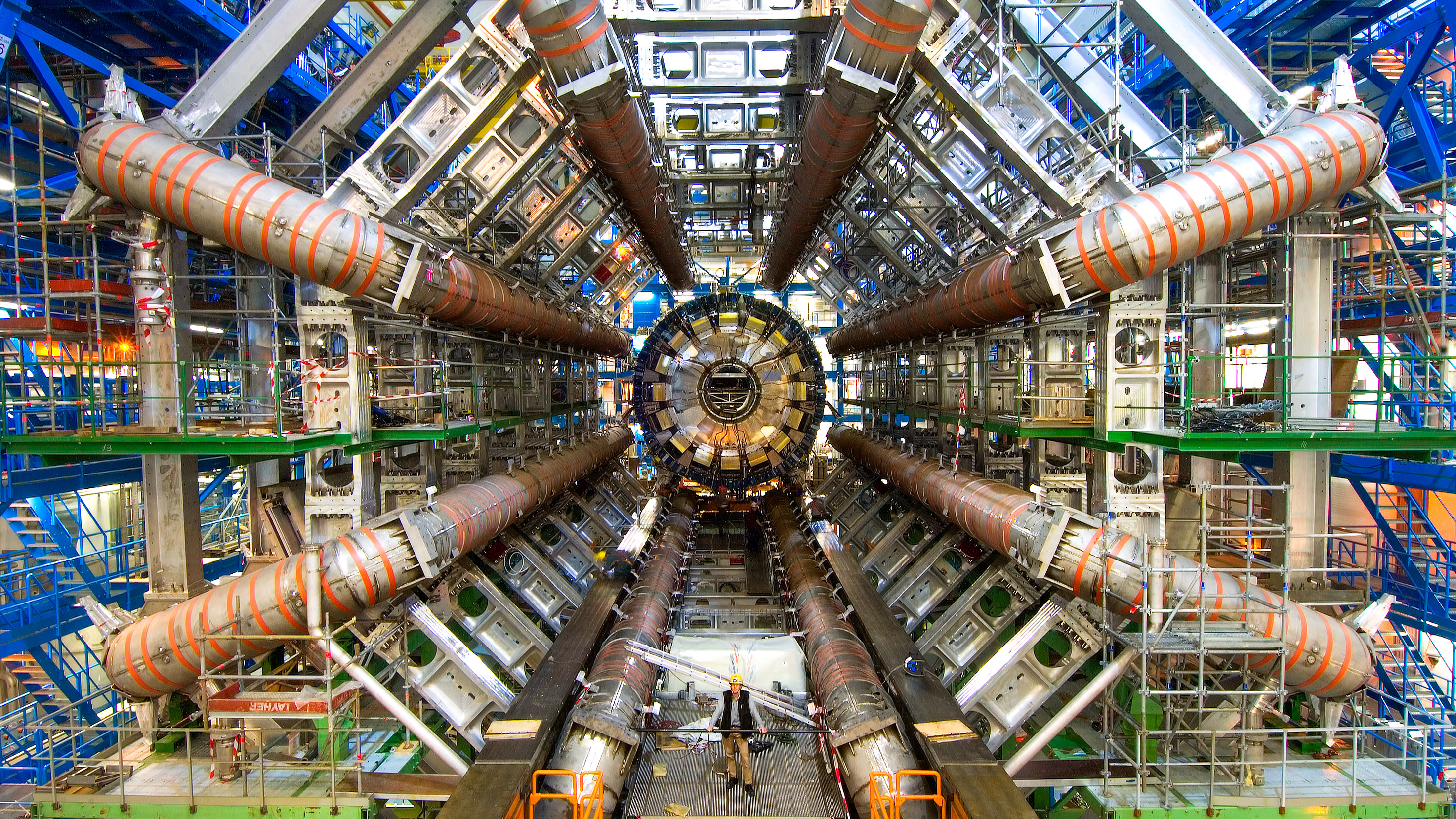
one of two general-purpose detectors at the Large Hadron Collider.
Inside the hunt for new physics at the world’s largest particle collider
In 2012, data from CERN’s Large Hadron Collider (LHC) unearthed a particle called the Higgs boson. The discovery answered a nagging question: where do fundamental particles, such as the ones that make up all the protons and neutrons in our bodies, get their mass?
But now particle physicists have reached an impasse in their quest to discover, produce, and study new particles at colliders. Find out what they’re trying to do about it.
—Dan Garisto
We can still have nice things
A place for comfort, fun and distraction to brighten up your day. (Got any ideas? Drop me a line.)
+ Enjoy this tale of the “joke” sound that accidentally defined 90s rave culture.
+ Take a nostalgic trip through the websites of the early 00s.
+ One for animal lovers: sperm whales have teamed up to support a newborn.
+ Here’s a long overdue answer to a vital question: can the world’s largest mousetrap catch a limousine?