dailynewsnblog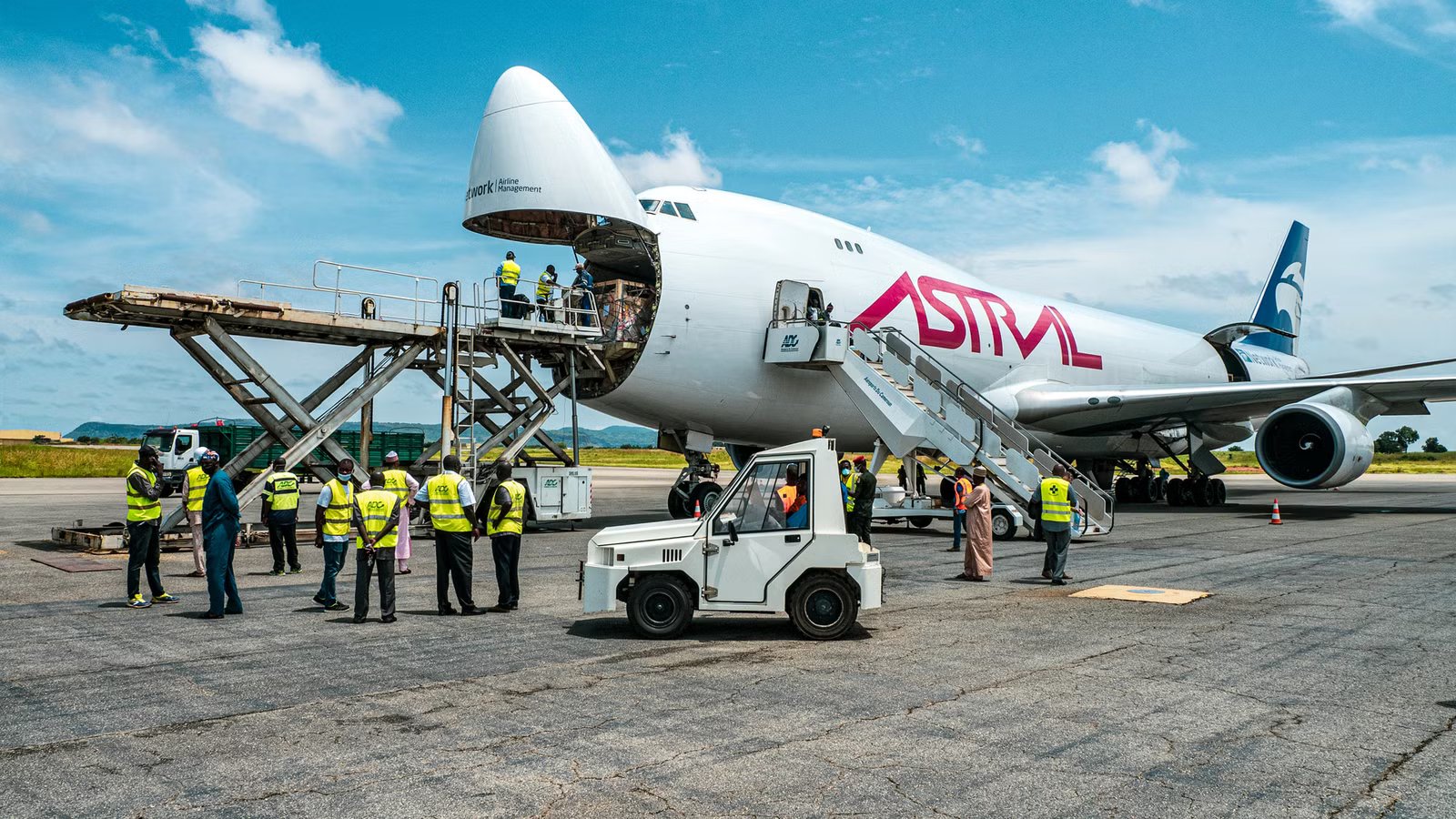
Save for perhaps the Concorde, there is no aircraft more recognizable and more iconic than the Boeing 747. First introduced in 1970, the double-decker was the world’s first widebody airliner, and the 747 has transported over seven billion passengers across its five-and-a-half decades in service. While the 747’s final form was the 747-8, the series reached its height with the 747-400, as this was the most popular variant of the 747. 694 of the 1,574 747s produced for the 747-400 model, nearly 45%.
Although the Boeing 747 was famous mostly for its role in passenger service, the jet was designed primarily to serve as a cargo transporter. In the 1960s, when the 747 was being developed, it was believed that supersonic transports would supersede subsonic passenger jets in the following decades, much like how jets had just replaced propeller planes. To ensure that Boeing’s enormously expensive project, largely developed at the request of Pan Am, had a future, it was optimized as a freighter. Today, in the 747’s final days, it has fittingly settled into this role.
Overview Of The Boeing 747-400

In the 1960s, Boeing was approached by Juan Trippe, long-time president of Pan American World Airways, with a request for a new airliner roughly two-and-a-half times the size of the Boeing 707. The goal was to significantly lower per-seat costs, thereby lowering ticket prices. As Trippe’s request came with an order for 25 examples, Boeing agreed to commence development of what is now known as the 747. While the 747 took inspiration from elements of Boeing’s proposal for a USAF request that ultimately became the Lockheed C-5, the 747 as a whole was a completely new design.
The 747-400 was a significant update to the 747 line. First introduced in 1989 with Northwest Airlines, the type was derived from the 747-300, which introduced a stretched upper deck that added passenger capacity, trading range for capacity due to the extra weight. Up front, the 747-400 introduced a two-crew flight deck with a full glass cockpit, along with significant updates to the autopilot. The 747-400 included new canted winglets, as well as a bump in gross weight, additional fuel capacity, and updated engines.
In total,  Boeing produced 422 standard 747-400 passenger examples, along with 19 747-400D short-range aircraft, and six 747-400ERs. In addition, the company sold 61 747-400M combis, along with 126 747-400Fs and 40 747-400ERFs. While only a fraction of the passenger 747-400s produced still carry passengers, the 747-400F is still going strong. In addition, dozens of aging passenger 747-400s were converted to become cargo aircraft, with there being well over 200 cargo 747-400s in service today.
The Boeing 747-400 Freighter

Until the debut of the Boeing 747-8F, the Boeing 747-400F was the largest and most capable freighter available on the market. But despite being the same length as prior 747 models, the 747-400F has more cargo capacity. A redesign of the main deck’s ceiling meant that two extra positions could accommodate 10-foot (three-meter) high containers (as the ceiling is lower underneath the upper deck, while a redesign of the sidewalls in the nose area added more room. In total, the 747-400F came with an additional 774 cubic feet (21.9 cubic meters) of volume over the 747-200F.
Inside, the 747-400F’s main deck boasts 21,645 cubic feet (610.1 cubic meters) of space, while the lower cargo hold also adds 4,601 cubic feet (130.3 cubic meters). In addition, the 747-400F has a bulk cargo area with 520 cubic feet (14.7 cubic meters) of space. Altogether, the 747-400F offers 26,766 cubic feet (755 cubic meters) of interior volume. The 747-400F is capable of transporting 10-foot (three-meter) high containers, and the main deck cargo hold is roughly 185 feet (56.4 meters) long.
|
Area |
Volume (Cubic Feet) |
Volume (Cubic Meters) |
|---|---|---|
|
Main deck |
21,645 cubic feet |
610.1 cubic meters |
|
Lower deck |
4,601 cubic feet |
130.3 cubic meters |
|
Bulk cargo hold |
520 cubic feet |
14.7 cubic meters |
|
Total |
26,766 cubic feet |
755 cubic meters |
The 747-400F features a main deck cargo door on the left side of the aircraft, measuring 134 inches (3.4 meters) by 123 inches (3.1 meters). In addition, the entire nose of the 747-400F lifts upwards to provide full access to the cargo hold. This allows the 747-400F to carry outsize cargo on its main deck, making it the top choice for transporting large items with unusual dimensions. However, this is only available on newly-built 747-400Fs, as converted 747-400s do not feature a nose door.

The Aircraft Replacing The Boeing 747
As Boeing’s flagship, the Boeing 777X is the closest thing to replacing the Jumbo, although it is not a direct replacement.
The Capabilities Of The Boeing 747-400F

With a maximum takeoff weight of roughly 397 tons, the 747-400F can carry roughly 249,000 pounds (113,000 kilograms) of payload, among the highest of any commercial freighter. In addition, the type can fly 4,495 NM (8,250 km). The 747-400ERF has even greater payload capacity and can fly longer distances. The 747-400ERF, in fact, was significantly more popular than the passenger 747-400ER, which was only flown by Qantas. For carrying high payloads, large numbers of lightweight items, or operating long-distance flights, the 747-400F has long been unrivaled.
747-400Fs fresh from the factory were built with a nose-cargo door, allowing full unobstructed access to the aircraft’s cargo hold and giving it the ability to carry outsized loads. This capability, also seen on the C-5 Galaxy, Antonov An-124 Ruslan, and tragically destroyed An-225 Mriya, is rare yet nearly always necessary to load large individual items, and the 747 has emerged as the default choice to lift outsize cargo. This is because the C-5 Galaxy is a military plane, while the Ruslan is both far rarer than the 747 and more expensive to operate.
|
Aircraft |
In Service |
|---|---|
|
Boeing 747-400F |
218 |
|
Antoniv An-124 Ruslan |
15 (commercial) |
The 747-400F can accommodate 30 96-inch by 123-inch pallets on its main deck, and can accommodate containers as long as 20 feet (six meters) long through its side cargo door. Behind where the upper deck is located, the main deck cargo hold can accommodate 10-foot (three-meter) high containers, which is a feature unmatched by any newer commercial aircraft type short of an Antonov.
The Upper Deck Of The Boeing 747-400F

The 747’s hump was created in an effort to move the cockpit out of the way to permit unobstructed forward loading via a nose door. This design was inspired by Boeing’s submission for the Air Force’s CX-HLS project, which ultimately became the Lockheed C-5 Galaxy. Initially, little consideration was given as to what this small space would be used for, besides the cockpit. Similar in width to a narrowbody airliner, it’s now used as permanent seating on the passenger 747, while it remains the same size on modern freighter 747s as the original 747-100.
The 747-400 was the first Boeing aircraft to incorporate a full glass cockpit, incorporating technologies from the Boeing 757 and Boeing 767 (which featured a partial glass cockpit). This meant that the 747-400 needed only two pilots. Behind the cockpit, typically separated by a curtain, is the crew service door, along with a coat closet. Behind these are a galley for the pilots, located opposite the lavatory, and further back are six seats. Behind the seating area lies a bunk area, fitted with two beds and two closets.
There are two rows of seats on the right side of the upper deck and only one on the left side. In front of the row of seats on the left side of the upper deck is the entrance area. Partitioned with a door, this compartment reveals a ladder that folds down into the cargo hold when in use. The ladder was changed from the 747-200F, as it was located closer to the center of the cabin and pointed forward. On the 747-400F, the ladder is pointed towards the left side of the plane and is closer to the wall, thereby increasing usable cargo space.

Is An Airbus A350 Bigger Than A Boeing 747?
The A350-1000 is similar in some metrics to the Boeing 747-100, while the Boeing 747-8 is significantly larger than the A350.
Replacing The Boeing 747-400F

Within Boeing’s lineup, the 747-400F was replaced by the 747-8F. The freighter variant of the 747-8, this aircraft featured a fuselage stretch (a first for the 747 line) along with updated technology, a reprofiled wing, and a bump in gross weight. Once again, the 747-8F features the same upper deck design as the 747-400F, as well as the 747-100 and 747-200, while the passenger 747-8 received a further stretch to the upper deck. In addition, the 747-8 also comes with new General Electric GEnx-2B engines, greatly improving fuel efficiency.
Airbus has long been weak in the new-build commercial freighter market compared to Boeing, and so, the company launched the A350F in 2021, targeting the 747-400F replacement market. At 232 feet (70.8 meters), the A350F is sized between the A350-900 and A350-1000, while retaining the A350-1000’s wings, landing gear, engines, and gross weight. More importantly, it’s the same length as the 747-400F while being able to carry nearly the same amount of payload. In addition, the side cargo door will be the largest ever designed on a commercial airliner, attempting to replicate the capabilities of the 747’s nose door.
Not ones to be outdone in the freighter market, Boeing launched the 777-8F in 2022. To date, the 777-8F has received 63 orders, nearly double the orders of the passenger 777-8. Whereas the Boeing 777X and Airbus A350 families have significant differences as a whole, the 777-8F and A350F are essentially the same plane regarding capabilities. Both have similar ranges, similar payload capacities, and are the same length as a 747-400F. However, the 777-8F’s cargo door will be smaller than that of the A350F.