dailynewsnblog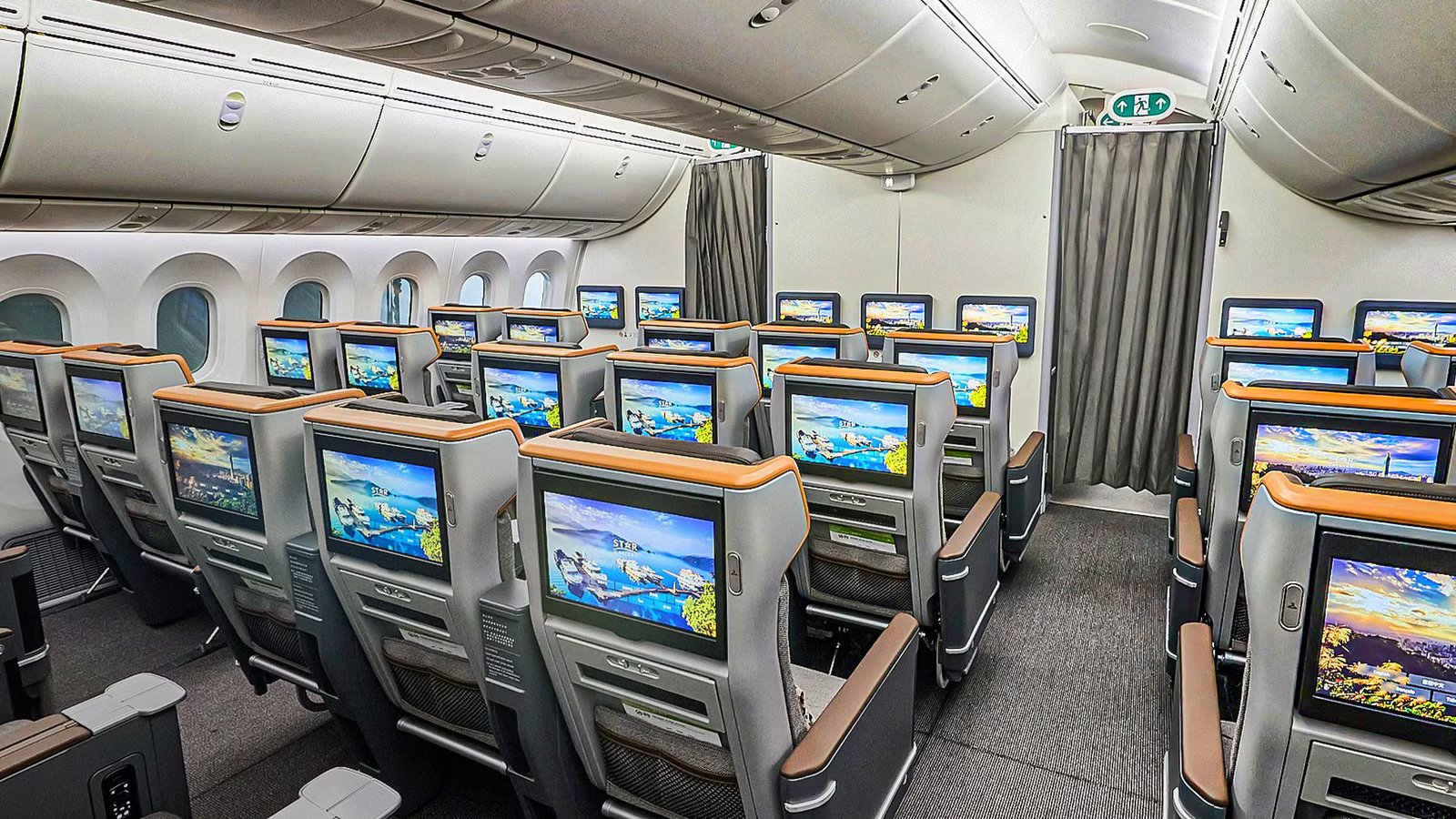
Around the world, premium economy is growing and more airlines are expected to increase their capacity in this class, although it can take years for an airline to fully transition to a new cabin type. Broadly speaking, premium economy is confined to widebody aircraft assigned to longer-haul routes, although there are exceptions like American Airlines’ transcontinental A321XLRs and Emirates’ widebodies that are used for short-haul routes.
Widebodies generally fall into three categories as far as rolling out a new seating class is concerned. One category is new aircraft being delivered, which are typically received from the manufacturer with the latest airline cabins. Another group of aircraft is those already in service with years of service ahead of them. These are retrofitted as they are cycled through their scheduled maintenance. Finally, there are older aircraft in service that are scheduled to retire that an airline may not bother retrofitting.
The Road To Premium Economy

Originally, all commercial fares were effectively first class, as flying was only something the elite could afford to do. Over time, economy class emerged, and then in the 1970s, business class emerged as a bridge between first and economy. For many business class passengers, first class was excessively expensive, while economy was not becoming of business representatives on business trips. The class also introduced the notion of working on the aircraft.
As air travel became mainstream and everyone could fly, flying lost its prestige status symbol. Private jets may be the domain of the wealthy, but not commercial flying, and no longer did passengers dress up for the occasion and treat it as something of a first-class voyage. Without the status of the past, the first class became seen as excessively expensive, while also being squeezed by an improving business class. This has led to the decline of first class around the world.
Meanwhile, pressures mounted in two directions. One was the increased demand for ultra-cheap and utilitarian flights, which gave rise to low-cost and ultra-low-cost carriers. Another was the demand for a class better than economy, but not as prohibitively expensive as business class. This led to the rise of premium economy as a ‘sweet spot’ between affordability and comfort. It fits today’s mainline market, where flying needs to be comfortable and affordable, but not overly lavish.
The Dam Has Burst On Premium Economy

Premium economy is the youngest of the four classes, and many airlines were reluctant to introduce it. Some airlines saw it as a threat that would undermine their profitable business class, as premium economy works if it gets economy-class passengers to upgrade, but it is counterproductive if it convinces business-class passengers to downgrade. Some mainline carriers, like Emirates, were also concerned about how it would affect their brand image as a luxury mainline airline.
Now, however, that dam has burst, and airlines are rushing to retrofit their aircraft with premium economy. Emirates CEO Tim Clark said that “our Premium Economy product was carefully developed in keeping with Emirates’ brand positioning as a full-service airline of the highest quality.” He has also described the demand for Emirates’ premium economy as “tremendous” and “shocking” while noting he could sell the seats multiple times.
|
Industry standards for Premium Economy (per Emirates, others) |
|
|---|---|
|
Seat pitch |
38–40 inches (96–102 cm) |
|
Seat width (with wider armrests) |
18.5–19.5 inches (47–50 cm) |
|
Seat recline |
7–9 inches (18–23 cm) |
|
Touchscreen |
12–13 inches |
|
Checked baggage (some exceptions) |
2 × 23 kg (50 lb) |
|
Cost above the economy (varies regionally) |
Typically 1.3x to 1.8x economy |
|
Business cost above premium (varies regionally) |
Typically 2.5x to 4x |
Emirates is a great example of a holdout that has now fully embraced the class. During 2026, Emirates will not introduce a new premium economy, as it already exists, but it is rolling it out for more and more routes as aircraft are retrofitted, such as Tokyo to Cairo via Dubai. Lufthansa has gone so far as to call it a “money-generating machine” and claim it generates 33% more per square foot than economy class and 6% more than business class.

Emirates Vs. Etihad Airways Vs. Qatar Airways: Which Carrier Wins In Premium Economy?
While Emirates has its own official Premium Economy, both Qatar and Etihad have their own unique approach to an elevated economy experience.
Changes To US-Based Carriers

United Airlines is upgrading its Boeing 787-9’s international cabins with a refreshed premium economy class as part of its broader ‘Elevated Interior’ launch. In May 2025, the carrier said that “United expects to take delivery of the first 787-9 with the Elevated interior before the end of 2025, with the first international passenger flights planned in 2026 from San Francisco to Singapore and San Francisco to London.”
American Airlines’ new premium economy debuted in late 2025 on its new Being 787-9 Dreamliners (789P) and A321XLR transcontinental aircraft, while existing 777-300ERs are being retrofitted with the new seats. This is part of American’s cabin refresh, and it is the last US-based airline to finally ditch first class, while it rebalances with more premium economy options.
Delta Air Lines is enhancing its premium economy class at the expense of economy class seats, while JetBlue is introducing its Junior Mint seats in 2026. While not typically classified as traditional premium economy, Junior Mint is still presented as a bridge between economy and business. One holdout appears to be Alaska Airlines. It is now receiving its first 787 Dreamliners originally intended for Hawaiian, but these are, for now at least, only configured with business and economy class seats.
European Premium Economy Expansion

In Europe, Virgin Atlantic is taking delivery of new A330neo aircraft with expanded premium cabins (56). Elsewhere, Lufthansa is now accepting its new Boeing 787 Dreamliners after delays with the new Allegris cabins, while more A350-900s with Allegris premium economy cabins are delivered. Older Lufthansa aircraft, like 747-8s, are to be retrofitted.
In December 2025, Business Traveller News reported that “TAP Air Portugal in summer 2026 will introduce a new premium economy cabin on long-haul flights for its Airbus A330 and A321LR aircraft, the carrier announced Wednesday.” It added that this will include 12 seats in three rows of four on these narrowbody aircraft. British Airways is also in the process of refreshing its cabin interiors, including its premium economy seats.
By now, the vast majority of major European full-service airlines with significant long-haul networks have adopted premium economy. However, there are a few holdouts, most notably Ireland’s Aer Lingus, Spain’s Air Europa, and until now, Turkish Airlines. Turkish Airlines is, however, relaunching its premium economy after a 12-year hiatus on long-haul flights in 2026.

What Are The Benefits Of Flying In American Airlines’ New Premium Economy?
The refreshed premium economy seats are more comfortable, aesthetically pleasing, and technologically advanced than older seats.
Other Regions’ Premium Economy Expansion

EVA Air unveiled its fourth-generation premium economy seats in early 2025. As a side point, EVA Air is widely credited for having launched the world’s first true premium economy class in 1992, which, at the time, was called Evergreen Deluxe. Singapore Airlines and Air France are also among the airlines rolling out refreshed premium economy seats in 2026. Philippine Airlines has unveiled its first Airbus A350-1000 with a premium economy cabin, and more of these aircraft are to arrive in 2026.
As stated, one of the biggest stories for premium economy is Emirates, which is estimated to be adding 10 more premium economy routes, bringing the total to over 84. It is rolling out premium across its refreshed Boeing 777s and A380s, while as a first, its new A350-900s are not being delivered with first class seats but with 32 business class seats, 21 or 28 premium economy seats, and 238 or 259 economy class seats.
Air New Zealand is among the airlines doubling down on premium economy, introducing increased premium economy capacity on its retrofitted Boeing 787 Dreamliners from late 2025 into 2026. The carrier stated mid-2025 that “customers travelling to North America will have access to more than 34,000 additional seats, alongside a boost of 20,500 premium seats across the wider long-haul network.”
Premium Economy Beyond 2026

Beyond 2026, Hawaiian Airlines plans to roll out premium economy for the first time on its widebody A330s, starting in 2028. Elsewhere, Thai Airways has plans to add a new premium economy cabin to its 777-300ERs and incoming 787-9s starting around 2027. Meanwhile, new premium economy announcements in 2025 included LATAM saying it would introduce a new Premium Comfort cabin on its Boeing 787-8 and 787-9 starting in 2027.
Premium economy is now the fastest growing class, having grown by 8% in recent years, ahead of economy’s 5.9% growth. In 2027, Germany’s leisure carrier, Discover Airlines, is introducing a premium economy cabin known as “Ocean Blue” on its A330 widebody fleet. The low-cost Dubai-based carrier, flydubai, is also adding premium economy for the first time on its new Boeing 787 Dreamliners in 2027. By contrast, first class seating is down by around 40% compared with 2019.
In Q4 of 2025, Delta Air Lines reached a new milestone, as premium cabin revenue exceeded economy revenue. The final quarter saw main cabin revenues fall by 7% from $6 billion to $5.6 billion, while premium revenues jumped by almost the same amount for the quarter ($473 million) from $5.2 billion in 2024 to $5.7 billion in 2025. Overall, the full-year main economy cabin revenues exceeded those of the premium economy cabin, but it seems that 2025 was the tipping point for Delta.