dailynewsnblog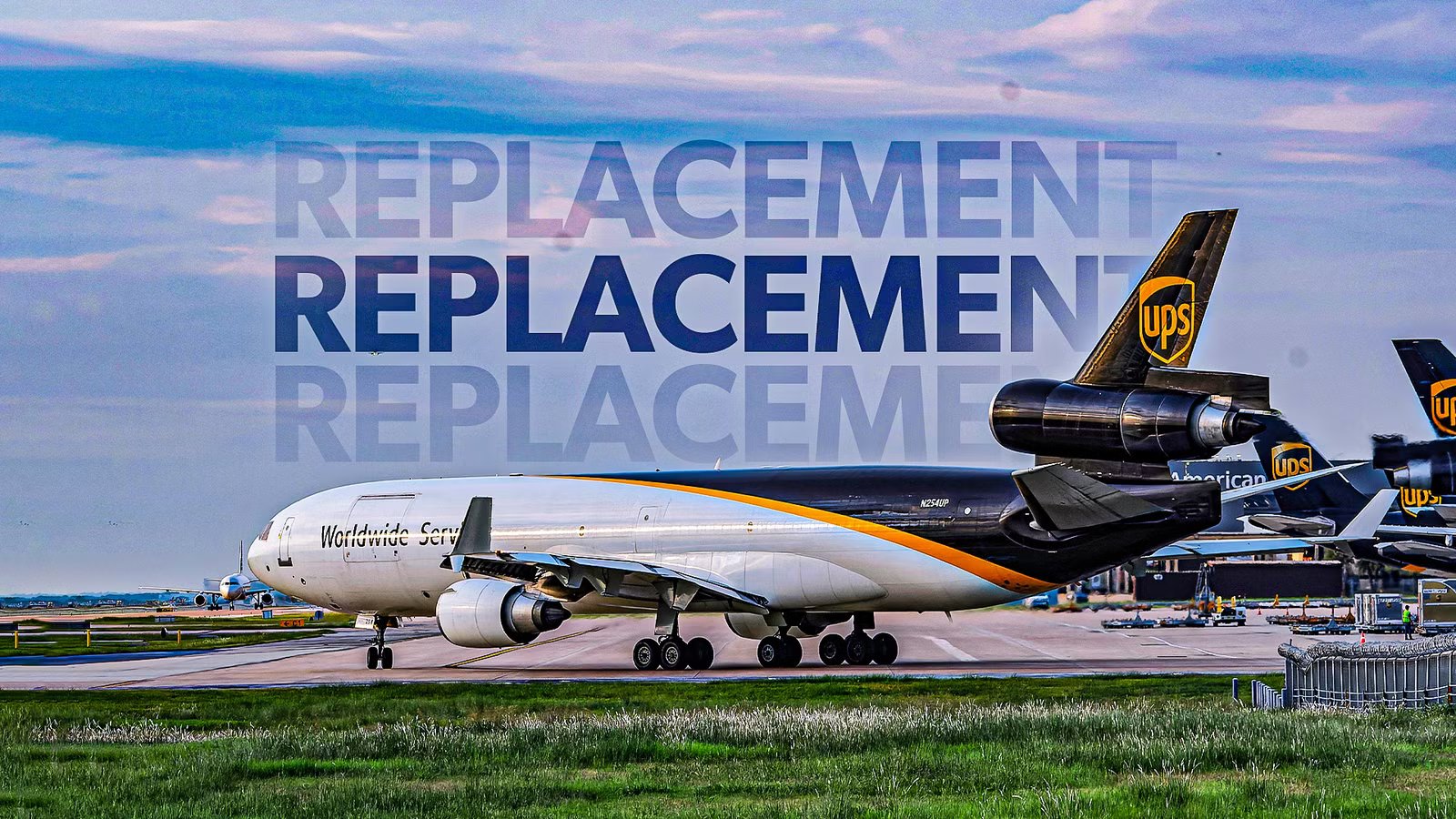
Following the fatal November 2025 crash of UPS Flight 2976 involving a McDonnell Douglas MD-11,  UPS Airlines accelerated the retirement of its entire MD-11 fleet, drawing the curtain on more than three decades of tri-jet operations. While the type had already been scheduled for retirement, the abrupt retirement raised the question of which aircraft could replace the MD-11 fleet.
Furthermore, the retirement did not come cheaply. The carrier recorded a $238 million after-tax charge tied to the fleet’s retirement. Interestingly enough, competitor FedEx has taken a different approach, working with authorities and Boeing to return its own MD-11 fleet to service rather than accelerating retirement. With 26 aircraft still active at the time of retirement, the question quickly became: what can truly replace the MD-11? The most obvious in-house candidate is the Boeing 767-300F, a proven and versatile workhorse that already forms the backbone of the carrier’s fleet. But can a smaller twin-engine freighter realistically fill the operational and economic role of a much larger tri-jet?
Is The Boeing 767 A Suitable MD-11 Alternative?

Following the tragic incident with MD-11 in the fall of 2025, UPS decided to retire its entire McDonnell Douglas MD-11 fleet, of which the airline had operated 43 aircraft throughout the years. The carrier was, however, already in the process of phasing out the MD-11s and, around the time of the crash, UPS still operated 27 MD-11 aircraft. As a result of this accelerated retirement, there was no time to formulate a true replacement strategy to fill the short-term capacity void.
The most obvious candidate to fill the void left by the MD-11 is the Boeing 767-300F, of which UPS was the launch customer back in 1995. However, this aircraft might not be the perfect fit to replace the MD-11 as it offers less capacity, but this is, of course, also dependent on market dynamics and future demand forecasts. Currently, the 767F is the largest aircraft type in the airline’s fleet with 100 aircraft in service. The majority of these are purpose-built freighters, while 10 aircraft are converted passenger aircraft. As of writing, 17 additional new 767-300F aircraft are to be delivered by Boeing in the near future, according to Ch-Aviation. To some, it might come as a surprise that Boeing is still constructing 767 freighter aircraft since production of the passenger version of the aircraft was discontinued back in 2014. However, only a limited number of aircraft are still on order, and the production of the Boeing 767-300F is set to be discontinued in the next few years as the 777x freighter is introduced.
These additional 17 aircraft are also not a new order but are part of a larger order that the cargo airlines placed back in 2022. At the time of the order, UPS Executive Vice President and President US Nando Cesarone, said the following: “The additional 767s will help us continue to deliver what matters to UPS customers around the world. This is a very versatile aircraft that we operate across every region of the globe. With these aircraft, our fleet will continue to be among the most modern in our industry, meeting our customers’ needs while improving our efficiency, sustainability and reliability.”

How Many Boeing 767s Does UPS Airlines Operate?
The UPS 767 fleet has become the primary successor to the recently retired MD-11 fleet. How many are currently in operation?
How Do The 767 and MD-11 Compare?

When comparing the Boeing 767-300F to the MD-11F, one of the most obvious differences is, of course, the MD-11Fs third engine in its tail, a feature that makes the aircraft less efficient compared to newer aircraft due to increased maintenance and fuel costs. Furthermore, the MD-11F is a larger aircraft compared to the 767F, with a length of 202 feet 2 inches (61.6 meters) compared to 180 feet 3 inches (54.9 meters), and a maximum payload of 201,000 lb (91.2 tons) versus 116,000 lb (52.7 tons). In terms of wingspan, the aircraft are similar. However, at 170 feet 6 inches (52.0 meters) for the MD-11 and 170 feet 4 inches (51.9 meters) for the 767F.
|
Specification |
B767-300F |
MD-11F |
|---|---|---|
|
Engines |
2 × turbofan |
3 × turbofan |
|
MTOW |
412,000 lb (186.9 t) |
630,500 lb (286.0 t) |
|
Max Payload |
116,000 lb (52.7 t) |
201,000 lb (91.2 t) |
|
Range (max payload) |
~3,255 nmi (6,025 km) |
~3,533 nmi (6,543 km) |
|
Range (typical) |
~6,025 nmi (11,160 km) |
~6,725 nmi (12,455 km) |
|
Cruise Speed |
Mach 0.80–0.86 |
Mach 0.83 |
|
Fuel Capacity |
~24,140 US gal (91,400 L) |
~38,615 US gal (146,170 L) |
|
Wingspan |
170 feet 4 inches (51.9 meters) |
170 feet 6 inches (52.0 meters) |
|
Length |
180 feet 3 inches (54.9 meters) |
202 feet 2 inches (61.6 meters) |
|
Typical Cargo Volume |
~15,500 ft³ (438 m³) |
~21,530 ft³ (609 m³) |
The larger size of the MD-11 is, unsurprisingly, also, reflected in its Maximum Take-off Weight (MTOW) of 630,500 lb (286.0 tons) compared to 412,000 lb (186.9 tons) for the 767F. As the MD-11 is larger and has more engines, it also has a higher fuel capacity. However, due to the higher fuel consumption as a result of the third engine and the larger payload, the aircraft’s range with maximum payload is only slightly further compared to the 767 at ~3,533 nmi (6,543 km) over ~3,255 nmi (6,025 km) for the 767.

Why In The World Did Boeing Build The 747 Freighter With A Nose Door?
Discover the surprising reason behind the 747 Freighter’s iconic nose door design.
A Look At The UPS Airlines Fleet

As of writing, UPS Airlines operates the second-largest fleet of the three large integrator airlines, with 270 aircraft, according to data from planespotters.net. The two other airlines, DHL Express and FedEx, operate 219 and 478 aircraft respectively. UPS’ fleet competition consists of four different aircraft types, with the majority of the fleet being Boeing aircraft. The only Airbus aircraft in the airline’s fleet is the Airbus A300-600F, of which UPS currently operates 52 aircraft, making it the second-largest operator of the type after FedEx. These aircraft have an average age of 23.1 years, with the youngest and oldest aircraft ranging between 19.7 and 25.9 years. When looking at the historic fleet date, this is also the only Airbus aircraft type ever operated by the airline.
The airline’s Boeing fleet consists of the aforementioned Boeing 767, the Boeing 757, and the Boeing 747, of which UPS operates two sub-variants. There are currently 100 767-300F aircraft already in the fleet, with another 17 on order. Furthermore, the airline operates 75 757-200Fs, which have an incredible average age of 32.5 years, as well as 13 747-400F aircraft with an average of 24.2 years and 30 younger 747-8F aircraft with an average age of 6.6 years. With 43 Boeing 747s in its fleet, UPS is the second-largest operator of the 747 in the world, behind only Atlas Air.
|
Aircraft |
# in fleet |
Average Age |
Capacity |
|---|---|---|---|
|
Airbus A300-600F |
52 |
23.1 Years |
48 metric tonnes |
|
Boeing 747-400F |
13 |
24.2 Years |
120 metric tonnes |
|
Boeing 747-8F |
30 |
6.6 Years |
140 metric tonnes |
|
Boeing 757-200F |
75 |
32.5 Years |
38 metric tonnes |
|
Boeing 767-300F |
100 |
16.4 Years |
53 metric tonnes |
UPS’ overall fleet age is 21.5 years, which is relatively high but not exactly uncommon for a cargo airline. Competitors, FedEx and DHL Express, have similar fleet ages, and also non-integrator cargo airlines such as Atlas Air tend to have older fleets. The primary reason for this is that cargo airlines tend to be less concerned with fuel efficiency and more focused on offsetting the low aircraft utilization common to cargo airlines. An important reason for lower aircraft utilization across all types of cargo airlines is the long turnaround times caused by aircraft loading and unloading.
UPS’s Business Model And Routes
For integrators such as UPS, these long turnaround times are even more dominant as the integrator’s business model uses a hubs-and-spoke model requiring aircraft to wait around for transfers. Integrators such as UPS differ from other cargo airlines in that they own and “integrate” the entire supply chain, taking full custody of a package or delivery from pickup to drop-off. To do this effectively, integrators own the entire supply chain themselves, operating their own trucks, aircraft, and sorting hubs. Most regular cargo airlines only take responsibility for the flight itself. Parcels and other cargo are collected and delivered during the day, meaning the sorting and distribution take place largely at night.
Since integrators operate vast scheduled networks in all corners of the world, an extensive hub-and-spoke network is essential for these companies to thrive. Aircraft wait around for a large period of time during the day at a feeder airport before departing in the late evening to one of UPS’ hubs. Often, this is only a short flight, resulting in low utilization and justifying the use of an old aircraft. The newer, larger aircraft, such as the 747-8F, are then used to transport sorted cargo on longer trunk routes between hubs where fuel efficiency matters more. For UPS, one of these trunk routes would, for example, be a flight between its largest US hub in Louisville (SDF) to its European hub in Cologne (CGN).