dailynewsnblog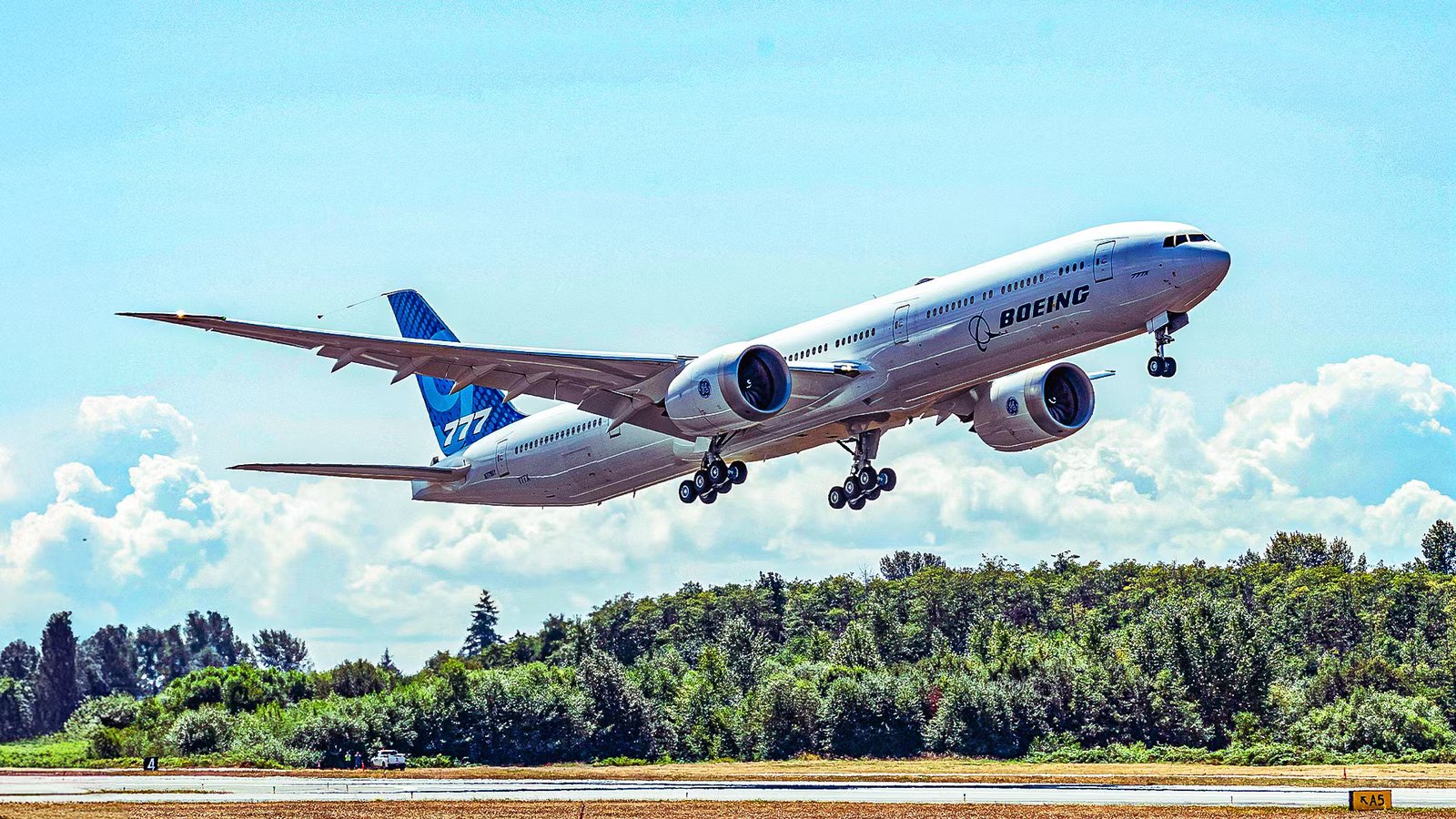
With the Airbus A380 and Boeing 747 programs terminated and there being a hiatus in Boeing 777 passenger jet deliveries, the Airbus A350 XWB is currently the widest passenger aircraft in production. However, this is not set to last, as the Boeing 777X will be over a foot wider than the Airbus A350 when it (eventually) launches. The Boeing 777-9 will be wider and longer (251 feet 9 inches vs 242 feet and 1 inch) and will come with more powerful engines.
Accordingly, it may come as a surprise to many that the Airbus A350-1000 is actually the higher-capacity aircraft for reasons discussed below. Boeing 777X passengers will enjoy plenty of space during their long-haul flights, while comfort for economy class A350 passengers will depend much more on how the aircraft is configured.
The Discontinued Giants

The airliners with the greatest internal cabin widths are the Airbus A380 and the Boeing 747. The A380’s main deck comes with a width of 21 feet and 7 inches, making it the widest cabin in the air today. Its upper deck is somewhat narrower at 19 feet and 5 inches, but this is still wider than any twin-engined aircraft except the Boeing 777 family. Meanwhile, the Boeing 747-8’s main deck boasts a width of 20 feet and 1 inch, while the upper deck offers 18 feet and 7 inches.
The Boeing 747-8 and Airbus A380 failed to compete with the more efficient twin-engined Boeing 787 Dreamliner and Airbus A350 XWB. However, the A350 was not designed to compete with the giant double-decker widebody quadjets: rather, it was designed to compete with the much smaller Boeing 787. When the 747-8 and A380 were terminated, the Boeing 777 was left as the largest passenger aircraft with the widest internal cabin in production, a title that it has now lost to the A350 but will regain with the 777X.
Exceeding The Boeing 787 Dreamliner, Competing With The 777X

When the Airbus A350 XWB (‘eXtra Wide Body’) entered service in 2015, it was ironically only the fourth-widest aircraft in production, behind the A380, 747, and 777. Its name comes from the fact that the new clean-sheet, twin-engined, airliner is wider than Airbus’s smaller A330 and A340 models. Its nomenclature was not necessarily in reference to Boeing’s 787 competitor, and certainly not compared with the much wider Boeing 777.
The original A350 production standard came with an internal cabin width of 18 feet and 1 inch. This is only marginally wider than the Boeing 787, with its 18-foot internal width. However, Airbus managed to shrink the thickness of the A350 walls by two inches on both sides, enabling the current production standard to come with a width of 18 feet and 5 inches.
|
Select widebody aircraft (per Airbus and Boeing) |
Internal cabin width |
|---|---|
|
Airbus A380 |
21 feet 7 inches (main cabin) |
|
Boeing 787-8 |
20 feet 1 inch (main cabin) |
|
Boeing 777X |
19 feet 7 inches |
|
Boeing 777-300ER |
19 feet 3 inches |
|
Airbus A350 |
18 feet 1 inch (original standard) |
|
Airbus A350 |
18 feet 5 inches (current standard) |
In the airline industry, it’s frequently a game of inches. Four inches may not sound like much, but it has the potential for a significant impact. The A350 was optimized for nine-abreast seating, although it could accommodate ten seats abreast. Ten-abreast seating is squishy, and only a few low-cost carriers chose to configure their aircraft that way. With an extra four inches, airlines have more freedom to configure their A350s ten-abreast, giving the smaller aircraft similar seating capacity to the Boeing 777-9.
The Boeing 777X Will Have The Widest Cabin

The final Boeing 777-300ER was likely delivered in 2024, and the upcoming Boeing 777X has been delayed to 2027. In the meantime, Boeing is only delivering 777 freighters. The family offers the widest internal cabin of any single-decked airliner, and the Boeing 777-300ER has an internal width of 19 feet and 3 inches, making it over a foot wider than Airbus’ original A350 production standard.
The Boeing 777X is the third generation of the 777 family, and it comes with a range of improvements. The aircraft incorporates some of the Boeing 787’s innovations (like large, dimming windows) while adding new technologies (like lengthened wings with folding wingtips). With that being said, while the lengthened wings may increase the aerodynamic performance of the aircraft, the novel folding wingtips may be contributing to its delayed certification.
Like the rival Airbus A350, the Boeing 777X features a narrowed cabin wall thickness by two inches on each side. This allows it to be four inches wider than the older Boeing 777-300ER at 19 feet and 7 inches. The Boeing 777X is set to be one foot and two inches wider than its Airbus A350 XWB rival.
Boeing 777X Comfort Vs Airbus A350 Economy

The implications of Airbus’ and Boeing’s engineering strategies to make their respective A350 and 777X aircraft four inches wider are not the same. The Boeing 777 was designed to be configured with ten seats abreast in economy class. Widening the cabin width by four inches does not enable the aircraft to be fitted eleven abreast, and it doesn’t necessarily allow the airline to carry more passengers, at least in the economy configuration.
Instead, the extra width allows the airline to offer passengers a little more space and comfort. This is great for premium flag carriers, like Qatar Airways and Emirates, which account for more than half of the Boeing 777X’s firm orders. On the other hand, the A350’s new production standard allows the aircraft to carry around 30 more seats.
This is aided by the internal cabin being lengthened by 35 inches due to a rear pressure bulkhead shift and cockpit wall relocation. Of course, airlines choosing to configure their aircraft 3-4-3 instead of 3-3-3 will be reducing the comfort of their passengers. In other words, from the point of view of passengers, the extra 777X inches can only mean more space and comfort. The extra A350 inches could mean more space and comfort, or it could mean less space and comfort being crammed in with more passengers and a net loss of personal space.

Is An Airbus A350 Bigger Than A Boeing 777?
While the 777-300ER is a physically bigger aircraft, the A350-1000 feels more spacious onboard.
Lengthening The A350 & Boeing 777X Cabins

Besides widening the cabins by four inches, both the A350 and Boeing 777X feature lengthened cabins. As stated, the new A350 production standard lengthens the cabin length by 2 feet and 11 inches. Airbus was able to accomplish this by slightly shifting the cockpit wall forward and optimizing monument arrangements. It also repositioned the rear pressure bulkhead by one frame rearwards.
The extra A350 cabin length provides flexible space that can be used for an extra trolley (up to four trolleys) or the installation of a new lavatory. Boeing says it has designed the more popular Boeing 777-9 variant to be 7 feet and 0 inches longer than the older Boeing 777-300ER, allowing it to carry 34 more passengers. As detailed in the table below, in reality, the 777-9 actually carries fewer passengers than the shorter 777-300ER in terms of the respective aircraft’s maximum permitted exit limit capacities.
|
Select aircraft |
Maximum exit limit (per Airbus and derived from Boeing) |
|---|---|
|
Boeing 777-300ER |
550 |
|
Airbus A350-1000 |
480 |
|
Boeing 777-9 |
475 |
|
Airbus A350-900 |
440 |
|
Boeing 777-8 |
440 |
The second Boeing 777X variant, the 777-8, is 12.9 feet shorter than the 777-300ER. While this means it carries considerably fewer passengers, it means it has a greater range. Boeing advertises the 777-8 with a slightly shorter range (8,745 nautical miles) than Airbus advertises the A350-1000 (9,000 nautical miles), but longer than the A350-900’s advertised range (8,500 nautical miles).
Boeing 777-9 Vs Airbus A350-1000: Passenger Capacity

Even though the Boeing 777-9 is larger than both the 777-300ER and the Airbus A350-1000, the theoretical maximum number of passengers it will be certified to carry appears to be lower than both. Airbus lists the maximum number of passengers the new production standard A350-1000 can carry as 480 passengers. Boeing does not and instead lists the aircraft as carrying 426 passengers in a typical two-class configuration.
To work out the maximum passenger capacity of the 777-9, you need to estimate based on the emergency exit doors installed. Boeing has put ten exit doors on the 777-9 with four pairs of larger Type-A doors and one pair of smaller Type-III doors. The Type-A doors each nominally support 110 passengers during evacuation, while the Type-III doors support 35 passengers. This means the 777-9 would have a maximum passenger capacity of 475 passengers, which is five fewer than its Airbus A350-1000 rival.
It is also much lower than the exit limit of the smaller Boeing 777-300ER, which can handle up to 550 passengers in a single-class setting. It’s unclear why Boeing has selected those exit doors, limiting passenger numbers, as some airlines do configure their 777s densely. One example is ANA, which has domestically configured Boeing 777-300s with 514 seats. One thing appears certain: passengers on the upcoming Boeing 777X can look forward to ample space.