dailynewsnblog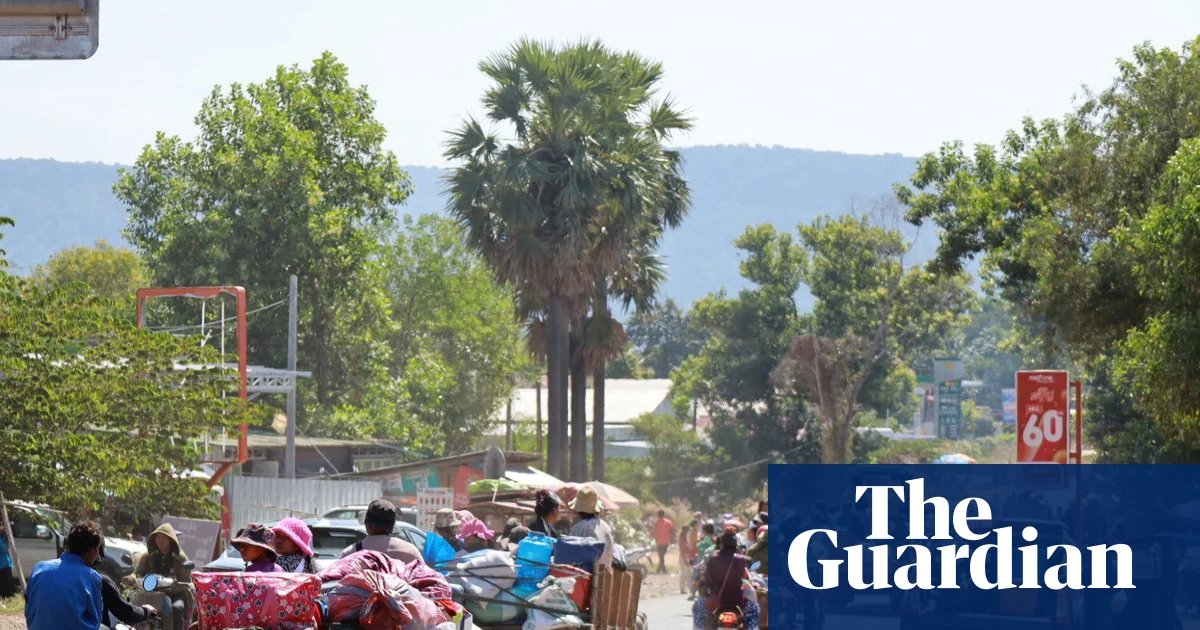
Thailand has launched airstrikes along its disputed border with Cambodia after both countries accused each other of breaching a ceasefire deal brokered by Donald Trump.
Four Cambodian civilians and at least one Thai soldier have been killed in the renewed clashes, which have forced tens of thousands of people to flee their homes.
Thailand’s military said airstrikes were launched after one of its soldiers was killed and four others wounded in fighting along the countries’ tense border on Monday morning.
The Thai air force said it was striking military targets in several areas and accused Cambodia of mobilising heavy weaponry and repositioning combat units.
Cambodia’s defence ministry blamed Thailand for the escalation. It said Thai forces had launched attacks on its troops on Monday and Cambodia had not retaliated, despite “provocative actions for many days”.
Four Cambodian civilians were killed in Oddar Meanchey and Preah Vihear provinces, according to Cambodia’s information minister, Neth Pheaktra.
Six weeks ago, Trump oversaw the signing of a ceasefire agreement he brokered to end a five-day war that erupted in July. At least 48 people were killed in the conflict and 300,000 forced to flee their homes.
Tensions have remained high despite the ceasefire agreement, with both sides accusing each other other of violations, and Thailand announcing in November that it was suspending the deal.
Cambodia’s former prime minister Hun Sen, who remains hugely influential and is the father of the current leader, Hun Manet, urged his country’s forces to exercise restraint although Thailand was trying to “pull us into retaliation”.
“The red line for responding has already been set. I urge commanders at all levels to educate all officers and soldiers accordingly,” Hun Sen said in a Facebook post.
Thailand’s prime minister, Anutin Charnvirakul, said the country did not want violence and denied initiating conflict. “However, Thailand will not tolerate violations of its sovereignty and will proceed rationally and with due regard for the principles of peace, security and humanity,” he said.
More than 385,000 civilians have been ordered to evacuate from border areas across four provinces, according to Thai authorities, who said about 35,000 people were registered at shelters on Monday morning, while more were believed to be staying with relatives.
People also fled villages on the Cambodian side of the border, according to the country’s ministry of information, which said 1,157 families had been evacuated to safe areas.
The Malaysian prime minister, Anwar Ibrahim, who helped broker the original ceasefire, urged Thailand and Cambodia to avoid escalation, warning that the fighting risked “unravelling the careful work that has gone into stabilising relations between the two neighbours”.
“We urge both sides to exercise maximum restraint, maintain open channels of communication and make full use of the mechanisms in place,” Anwar, the chair of the regional bloc Asean, said in a post online.
Tensions increased in May, when troops briefly exchanged fire at a contested area, killing a Cambodian soldier. This led to a series of tit-for-tat actions by both governments and escalated into conflict in July. A ceasefire was agreed after an intervention by Trump, who warned trade talks would be suspended until there was a peace deal, as well as efforts by Malaysia and China.
However, the arrangement has remained fragile, and last month Thailand said it was suspending the ceasefire deal, accusing Cambodia of laying fresh landmines along the border, including one it said had wounded a Thai soldier, who lost a foot in the explosion.
A Cambodian civilian was later killed, and three wounded, according to the Cambodian prime minister, after both sides accused the other of opening fire.
At the time, Trump, who has used trade negotiations to put pressure on both sides, played down the incidents, saying he had “stopped a war” through the use of tariffs, adding: “I think they’re gonna be fine.”
The dispute between Thailand and Cambodia dates back more than a century, to when France, which occupied Cambodia until 1953, first mapped the land border.
Conflict over the border, which stretches across more than 508 miles (817km), has erupted repeatedly over the years, fanned by nationalist sentiment.