dailynewsnblog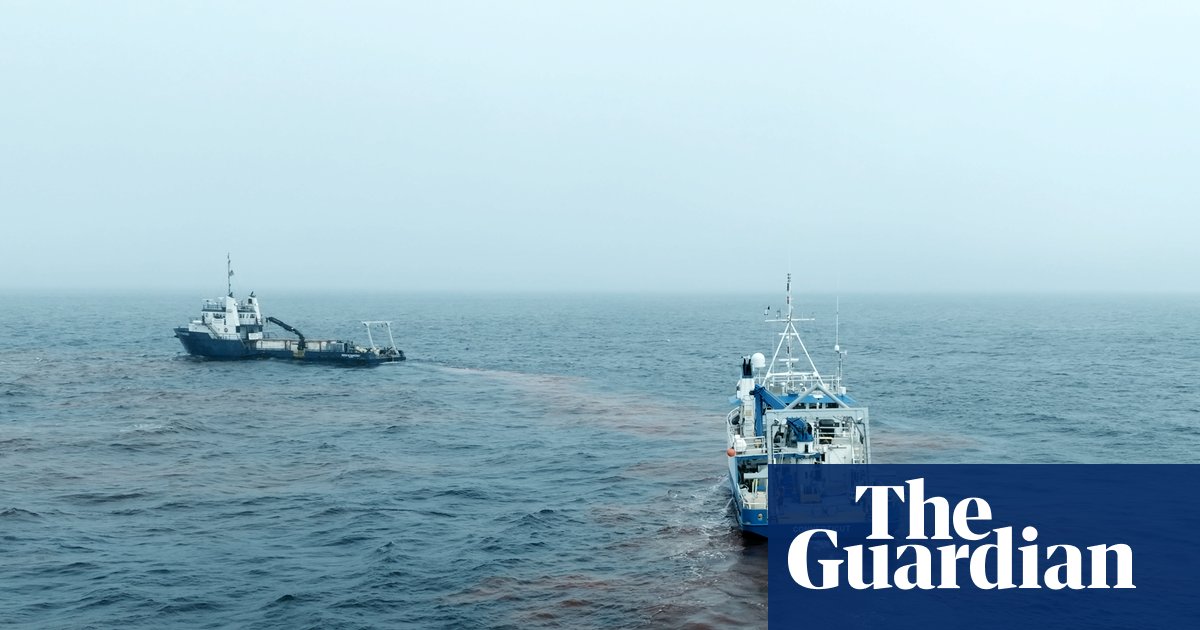
For four days last August, a thick slick of maroon bruised the waters of the Gulf of Maine. The scene, not unlike a toxic red tide, was the result of 65,000 litres of an alkaline chemical, tagged with a red dye, that had been deliberately pumped by scientists into the ocean.
Though it sounds perverse, the event was part of a scientific experiment that could advance a technology to combat both global heating and ocean acidification. Ocean alkalinity enhancement (OAE), as the approach is called, acts like natural weathering, but on human – rather than geological – timescales.
“The ocean is already incredibly alkaline. [It holds] 38,000bn tonnes of carbon, stored as dissolved bicarbonate, or baking soda,” says Adam Subhas, the lead oceanographer of the research team who announced early results from their test at the AGU Ocean Sciences Meeting in Glasgow.
Boosting this natural alkalinity using a chemical antacid should, in theory, encourage the ocean to absorb more carbon. Over a large surface area, and in combination with sharp emissions reductions, OAE could prevent global temperatures exceeding 2C above preindustrial levels, while locally reducing ocean acidity, which is now higher than at any point in the past million years and poses a dire threat to marine life and fisheries.
Licensed by the US Environmental Protection Agency and overseen by scientists from the Woods Hole Oceanographic Institution, the experiment took place 50 miles off the coast of Massachusetts in an area commonly fished for cod, haddock and lobster.
Albeit small in scale, their study, which has yet to go through peer review, found promising results. Over five days at sea, the Loc-ess project used state-of-the-art technology including autonomous gliders, long-range autonomous underwater vehicles and shipboard sensors to trace the dispersal of 65,000 litres of sodium hydroxide, an alkaline chemical that was tagged with a red dye, from the release site.
During that period, they measured up to 10 tonnes of carbon entering the ocean and an increase in local pH at the deployment site from 7.95 to 8.3, which represents a return of ocean alkalinity to preindustrial levels. The experiment showed no significant harm to creatures including plankton and fish and lobster larvae, though the team did not measure the impact on adult fish or marine mammals.
For some, using chemicals to solve an environmental problem seems reckless. “What we’re seeing is a push to exert more precise control over natural systems,” says Benjamin Day, a senior campaigner on climate and energy justice at Friends of the Earth US. Day says he is “profoundly concerned” about the environmental impacts of OEA happening at scale, including the risk of “catastrophic unforeseen consequences”.
But, like it or not, we are already experimenting with the climate, in uncontrolled ways. “We really need to think about this in terms of stewardship,” says Phil Renforth, an expert in carbon dioxide removal (CDR) at Heriot-Watt University in Edinburgh. “We’re adding CO2 to the atmosphere every year. A large proportion of that is going into the oceans, and the real question is: can we be proactive about how we manage it?”
In practice, OEA is a lot like liming, which was first used 2,000 years ago by Greek farmers to neutralise the acidity of their fields. More recently, in the 1980s, Scandinavian rivers suffering fish declines from acid rain were heavily dosed with alkaline lime; reported successes include the return of native salmon to Sweden’s Ätran River.
There are already numerous OAE startups verified to sell carbon credits through an international carbon removal registry, Isometric. Those credits are being bought by companies who aim to bill their businesses as net zero.
Yet it is still unclear whether OEA works safely at the level required to have a climate benefit. Subhas’s team, which includes researchers from Woods Hole Oceanographic Institution, Rutgers University and the Environmental Defence Fund, is the first to test this in open waters.
Their plan is now to model, using ocean data, how the chemical plume continues to absorb CO2 over time. “In the best-case scenario, this dispersal would lead to the uptake of about 50 tonnes of carbon dioxide from the atmosphere into seawater over the course of about a year,” says Subhas. For comparison, 50 tonnes of carbon is equivalent to the annual emissions of five UK citizens.
If that seems puny, it is because the team – who have no commercial ambitions with OAE – started small, to demonstrate best practice in a field that is fast evolving. “If these experiments need to be done, we want them to be done by respected, objective, transparent research institutions who are making a real effort to engage and involve us along the way,” says Sarah Schumann, a commercial fisher who joined the research team as an observer at sea.
Before her involvement, Schumann attended five of 50 meetings – conducted, in person, by the scientists – with fishers, tribal leaders and stakeholders along the Massachusetts coastline, to address local concerns ahead of the field trial.
While Schumann says local fishers have experience of collaborating with researchers, and generally trust the science, “there was a lot of concern that this could become a Trojan horse that allows other players to get their foot in the door”, she says, referring to the fact that commercial operators are keen to show OAE as effective, and therefore eligible for carbon credits.
Shumann is not alone in this concern. “We are getting a lot of companies that are just racing ahead of this,” says Day, “and they’re being facilitated by a few tech companies who were very eager to offset their emissions”.
But if OEA is to scale up as a meaningful technology, it will probably require private and public investment. The US National Oceanic and Atmospheric Administration says it could remove between 1bn and 15bn tonnes of CO2 annually at a cost of up to $160 (£120) per tonne.
“There are not many places on our planet where we can store carbon,” says Renforth. “We shouldn’t be throwing anything off the table until we’ve really got a workable solution across the whole space.”