dailynewsnblog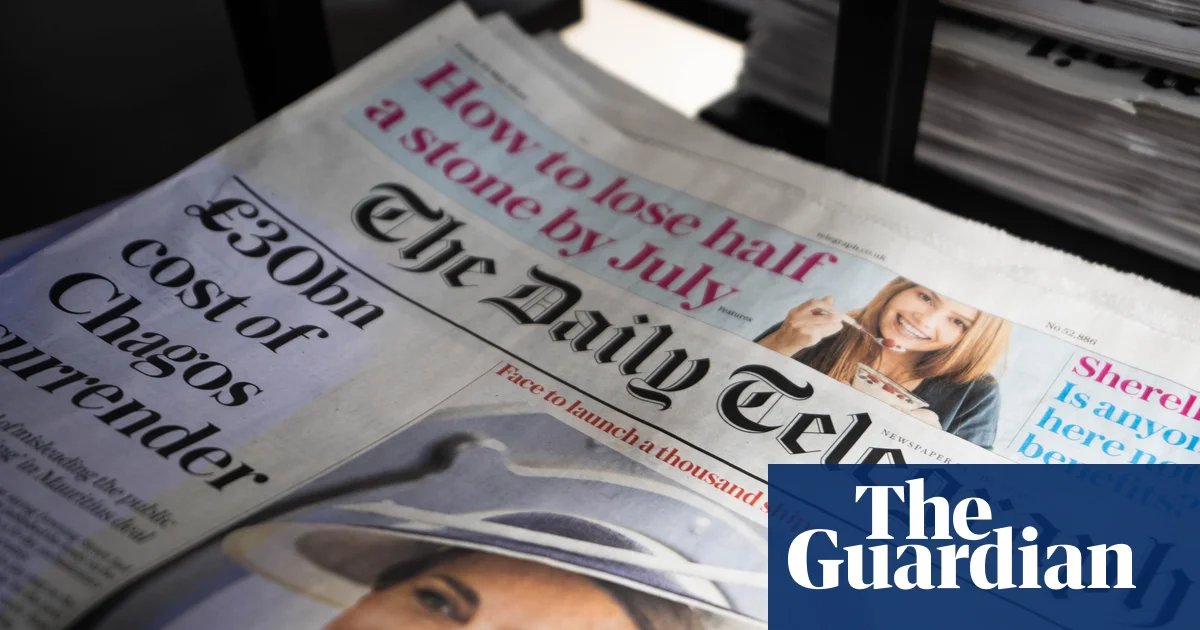
The European media group Axel Springer is to acquire the Telegraph after tabling a £575m deal that has scuppered a rival deal from the owner of the Daily Mail.
Axel Springer, which owns Europe’s biggest newspaper, Bild, and the daily Die Welt, has agreed an all-cash deal for Telegraph Media Group (TMG), the owner of the Daily and Sunday Telegraph.
Mathias Döpfner, the longstanding chief executive of Axel Springer, has made no secret of his desire to acquire assets after striking a deal with the private equity group KKR to take the media empire private two years ago.
The takeover tabled by Axel Springer, which owns Politico and Business Insider, is a significant premium to the £500m deal from Lord Rothermere’s Daily Mail & General Trust (DMGT) agreed in November.
Döpfner was trumped by a blockbuster £665m offer for the Telegraph by the Barclay brothers in 2004 and three years ago cast doubt on the likelihood of any future takeover of the group, saying Axel Springer was focused on a digital-only future.
“More than 20 years ago, we tried to acquire the Telegraph and did not succeed,” he said. “Now our dream comes true. To be the owner of this institution of quality British journalism is a privilege and a duty.”
Döpfner said the editorial independence of titles was “sacrosanct”, backing existing executives Chris Evans, the editor of the Telegraph, Allister Heath, the Sunday Telegraph editor, and Anna Jones, the chief executive of TMG.
He added that Axel Springer intended to invest in the Telegraph to make it the “leading centre-right media outlet in the English-speaking world”, with a rapid expansion planned for the US supported by the “significant expertise” of Politico and Business Insider.
“Editorial independence is sacrosanct at Axel Springer,” Döpfner said. “We believe that the best way to safeguard that is through financial and economic success. We see massive growth potential for TMG. Technological excellence and transformation with the best artificial intelligence tools is mission critical for this.”
The 63-year-old, who sits on the boards of Netflix and Warner Music, started out as a music journalist, rising to become editor of Die Welt, and was made chief executive of Axel Springer in 2002.
In 2020, Friede Springer, the widow of the German media group’s founder, Axel, named Döpfner her successor in an arrangement that gave him control of 22% of the business, the power to exercise all voting rights attached to her shareholding and made him a billionaire.
DMGT had been close to taking control of the Telegraph titles, having been given permission by the UK government to take over the right-to-buy option from RedBird IMI.
However, in recent weeks RedBird IMI, the United Arab Emirates-backed group that controls the Telegraph, started talks with Axel Springer after it expressed interest in tabling a superior offer.
The German media group is not expected to face regulatory hurdles, unlike DMGT, whose deal Lisa Nandy, the culture secretary, referred to the UK competition and media regulators for investigation last month.
“Following a swift and efficient negotiation, we are pleased to have reached an agreement with Axel Springer,” said a RedBird IMI spokesperson. “With the strength of their commercial offer and a straightforward regulatory path to ownership … our team is now working closely with the UK government to obtain the necessary approvals to finalise this transaction.”
Axel Springer and RedBird IMI acknowledged the “essential support and assistance” provided by the New York Sun owner, Dovid Efune, who had originally been part of the deal.
“Axel Springer will be an exemplary proprietor for this treasure of western journalism,” said Efune. “We’re glad to have played a meaningful role in guiding this positive outcome and helping secure the long-term future of the Telegraph.”
The takeover looks likely to bring an end to three years of uncertainty for Telegraph staff.
The sale of the newspapers was kicked off in 2023 when the Barclay family lost control of the group over £1.16bn of unpaid debts owed to Lloyds bank.
RedBird IMI – which is 75% controlled by Sheikh Mansour bin Zayed Al Nahyan, the vice-president of the UAE and the owner of Manchester City – took control of the publishing group after agreeing to pay the Barclays’ debts.
However, it was forced to put the titles back up for sale after the British government passed a law blocking foreign states or associated individuals from owning newspaper assets in the UK. There is now a 15% cap in place after the introduction of the foreign state influence regime.
A consortium led by Gerry Cardinale’s RedBird Capital, the junior partner in the RedBird IMI venture, tabled a £500m deal for the titles last year.
However, it pulled out in November, and DMGT struck its deal later that month.
“We are aware that the amazing journalists and employees at TMG have been operating in an extended period of uncertainty,” Döpfner said. “That is never easy. We want to bring that uncertainty to an end as soon as we can.”
TMG employs almost 900 staff, according to the most recent Companies House filing for 2024, with about 400 understood to be journalists.
GB News backer Sir Paul Marshall struck a £100m deal to buy the Spectator, which was also part of DMGT, in 2024.
In 2015, Axel Springer was pipped by an 11th-hour blockbuster £844m bid from Nikkei, Japan’s largest media group, to buy the Financial Times
DMGT has been approached for comment.