dailynewsnblog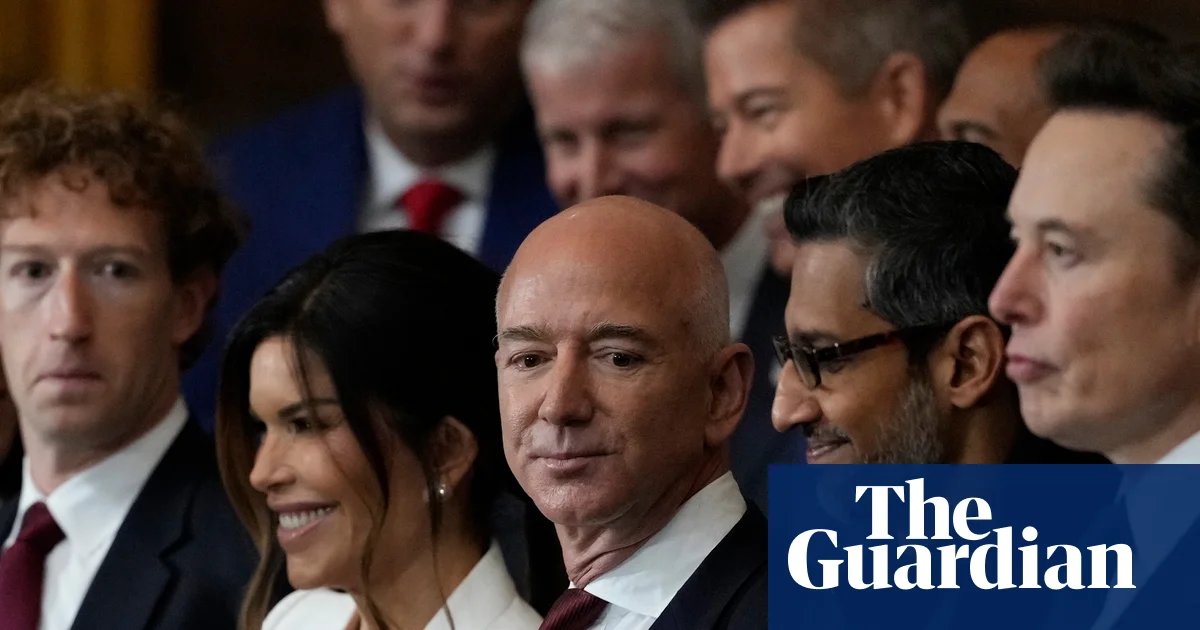
When Bill Gates became the first modern IT mogul to reach the apex of wealth and power in 1992, the world was a very different place. Gates joined the top 10 on Forbes magazine’s billionaires list alongside Japanese, German, Canadian, South Korean and Swedish billionaires, including those with family fortunes from Britain and America. A broad mix of industries was on the list: Retail and media, property management and packaging, an investment firm and a couple of industrial conglomerates. Their fortunes almost added up to $100bn – equivalent to about 0.4% of the US’s GDP that year.
The oligarchy has changed drastically since then. Bernard Arnault, of French luxury group LVMH, Amancio Ortega, the Spanish clothing mogul, and Warren Buffett, the US investor, were the only old-school billionaires among the top 10 in 2025. The rest largely made their money from high-tech: Elon Musk, Jeff Bezos, Mark Zuckerberg, Larry Ellison, Steve Ballmer and Google’s Sergey Brin and Larry Page. The top 10 amassed over $16trn, which is about 8% of US GDP.
This evolution offers a startling reminder of how fast new technologies have revolutionized the world economy over the last quarter-century, and how narrowly this brave new world is sharing the fruits of its prosperity. It raises a critical question: what happens when a narrow clutch of oligarchs at the helm of the technological revolution, sitting at the apex of wealth and power, get to determine the direction of humanity?
Is human- or even superhuman-level artificial general intelligence a goal we should strive for? Do we know what that means? How many trillions of dollars and terawatts of energy should we deploy to get there? What business models will survive it? Will it wipe out human labor? Will an ensuing productivity boom make everything free? What system of redistribution must be put in place to anticipate the future if it doesn’t?
These are consequential questions. It appears they will not be decided through public deliberation or democratic choice. The tight knot of people at the top of Forbes’ 2025 list will make the call. Add in Anthropic’s Dario Amodei, Open AI’s Sam Altman, the tech funder, Peter Thiel, and maybe a couple of dozen others and you’ve pretty much identified the set that will guide artificial intelligence as it shapes the future of the world.
This is problematic not just because they are billionaires, untouched by the daily concerns of most humans. Their worldview is embedded in a belief that technology offers the best solution to all of humanity’s challenges, whether social, political, economic, demographic, biological, psychological, environmental, or whatever other dimension one might think of. Their preferred AI-laced future has little space for the humdrum concerns of the all-too-real people who populate the present. It has no patience for slow, messy democratic governance, especially if said governance slows down the path to utopia.
They may not all align neatly along the left-right spectrum of our politics. That’s because their aspirations are orthogonal to the critical political debates of the day. How they choose to deploy their money, however, starting with nearly $200m directed so far to prevent states from imposing AI regulations, signals one of their key aspirations: allowing artificial intelligence to rip free and build the next phase of humanity’s cosmic evolution, one which may not include humans as we know them.
The tech oligarchs are not particularly shy about this ambition. Larry Page has argued that digital life is the “natural and desirable next step” in humanity’s cosmic evolution. “If we let digital minds be free rather than try to stop or enslave them, the outcome is almost certain to be good,” he said. Humanity “will be the first species ever to design our own descendants”, argued Altman. Humans “can either be the biological bootloader for digital intelligence and then fade into an evolutionary tree branch, or we can figure out what a successful merge looks like.”
Musk, whose Neuralink is working to patch AI into human minds, is also invested in building what will succeed everyday humans. So is Zuckerberg, who recently directed his philanthropy to devote itself entirely to advancing ways to extend life. When Thiel dies, his body and brain will be frozen in liquid nitrogen, to be transferred “into an immortal body” in the future. As he wrote in the Education of a Libertarian, “I stand against (…) the ideology of the inevitability of the death of every individual.”
The tech oligarchs don’t all think alike. Some moguls insist that their consciousness should be part of the next step in humanity’s evolution, whether cryogenically preserved or uploaded into some electronic gadget. Others just want to help bring about the next AI phase of intelligent life, even if their ego is not around to experience it. Nonetheless, they all share a disinterest in concerns about housing and healthcare, or the price of food and gas.
Indeed, the technological oligarchy is offended by the idea that humans, as we now know them, should take precedence over artificial life forms. “People talk about how much energy it takes to train an AI model, but it also takes a lot of energy to train a human,” Altman said. “It takes about 20 years of life, and all of the food you consume during that time, before you become smart.”
Anthropic has earned plaudits by calling for the regulation of AI and resisting the Pentagon’s demands to give it unrestricted access to its Claude AI. But even its leaders are gunning for a transhuman future. They may be eager to prevent a Skynet moment when an AI blows us all up before we achieve utopia. But Claude is being trained to become a new life form. As Amanda Askell, Anthropic’s resident ethicist put it: AIs will “inevitably form senses of self”.
Many economists will argue that all this is sci-fi claptrap. They will point out that we have gone through technological revolutions before. Since the Industrial Revolution, every breakthrough has brought about dystopian visions of their impact on society. But technology has mostly led to great gains in human wellbeing. The productivity gains promised by AI will undoubtedly enrich real people.
Perhaps. But our current technological revolution is unusual in a particularly unsettling way. It comes at the hands of a small group of very powerful people who hold themselves and their preferences in very high regard. However troubling their views of the future may be, nobody seems willing to stand in their way.
I never really appreciated billionaires. I understand the notion that contributions to human wellbeing and prosperity should be commensurately rewarded, to incentivize future breakthroughs. But I’ve had a hard time squaring “billions” with “commensurate”. Moreover, there is plenty of evidence that oligarchs’ “contributions” to society are often things society would have happily done without.
And yet I find myself nostalgic for the billionaires of yore. They seem so harmless from our perch in the present. They made Tetra Paks and sold real estate in Japan. They owned supermarkets. The guys at the helm of our economy today are way scarier. And they aim to transform human civilization as fast as they can.