dailynewsnblog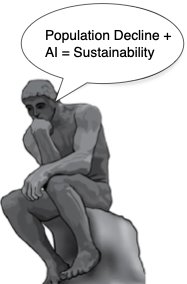

Two economic “problems” confound our policy-making. They appear distinct, yet offer a very promising relationship.
The first is population decline. Outside of Sub-Saharan Africa, the entire globe is seeing declines in birth rates to below the population replacement rate of 2.1. To maintain population growth, countries such as Canada must resort to immigration.
Economists fret about this because declining populations mean aging populations. That in turn means fewer young workers to take care of more retirees, a problem indeed.
The second problem is automation, particularly artificial intelligence (AI). There is a growing fear, especially among young people, that we are being replaced by machines, that we will run out of jobs. Considering the remarkable potential of AI, this is not unreasonable.
But are these really two problems? If we stopped looking at them separately, if we combine them, we discover a solution, a solution to the greatest problem facing humanity—creating a sustainable economy.
If population declines, our overall needs can decline as well along with our demands on the planet’s resources. But our individual demands can remain the same. In other words, we can maintain our individual standards of living.
Shrinking populations will, as economists fear, lead to aging populations. There will be increasingly fewer young workers. However, the need for labour to replace those who are aging out can be made up with machines, with AI and automation.
Complement declining populations with AI and automation to meet labour needs and we can achieve sustainability. We can reduce our demands on resources until what we use can be replaced by the environment, something that is not happening now. Currently, we are exhausting the planet’s resources, sucking it dry. And, at the same time, we are polluting it faster than it can absorb the pollution.
The two “problems” are offering us a way to live within our means without sacrificing our life styles. They will, of course, require monitoring and guiding such that they complement each other.
Also required will be educating the masses and their political leaders about the opportunity. Judging by the difficulty in getting them to accept global warming/climate change, that won’t be easy.
Everyone from economists to politicians to business people are committed to growth. If that growth is in productivity, it doesn’t present a problem. Indeed if AI and automation allowed us to increase productivity sufficiently to reduce our demands on resources to a sustainable level, we wouldn’t need to reduce our populations. But that has never happened. In the past, increased productivity was more likely to increase, not reduce, demand.
Population growth is also often desired by politicians and others in order to increase political or ethnic power. For example, we currently see, in the U.S. and Europe, many conservatives despairing at white Christians being “replaced” by people of other races and religions. White Christian nationalism is having a moment.
AI and automation also find resistance, in this case justifiably. They are transforming work faster than our work forces can adapt, even threatening to make human labour obsolete, a frightening prospect.
Technology won’t stop advancing, but we can minimize the fear. We can better transition workers. We can improve the prediction of and adaption to job losses with better support for workers moving to new jobs in the new economy. AI can contribute to a jobs apocalypse or be a partner in achieving a sustainable future.
The challenge is to co-ordinate the implementation of AI, and automation generally, with population decline so as to achieve sustainability. We are offered an answer to our greatest problem.