dailynewsnblog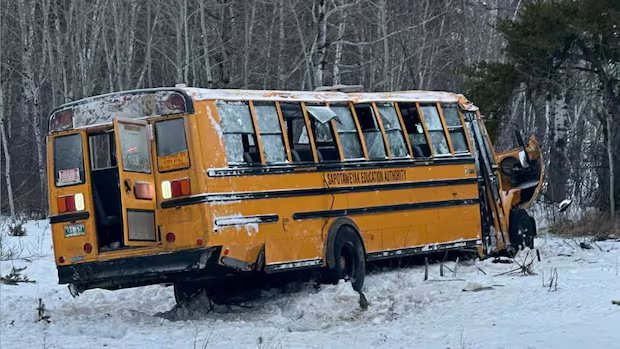
A school administrator in an Ontario community that experimented with seatbelts on three school buses says there was a learning curve — especially with younger students — but also an enhanced sense of student safety, along with some unexpected upsides.
“Those three drivers have said they don’t ever want to go back to a bus without seatbelts,” said Renée Boucher, executive director at the Sudbury Student Services Consortium. “It has been very positive for us not solely during the pilot project, but now as well.”
Two communities in Ontario and two in B.C. that have introduced seatbelts on school buses in recent years may have helpful insights to offer Manitoba as safety discussions swirl after a rural crash that injured several students on Tuesday.
The driver and 14 high-school-aged students from Sapotaweyak Cree Nation were treated for injuries after their bus tried to pass another bus on Highway 10, south of Mafeking, and rolled into a snowy ditch.
Three students who were airlifted to hospital in Winnipeg have since been released. Other students and the driver were taken to a closer hospital in Swan River, about 380 kilometres northwest of Winnipeg.
RCMP continue to investigate the crash. No charges have been laid.
On Tuesday, Manitoba’s premier said he is open to discussions around seatbelts on school buses, but cautioned that not all of the circumstances of the crash have surfaced yet.
In December, Manitoba’s Opposition Progressive Conservatives introduced a private member’s bill that would make seatbelts mandatory on new school buses if adopted.
School bus safety: then and now
For decades, a cornerstone of school bus safety design has been “compartmentalization” — described by Transport Canada as the system of closely spaced, high-backed seats with energy-absorbing padding that are designed to reduce injury risk in the event of head-on collisions by keeping students contained in a protective compartment.
A seminal 1984 study by Transport Canada suggested compartmentalization was a sufficient safety measure. It also suggested two-point lap seatbelts were ineffective, may even cause “fatal injuries” and should not be introduced on school buses.
That research did not account for side-impact collisions or rollovers, and some of its findings have come under scrutiny in recent years.
Though details are still emerging, at least two of the 14 students involved in the Manitoba crash this week said they were thrown from their seats and ejected through windows as their bus rolled.

“Compartmentalization has been around for around 50 years, and at the time it was basically stated that it was incomplete,” said John Barrington, executive director of sales at IMMI, a U.S.-based manufacturer of school bus seatbelt systems.
“Compartmentalization only works if the students are in the compartment.”
That was echoed by Sudbury’s Boucher.
“On regular buses without seatbelts, many children are not seated properly. They turn around, they’re on their knees,” she said.
“So if there was a collision … that compartmentalization system would not work for those particular children.”
Sudbury seatbelt pilot
The Sudbury Student Services Consortium was one of three to pilot seatbelts on buses as part of a joint study by the B.C. and Ontario governments, along with Transport Canada, called “Strengthening School Bus Safety in Canada 2025.”
Researchers also looked at the experience of the Student Transportation Services of Waterloo Region, which independently started a seatbelt pilot of its own after rollover and side-impact crashes in 2019 and 2022, respectively, according to the study.
Keith Prudham, general manager of the organization, said the pilot has been successful — so much so that 69 of its current fleet of about 270 buses now have three-point seatbelts, and more are being added each year.
Continuing research has found “opportunities to further enhance safety, particularly in the event of side-impact collisions and rollovers” — situations where three-point seatbelts offer another layer of protection, Prudham said in a statement.

The introduction of seatbelts didn’t come without snags in the pilots.
All four found that seating three students per bench was only feasible for kids below Grade 4, due to the nature of the buckle placements. That resulted in a reduced capacity on buses in Fraser-Cascade, B.C., from 76 to 55.
Seatbelts also added time to trips — five to 10 minutes overall, three to five on average for routes in Sudbury — to allow for buckling up.
In the winter, snowsuits could pose a challenge for some students.
A dozen parents in Sudbury initially considered pulling their children from the pilot because the students complained about seatbelts pushing into their necks.
But that initial opposition and some of the other snags were temporary, Boucher said.
Younger students required more time earlier on in the pilot to figure out how to buckle up properly, but they got the hang of it over time through training from teachers and help from teenage monitors assigned to help on buses, she said.
A song sung while boarding the bus helped remind young students to take off their backpacks before buckling up.
The Sudbury consortium also produced a how-to video and encouraged parents to review it with their children.

The Sudbury Student Services Consortium produced this video to help parents and students prepare to use seatbelts on school buses as part of a pilot program.
It took longer to evacuate buses in the pilots, but in Sudbury, at least, that added time was marginal: evacuation exercises took 14 seconds longer, said Boucher.
Though older students for the most part did not struggle with seatbelts, for a time they seemed more likely to unbuckle during the ride. Boucher said that was effectively addressed through a system of warnings for students and parents.
“Busing is a privilege, of course, and so it will be a lost privilege if they don’t buckle,” she said.
That ties into another key finding across the four pilots: seatbelts had a “positive impact on student behaviour,” reducing noise and improving drivers’ ability to focus on the road, the report says.
“The children don’t have a choice but to sit down and buckle up, so it has helped with the discipline issues on those buses — which explains why those drivers absolutely love them,” said Boucher.
An added bonus that didn’t make it into the study was that buckled students seemed to be bumping into bus windows and seats less often when travelling over potholes and crummy roads, she said.
“If money was no issue, if resources were not an issue, I would want to see more” buses with seatbelts, said Boucher.

Findings from a pilot project in Sudbury, Ont., involving seatbelts on school buses may hold valuable insights for Manitoba as safety questions emerge following a rural school bus crash.