Stocks sag in Asia, Brent crude heading for record month


By Wayne Cole

SYDNEY, March 30 (Reuters) – Stock markets slid in Asia on Monday as investors dug in for a protracted Gulf conflict that already has oil prices heading for a record monthly rise, bringing a spike in inflation and the risk of recession to much of the globe.

Pakistan said it was ‌preparing to host “meaningful talks” to end the conflict over Iran in coming days, even though Tehran accused Washington of preparing a land assault as the U.S. military builds ‌up forces in the region.

The Financial Times late on Sunday quoted President Donald Trump saying the U.S. could seize Kharg Island in the Persian Gulf, from where Iran exports much of its oil, but also that a ​ceasefire could come quickly.

Yemen’s Iran-aligned Houthis also launched their first attacks on Israel since the start of the conflict.

“Iran’s control of the Strait of Hormuz, capacity to disrupt global energy and food markets, and sustained missile and drone capabilities give it little incentive to concede, pressuring the U.S. to escalate,” said Madison Cartwright, senior geo-economics analyst at Commonwealth Bank of Australia.

“We expect the war to run at least into June, with the risk tilted to a longer conflict.”

The clampdown on the strait has sent prices for oil, gas, fertiliser, plastic and aluminium surging, along with fuel for ‌planes and shipping. Prices for food, pharmaceuticals and petrochemical products are ⁠all set to rise.

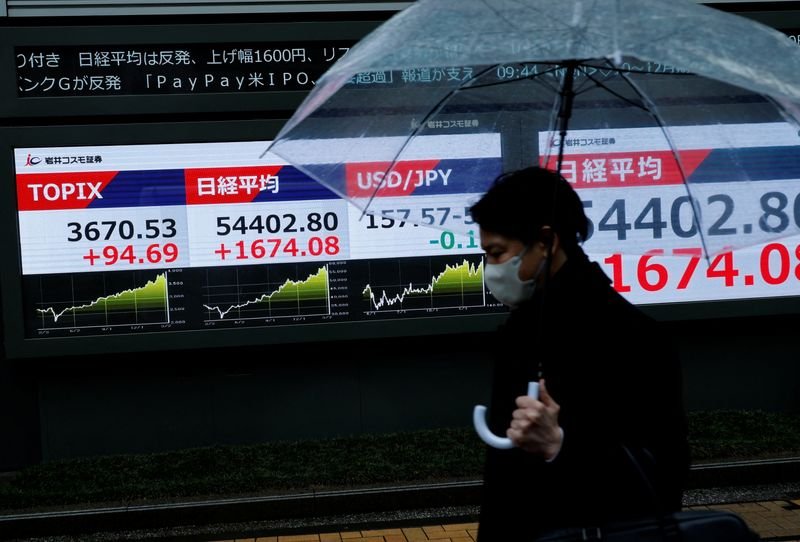
That is bad news for Asia, as much of the region is highly dependent on energy from the Middle East. Japan’s Nikkei shed another 3.4%, bringing losses for March to nearly 13%.

South Korea’s market was down 3.0% on Monday, while Chinese blue chips lost 0.2%. ⁠MSCI’s broadest index of Asia-Pacific shares outside Japan dropped 1.3%.

S&P 500 futures and Nasdaq futures pared their early losses to be a fraction easier. For Europe, EUROSTOXX 50 futures and DAX futures both fell 0.7%, while FTSE futures dipped 0.4%.

Brent crude rose 2.0% to $114.90 a barrel, bringing its gains for the month to almost 59% and outpacing the jump that followed Iraq’s invasion of Kuwait in 1990. U.S. ​crude ​climbed 1.8% to $101.39, making a monthly rise of 51%. [O/R]

“The longer the Strait remains closed, the sharper the drawdown ​in buffer supplies that could spark dramatic increases in the price ‌of crude oil, natural gas and other commodities,” warned Bruce Kasman, global head of economics at JPMorgan.

“A scenario in which the Strait remains closed for an additional month would be consistent with oil prices rising towards $150/bbl and constraints on industrial consumers of energy supply.”


FED IN FOCUS AS PAYROLLS LOOM

The inflationary threat has led investors to revise up the outlook for interest rates almost everywhere. Markets now imply 12 basis points of tightening by the Federal Reserve this year, compared with 50 basis points of cuts a month ago.

Fed Chair Jerome Powell will have a chance to air his own views at an event later on Monday and the influential head of the New York Fed, John Williams, is also talking.

Data on U.S. retail sales, ‌manufacturing and payrolls this week will provide an update on how the economy is faring. Jobs are ​seen rising 55,000 in March, after February’s shock 92,000 drop, keeping unemployment at 4.4%.

In the European Union, figures ​on Tuesday are forecast to show annual inflation leaped to 2.7% in March from ​1.9% the month before, though core prices should be steadier.

The energy shock, combined with pressure on fiscal budgets from higher borrowing costs and the ‌need for more defence spending, has slugged sovereign bond markets.

Ten-year U.S. Treasury ​yields are up roughly 44 basis points for ​the month so far at 4.407%, while two-year yields have climbed 50 basis points.

Heightened volatility in markets has tended to benefit the U.S. dollar as the world’s most liquid currency. The U.S. is also a net energy exporter, giving it a relative advantage over Europe and much of Asia.

Yet warnings of possible intervention from the ​Japanese authorities did see the dollar ease 0.3% to 159.74 yen. ‌It crossed the 160 barrier last week for the first time since July 2024 when Japan last acted to buy yen.

The euro was stuck at $1.1513, not ​far from a March trough of $1.1409.

In commodity markets, gold was flat at $4,493 an ounce, having drawn scant support as a safe haven or as a hedge ​against inflation risks. [GOL/]

(Reporting by Wayne Cole; Editing by Edmund Klamann, Muralikumar Anantharaman and Thomas Derpinghaus)


Source link

  • Related Posts

    Iran’s Attacks on Aluminum Plants Raise Risk of Supply Crisis

    For aluminum buyers, the impact is likely to be felt over the coming months. Some shipments of aluminum from the Middle East had already cleared the Strait of Hormuz when…

    International Petroleum Corp. Annual General Meeting to be held on May 6, 2026

    For further information, please contact: Read More Source link

    Leave a Reply

    Your email address will not be published. Required fields are marked *

    You Missed

    Sheffield Shield final 2025-26 – Vic v SA – Ryan Harris thinks Nathan McAndrew should be in the Test frame

    Sheffield Shield final 2025-26 – Vic v SA – Ryan Harris thinks Nathan McAndrew should be in the Test frame

    Chanel’s Le19M Heads to Shanghai, Deepens Its Dialogue With Asia

    Chanel’s Le19M Heads to Shanghai, Deepens Its Dialogue With Asia

    Iran live updates: Trump touts ‘big day’ in Iran with ‘many’ strikes

    Iran live updates: Trump touts ‘big day’ in Iran with ‘many’ strikes

    Glen Powell is voicing Starfox’s Fox McCloud in the upcoming Super Mario Galaxy movie

    Glen Powell is voicing Starfox’s Fox McCloud in the upcoming Super Mario Galaxy movie

    Iran’s Attacks on Aluminum Plants Raise Risk of Supply Crisis

    Big retailers say UK jobs at risk from guaranteed hours reforms | Employment law

    Big retailers say UK jobs at risk from guaranteed hours reforms | Employment law