dailynewsnblog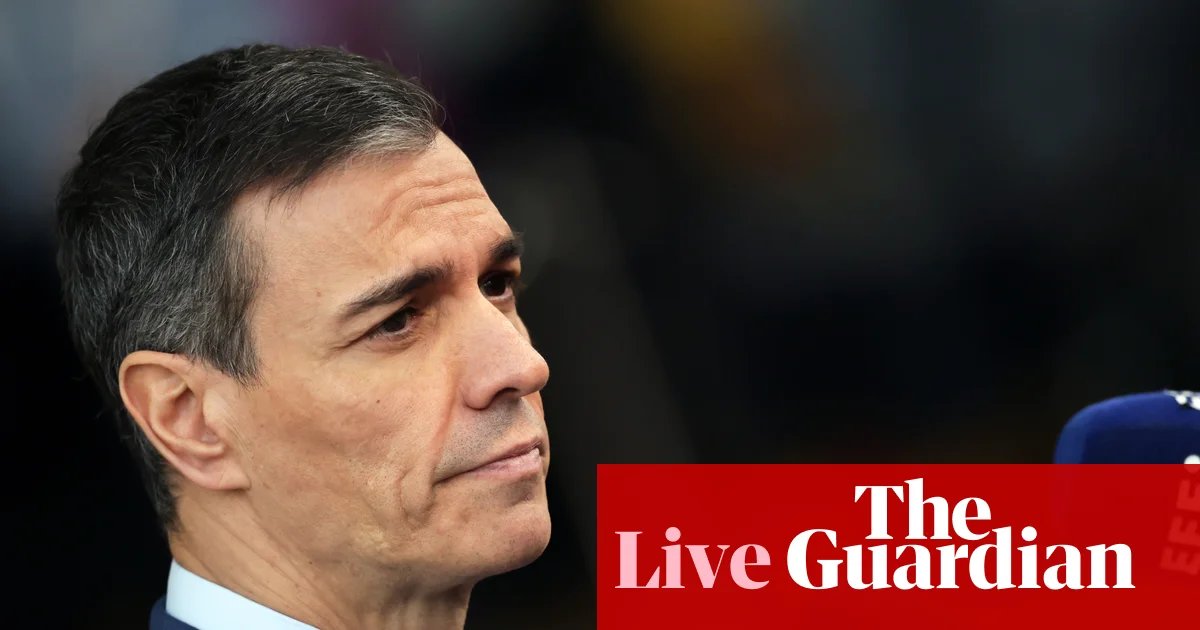
Morning opening: Spain moves first to help with energy prices
Spain is set to put forward a number of emergency tax cuts this morning to counter the economic impact of the Iran war.

The measures – set to be presented at a press conference 11am local time – are expected to include lowering VAT tax on fuels to 10% from 21%, according to early media reports, alongside other changes, including to the hydrocarbon and electricity duties, intended to help with growing energy prices.
Reuters says that change to the hydrocarbon levy itself alone is likely to lead to an immediate reduction in the price of diesel and petrol between 0.30 and 0.40 euros.
Spain’s prime minister, Pedro Sánchez, has been a leading European voice critical of US and Israeli strike in Iran, repeatedly sounding alarm about its likely economic impact on Europe.
Ministers said earlier this week the measures would include aid for economic sectors most exposed to the crisis, but added that the country’s high generation of renewable energy meant its economy was less exposed to the impact of oil price spikes caused by the war, Reuters noted.
But other countries may now follow as the European Commission president, Ursula von der Leyen, signalled last night that there was some intent to move in this area.
Speaking after a meeting of the European Council, she said that electricity is often taxed higher than gas and that needs to change, while proposing to reduce grid charges. She also suggested some flexibility on the use of state aid to help with growing energy costs.
Separately, we will keep an eye on the final moments of the parliamentary campaign in Slovenia, local races in France and Germany, and the Italian judiciary referendum – all taking place this weekend.
It’s Friday, 20 March 2026, it’s Jakub Krupa here, and this is Europe Live.
Good morning.
Key events
Belgium’s De Wever defends comments on ‘normalising’ relations with Russia after Ukraine war ends, but insists he is fiercely pro-Ukrainian
Separately, Belgium’s prime minister, Bart De Wever, has defended his comments calling for the normalisation of relations with Russia to re-establish cheap energy supplies.
Earlier this week, he told the Belgian newspaper L’Echo that “we are losing on all fronts, we must end the conflict in Europe’s interest.”
De Wever said Europe had to rearm “and at the same time we must normalise relations with Russia and regain access to cheap energy. It is common sense. In private European leaders tell me I am right, but no one dares say it out loud.”
But during his post-summit presser last night, he defended his position, saying he is used to the fact that “the first one who speaks [out], gets all the bad media.”
“It [caused] a commotion in Belgium, it always [causes] a commotion in Belgium, because it was the an ideal moment to play political games, but I noticed none of that in the room here, none, nothing. People know very well what I think in this room, I’m very outspoken, and they have no doubts of about my loyalty to Ukraine.”
De Wever said that his comments only related to a post-peace scenario, when Ukraine gets an acceptable peace deal with Russia.
“Once you have an acceptable peace for Ukraine and Europe, the next question is, what is your long term relationship [with] Russia?
Should it be hostility, a new cold war for decades, no relations, no economic [exchange], none whatsoever, or should your goal … be to go to normalisation. In that option, my idea as an historian is it would be better to go to normalisation; otherwise you have very little to offer.”
He said it was not up to him or other European leaders to “offer concessions” before a peace agreement with Ukraine is struck, but that the promise “of going back to normal relations is something that could be convincing for the other side” to engage in talks more seriously.
But De Wever insisted he was “very pro-Ukrainian,” particularly given his family background.
“I come from a family that has a history with Ukraine [going back] decades. I could tell you stories about my family in Ukraine that are very colourful.
My brother even smuggled money into Ukraine during the Soviet times to finance dissidents. And … my father was the first to cross the border into Ukraine to set up a aid organisation. My entire childhood, I remember Ukrainian presence in my house where Ukrainian families came to work and to earn some [money].
So the idea that I am not pro-Ukrainian is to me, quite insulting, even at the emotional level.”
But he said it was in Europe’s interest to resolve existing tensions as the geopolitical situation becomes too complicated to navigate.
“Having a war in the Middle East, having a war in Ukraine, having protectionism and tariffs from the United States, having fierce competition from China, with massive dumping of industrial products – it’s a lot for Europe. A lot. If I look around me in the world, I think this is a little bit too much. …
I think we should actively think about our situation and try to get to a better situation, that’s all I wanted to say.”
There are no prizes for guessing that his view is still unlikely to be particularly popular with several other EU leaders, not just in central and eastern Europe, who keep warning about Russia’s aggressive and expansionist policy…
‘I stand for their interests,’ Orbán defends his opposition to EU’s Ukraine loan and calls for return to Russian oil
A large part of last night’s European Council summit was about Viktor Orbán and his refusal to drop his opposition to a vital €90bn (£78bn) loan for Ukraine, with other leaders accusing him of betrayal and acting in bad faith.
But the embattled Hungarian prime minister, who faces a tough election next month which could see him ousted after 16 years in power, ignored the criticisms when briefing the media at the end of the talks.
When asked what Hungarian voters will make of his position, he said:
“I stand for their interest. What I have done here is [tried] to crush the oil blockade imposed on us by Zelenskyy, so I defended the interests of the country.”
Curiously, Orbán also went further, insisting that the EU will need to reset its relations with Russia and import Russian energy to deal with expected shortages caused by the Middle East crisis.
“At this moment, [we are] just knocking on the door of a shortage of oil globally. So the behaviour, the strategy, that Europeans have here is just crazy.
We definitely need the Russian oil, so we cannot survive this situation … without involving Russian fuel energy again. Europe cannot survive without that. Probably now they deny that fact, but it [will] take not more than one or two weeks [and] this will be obvious for everybody.”
Separately, asked if he can still win the upcoming election, he smiled: “Certainly.”
Morning opening: Spain moves first to help with energy prices
Spain is set to put forward a number of emergency tax cuts this morning to counter the economic impact of the Iran war.
The measures – set to be presented at a press conference 11am local time – are expected to include lowering VAT tax on fuels to 10% from 21%, according to early media reports, alongside other changes, including to the hydrocarbon and electricity duties, intended to help with growing energy prices.
Reuters says that change to the hydrocarbon levy itself alone is likely to lead to an immediate reduction in the price of diesel and petrol between 0.30 and 0.40 euros.
Spain’s prime minister, Pedro Sánchez, has been a leading European voice critical of US and Israeli strike in Iran, repeatedly sounding alarm about its likely economic impact on Europe.
Ministers said earlier this week the measures would include aid for economic sectors most exposed to the crisis, but added that the country’s high generation of renewable energy meant its economy was less exposed to the impact of oil price spikes caused by the war, Reuters noted.
But other countries may now follow as the European Commission president, Ursula von der Leyen, signalled last night that there was some intent to move in this area.
Speaking after a meeting of the European Council, she said that electricity is often taxed higher than gas and that needs to change, while proposing to reduce grid charges. She also suggested some flexibility on the use of state aid to help with growing energy costs.
Separately, we will keep an eye on the final moments of the parliamentary campaign in Slovenia, local races in France and Germany, and the Italian judiciary referendum – all taking place this weekend.
It’s Friday, 20 March 2026, it’s Jakub Krupa here, and this is Europe Live.
Good morning.