dailynewsnblog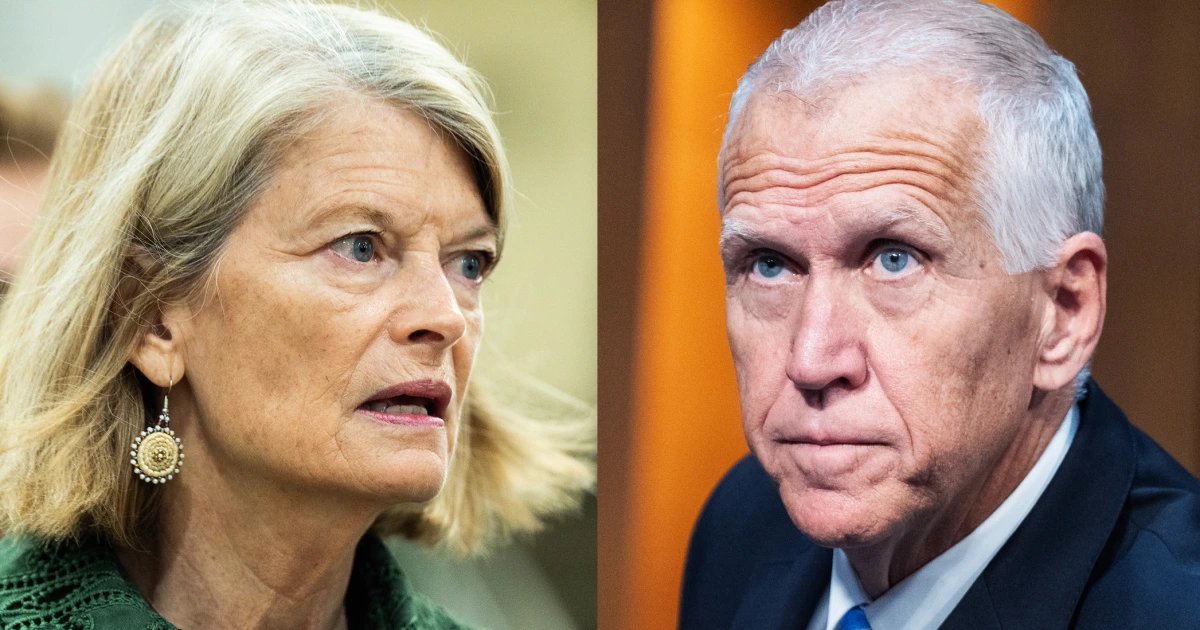
WASHINGTON — Sen. Mike Lee has been marshaling an online army to pressure fellow Republicans to pass the SAVE America Act, a sweeping bill to rewrite election laws across the country, which President Donald Trump has declared his “No. 1 priority.”
It is testing the relationship between Trump and Senate Majority Leader John Thune, R-S.D., who is seeking to balance the demands of the president and passions of the GOP base with the unforgiving realities of the Senate.
“Next week I will be bringing the SAVE America Act to the floor, and we’ll be having a full and robust debate,” Thune said Thursday on the Senate floor. “I can’t guarantee an outcome on this legislation. I can guarantee you that we are going to put Democrats on the record, that they will be forced to defend their outrageous positions on these issues.”
Early next week, Thune plans to bring up the House-passed version, which was structured as a “message” to allow the Senate to begin debate with 51 votes. A GOP leadership aide said the Senate will engage in days of extended debate on the bill, giving senators ample chance to speak on it and force Democrats to defend their opposition, while considering amendments sought by Republicans. The process could extend into the following weekend and beyond, the aide added.

But in the end, it will take 60 votes to cut off debate. As a result, some Republicans say it has no viable path to Trump’s desk.
“There isn’t any strategy,” Sen. Thom Tillis, R-N.C., told reporters. “There’s a 0% [chance] of this succeeding.”
“People on my side of the aisle — and people at the far right of the political spectrum — are trying to swing for the fences, and they’re not going to succeed,” said Tillis, while adding that he supports the legislation on the merits. “And we’re not going to have more states with more voter ID, which is what I want. In the process, we are setting up vulnerable Republicans for a more difficult environment than they already have.”
Some Republicans are frustrated that Trump is so fixated on an election bill that won’t pass and wish he’d put the same amount of political capital into moving bills to lower the cost of living ahead of the midterm elections, when their majorities in Congress are on the line.
“This is frustrating, but it’s also a regular occurrence,” one House Republican in a competitive re-election race told NBC News, speaking freely about frustrations with their own party on the condition of anonymity. “Congress just needs to keep moving forward with bills like the housing one and others that help with affordability.”
Why the bill is unlikely to pass
The math isn’t on the GOP’s side: They have 51 votes in favor of the bill, but face a 60-vote threshold to pass it. And they have no chance to get there, as Democrats unanimously and firmly oppose it.
Supporters of the SAVE America Act have floated two approaches to get around the 60-vote rule. Both are likely to fail.
The first idea is the “talking filibuster” under current rules, which Lee, R-Utah, has called for. Proponents can’t point to any example of this tactic working unless at least 60 senators vote to cut off debate and allow for final passage, which Democrats have made clear they won’t do.
And attempting it could lead to days or weeks of debate, going through the night, where the minority Democrats would have a huge advantage: They just need one senator to hold the floor to give speeches of infinite length, and can rotate between their 47 members. Republicans, however, would need 51 of their 53 senators to be on or near the floor at all times, and all hours or the day, for a “quorum.” Otherwise, one Democrat could just adjourn the Senate and end the “talking filibuster.”
“It’s a waste of time,” Tillis told NBC News. “I don’t think it’s going to result in an outcome. And if you take a look at the chances of success versus the probability of failure, it’s not even close.”
Tillis also warned that Democrats could offer unlimited amendments at a simple-majority threshold, some of which could put politically vulnerable Republican senators in a bind.
“Do you really think if you’re targeting Susan Collins, or some of our most at-risk people, and she has to vote against something that’s politically problematic, that they’re going to be able to explain, well, it was just a motion to table?” he said, referring to the Maine Republican who is one of the GOP’s most vulnerable senators up for re-election this fall.
Sen. Ron Johnson, R-Wis., also conceded that pursuing a “talking filibuster” is unlikely to work for the SAVE America Act.
“It’s almost impossible to pass it that way,” he said.
The second idea is to trigger the “nuclear option” and change the rules of the Senate with 51 votes to weaken or abolish the legislative filibuster. Trump has championed this idea.
But he’s vastly outnumbered. Only a few Republicans have endorsed that idea, like Johnson and Sens. John Cornyn, R-Texas, Bernie Moreno, R-Ohio, and Tommy Tuberville, R-Ala.
Thune told reporters there are “not even close” to enough votes in the Senate to nuke the filibuster.
And many Republicans are dug in against a filibuster rule change — including Tillis and Collins, as well as Sens. Lisa Murkowski, R-Alaska, and Mitch McConnell, R-Ky.
There are plenty of other senators who support the SAVE America Act on the merits but aren’t willing to dispense with the filibuster to pass it. Many Republicans believe that the 60-vote hurdle benefits conservatives in the long-run, by empowering them to block Democratic priorities the next time they are in the minority.
Sen. Rick Scott, R-Fla., said the first priority is to get 60 votes, but “that appears difficult.” The fallback is to attach the SAVE America Act to a “must-pass bill,” in the hopes Democrats would go for it, but Democrats could block that, too.
Beyond that, “if we can do the talking filibuster, that’s great,” Scott said. But notably, even Scott declined to endorse a filibuster rule change.
“I think we have to figure out how to get it done,” he said. “I don’t want to make a decision yet.”
GOP warnings
Retiring Rep. Don Bacon, R-Neb., supports the SAVE America Act, but said it would be wiser for Trump to just narrowly focus on voter ID provisions, which have more widespread support. The bill also requires proof of citizenship to register to vote, which Democrats argue is unnecessary since non-citizen voting is already illegal and rare and would just end up disenfranchising American citizens with added burdens. And Trump has suggested that Republicans add even more contentious issues, like banning transgender people from women’s sports.
“There’s dreams, and there’s then reality,” Bacon told NBC News. “The smart plan is to focus on voter ID. And have a plan to make housing more affordable.”
“He’s still fixated on 2020,” Bacon added of Trump’s relentless focus on the SAVE America Act.
Trump has not posted about the Senate’s major, bipartisan bill to address housing costs and shortages since it passed on Thursday. But he has repeatedly posted about the SAVE America Act. He also appears to be withholding his endorsement in a key Texas Senate race over the issue and has threatened to not sign any other bill until Congress passes the voting restrictions.
Murkowski is a rare Republican senator who opposes the SAVE America Act, arguing that her party has long purported to be against federal mandates for states when it comes to their elections.
She added that she worries that Trump is setting himself up to falsely claim the 2026 elections were “rigged” if the SAVE America Act fails and Republicans lose.
“If you’re suggesting now — this is March — that ‘If my bill doesn’t pass, something that I want doesn’t pass, somehow or other, elections in the country are rigged?’ Why am I concerned that that might be the strategy?” Murkowski said. “Because I think that we saw this suggestion back in 2020 that if, if President Trump didn’t win, it was because the election was rigged because people were cheating.”