dailynewsnblog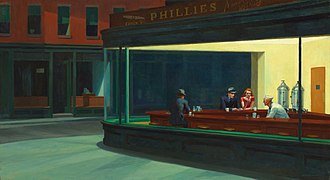
I have occasionally posted about paintings I like, going back to those dim and distant days when I studied History of Art at Uni. I first did this back in 2014 and have repeated the idea several times since then, but with an added element: more recent posts have been built around a painting that has a song attached to it. You may have seen the previous one of these, The Starry Night, which I shared last September. Today I’m taking you on a little journey, covering two paintings that lead to a song, with another musical link as a side alley down which I’m not going.
The first of these paintings is one that you may well know: Nighthawks, by Edward Hopper:

Nighthawks dates from 1942, and portrays four people in a downtown diner late at night as viewed through the diner’s large glass window. The light coming from the diner illuminates a darkened and deserted urban streetscape. The figures were ‘posed’ by Hopper himself, looking at images in a mirror, and by his wife, Jo. It has been suggested that Hopper was inspired by a short story of Ernest Hemingway’s, either The Killers (1927), which Hopper greatly admired, or the more philosophical A Clean, Well-Lighted Place (1933). Either way, it is part of a long history of artworks that have been inspired by literature. And it in turn inspired the title of Tom Waits’ 1973 album Nighthawks At The Diner. That phrase is the opening line to one of the songs on the album, Eggs and Sausage (In a Cadillac with Susan Michelson). The album’s cover, designed by Cal Schenkel, evokes the mood of Hopper’s painting:

Nighthawks has inspired many others, who have done their own versions of this theme. One of these is a spoof by an artist of whom you may not have heard, Gottfried Helnwein, an Austrian-Irish visual artist, known for creating album sleeves of his own for the likes of The Scorpions and Rammstein, and for collections of photos of The Rolling Stones. He is multi-faceted, having worked as a painter, draftsman, photographer, muralist, sculptor, installation and performance artist, using a wide variety of techniques and media. His pastiche is this:
Helnwein produced this in 1984, and it features 1950s pop culture icons – James Dean, Marilyn Monroe, and Humphrey Bogart, with Elvis Presley as their waiter – in a moody, deserted diner. His intent, in which I think he succeeds, was to symbolise the tragic, lonely fate of celebrity, as many come to feel it. In doing so I think he has captured the spirit of Hopper’s work through later eyes, and given it added meaning. The title for his painting has also been the inspiration for a song – it was Boulevard Of Broken Dreams:
Boulevard Of Broken Dreams was a track on Green Day’s seventh album, American Idiot, which was released in September 2004. The album’s narrative is focused on the story of a teenager (who refers to himself as the “Jesus of Suburbia”) growing up in the United States under the presidency of George W. Bush during the Iraq War, criticising both. This song and album were hugely successful, and amongst massive sales figures this track won the 2006 Grammy Award for Best Song, as well as peaking at #2 in the US and #5 in the UK. This video won six awards at the MTV Video Music Awards in 2005, most notably for Video of the Year. It also won Best Group Video, Best Rock Video, Best Direction, Best Editing, and Best Cinematography. The album made #1 in the US, Canada and the UK, among others, and has sold 16m worldwide.
One of the things which fascinates me in pursuing connections like these is how something which first appeared over eighty years ago can still resonate today, through a timeline of homages and inspirations by and for others. Green Day’s album came out twenty two years ago but still feels fresh and relevant now, particularly in the light of current events in the US, about which Billie Joe Armstrong, who wrote this song, has been equally scathing.
Art, music and literature: they go together, don’t they?