dailynewsnblog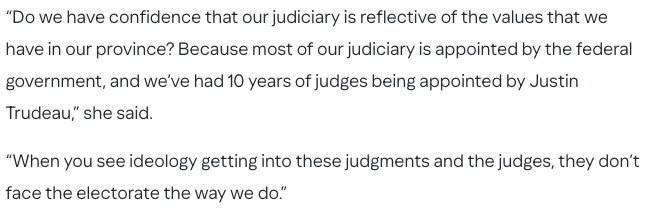
In a year-end interview, Premier Smith of Alberta complained that “judges aren’t accountable”, and elected politicians are.
Like everything else that comes out of today’s conservative politicians, this is 1 part truth, 9 parts lie. Accountability takes many forms, and to frame elections as the only legitimate kind of accountability in our system of government is simply false. It’s convenient for her in the moment, but when she then turns around and complains that “people are abusing recall”, one does have to wonder exactly how sincere she really is.

Smith complains that “we’ve had 10 years of Justin Trudeau appointing judges”, and that “…ideology getting into these judgements …”. What she’s really doing is misrepresenting the process through which judges are appointed in this country, as well as the nature of how judgments are written – judges actually explain their reasoning in their rulings, something that politicians seldom bother with.

Conservatives Dislike The Charter
The problem here is that what Smith is basically signalling is that she is willing to shred The Charter in favour of her political whims. This comes to a point I have held for a long time: where the Charter (and the Constitution in general) are designed to constrain the exercise of power, conservatives loathe it for precisely that reason. Lurking in modern day conservatism is a strong authoritarian reflex that demands power be exercised “top down”, and that the lines of power be clear, and straight.
The Charter annoys them because it places all rights in tension with each other. One person’s freedom of religion cannot be used to justify oppressing another person who believes differently. Further, where The Charter is fundamentally an egalitarian document which does not impose any kind of hierarchy to rights or those who hold them, conservatives have come to believe that not only should there be social-political hierarchy of power, but also a hierarchy of rights – where rights held by some are deemed to be more important than rights held by others (and guess who wants to decide who has what rights?).
Needless to say, an egalitarian approach to rights is necessarily more complicated than a hierarchical approach to rights – especially for legislators. Populist conservatives like Smith want to “legislate common sense”, but they ignore the notion that their “common sense” solutions to issues may in fact represent massive violations of rights for those who are affected.
In the Federal Government, the Department of Justice has an entire division whose job it is to advise Parliamentarians on how to draft laws so that they will stand up to Charter review in the courts. It was well known that Harper absolutely hated that process, because far too often his government’s legislation would be sent back for massive changes because it would not survive Charter review. A lot of his government’s criminal policies were ejected because of this reality.
Mandatory Minimum Sentences
Mandatory minimum sentences are an excellent example of this. Mandatory minimum sentences make great political stump speech material, but the laws that they are applied to often are very broad in their wording, and may create situations where people on the edges of the offence described in law may suddenly find themselves facing a sentence that is vastly disproportionate to the actual scale of their infringement of that law.
Mandatory minimum sentences in cases involving murder have been a stable part of our laws for decades because there is little chance of a “reasonably foreseeable” case arising where the seriousness of the offence is somehow lesser than the charge the person is facing, and we have a fairly broad range of chargeable offences – manslaughter, second degree murder, and first degree murder. Each representing different levels of intent, and making it possible for the courts to set punishment based on the facts of the case.
In other parts of the criminal code, the offence covers a wide range of degrees, and to impose a simple mandatory minimum makes it harder for the courts to deliver a sentence proportional to the degree of offence. Assault as an example can range anything from shoving somebody in a lineup to brawling. A mandatory minimum here would lock up the person who may have shoved someone too hard in a lineup for at least as long as the person who engaged in a brawl resulting in serious injuries. These are the kind of “foreseeable” cases that get mandatory minimums struck down if the law itself isn’t carefully tailored so that those caught up in that mandatory minimum aren’t being punished excessively for something that was a comparatively minor offence. Unfortunately, conservatives don’t seem inclined to want to understand these nuances.
Accountability
Politicians
Politicians are subject to the whims of the electorate – and that is legitimate. The courts are not subject to those same concerns for many reasons. What is popular among the electorate may in fact be fundamentally unjust when held up against principles of fundamental justice. One example of this might be the death penalty. In certain corners of the country, that may be a “popular” idea, but we long ago decided that was a bad idea in part on the basis that innocent people have been executed – the punishment deemed too prone to gross miscarriages of justice.
While an election is a form of consent, it is not by any means total consent – the UCP won a majority in 2023, but that doesn’t grant Smith unbounded authority to do what she wants. Much of what she has legislated on since then has had very little to do with her platform in 2023, and in some signature areas of her legislative agenda, she clearly avoided talking about the subject entirely.
In other contexts, conservatives have attempted to pillory governments for legislating on topics that they didn’t explicitly lay out in their campaign platform. The reality, of course, is that when in power, issues do arise that weren’t foreseen during the election. So, some degree of realignment in terms of policy and legislation is to be expected.
There is an argument to be made that much of what Smith has legislated on she has no mandate from the electorate to do. Did she run on a platform of attacking transgender people, and separatism? No. In fact she explicitly avoided talking about either.
The Judiciary
A judiciary that operates at arms-length from both the executive and legislative arms of government serves as an important check on power. “Does new legislation or regulation function within the framework of the laws of the land?” is an important question. If the courts cannot stay the hand of an overzealous government, then we no longer have a functioning liberal democracy, and are descending into the same territory that liberal democracy was designed to pull us out of.
Courts have limited powers – they cannot create laws, nor can they write regulations. They can – and do – tell politicians where they ran afoul of other aspects of the law. In a liberal democracy, we need to understand that nobody – including governments – sits outside the law itself. The notion “Rule of Law” means that legislators must regard themselves and their actions as subject to law as well.
Accountability in the courts exists in several forms – including the right to appeal a ruling to a higher court, as well as a judge is required to document their reasoning in a ruling in considerable detail. The second part of accountability in the courts exists in the fact that the courts operate with respect to the laws made by the legislators (you know – the people elected to write laws?).
The only real power the courts possess stems from the framework of the Constitution and the broadly understood meaning of “The Rule of Law”. So, while Danielle complains that judges aren’t “accountable to the people”, she is misrepresenting the reality.
The Danger
Writing legislation that operates within the confines set out by our Constitution is difficult – and it damned well should be. If you are going to write legislation that rips people’s rights and dignity away from them, it should be difficult – the bar for that should be high. Smith is attempting to pull that bar down, and place the power entirely in her own hands.
When Smith threatens to use S33 more, what she’s really telling us is that “she’s going to decide who has what rights, and you’re going to like it”. This is so close to “rule by decree” territory that it should horrify anybody in Canada. This isn’t democracy, much less is it the bounded form of democracy that liberal democracy evolved into.
The language of The Charter uses the word “guarantee” in many places. A right guaranteed under The Charter should only be limited in the most minimal way possible by legislation. To do otherwise, as Smith has done on numerous fronts, reduces the Charter to a mere legislative suggestion rather than a guarantee to all Canadians.
I implore the Federal Government to use whatever tools are needed to bring Smith and her allies into line. To do less than disallow these horrible laws of hers creates a situation which will deny Canadians their rights under The Constitution and The Charter of Rights and Freedoms based upon where in Canada they live. This would be the beginning of the end of Canada as a liberal, constitutional democracy and set the confederation on to the path of disintegration.