dailynewsnblog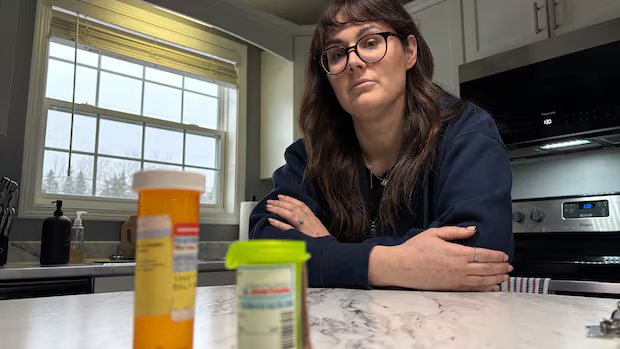
It should have been a routine pharmacy pickup.
Instead, Marissa Dawson says it turned into a months-long ordeal that ended in the emergency room — and exposed gaps in the system meant to keep patients safe.
The 35-year-old Moncton, N.B., mother of two was prescribed a new allergy medication in October 2024 to manage the itching from chronic eczema. She was supposed to receive hydroxyzine, an antihistamine. But what she picked up from a Shoppers Drug Mart pharmacy was hydralazine, which is used to lower blood pressure.
Instead of her allergies improving, she noticed she was often flushed, felt dizzy and struggled to breathe.
“I felt completely lethargic, and I was very faint,” she said.
By April, she says her symptoms continued to worsen, until her mother had to drive her to the emergency room.
That’s where an emergency nurse checked her medication, everything became clear: She had unknowingly been taking the wrong medication for months.
“I was just kind of confused,” she said. “And I started just thinking, ‘What if this happened to my kid, or any child?’ I was scared.”
- Got a story you want investigated? Contact Erica and the Go Public team at gopublic@cbc.ca.
Dawson is one of tens of thousands of Canadians who experience medication mix-ups. There are a variety of protections in place meant to catch errors like these, in what’s known as the “Swiss cheese model” of medication safety, said Jennifer Lake, a pharmacy education researcher at the University of Toronto. But when they fail, patients can end up paying the price.
Medical error numbers remain murky
The consequences of these mistakes are potentially wide-reaching, with more than 800 million prescriptions dispensed in Canada every year, according to the Canadian Generic Pharmaceutical Association.
And the number of errors reported doesn’t tell the whole story.
While many provinces require pharmacies and hospitals to report medication errors, only six currently submit data to the national tracking system, the National Incident Data Repository for Community Pharmacies database.
According to that system, more than 26,000 medication incidents were reported in 2024, but that number only included 1,700 of approximately 12,000 licensed pharmacies in Canada that year.
Melissa Sheldrick, 52, knows the stakes.
In 2016, Go Public told the story of Mississauga, Ont., woman’s eight-year-old son, Andrew, who died after a medication error. He was supposed to receive sleep medication. Instead, the pharmacy replaced it with a muscle relaxant — at a toxic level.
Andrew died after a single dose.

“It’s really frightening to know and to think about how powerful medications are and the impact that they have on our bodies,” she said. “And we know, unfortunately, better than most, the instant nature that can have.”
Since then, Sheldrick has become one of Canada’s leading advocates for medication safety, and is now the patient and family adviser at ISMP Canada, a non-profit organization set up to improve medication safety.
She says the problem goes far beyond a single mistake.
“We know that health-care providers are stretched,” said Sheldrick. “It’s not necessarily triple-checking something, but it really is strengthening those systems and [preventing] those errors getting all the way to the patient.”
Missed safety checks
Dawson, the woman from Moncton, ended up filing a complaint in May 2025 with the New Brunswick College of Pharmacists, which found the error was largely linked to a drug name mix-up and staff fatigue.
It also pointed to a key failure. No counselling was done by a pharmacist when Dawson picked up her medication. That refers to a process that’s supposed to happen and could have caught the mistake.
“I was just handed the prescription.”

Documents that Dawson provided to Go Public show the pharmacy acknowledged the mix-up and took steps to prevent it from happening again.
In a written response to her complaint to the college, the pharmacy owner said they briefed staff, posted a list of commonly confused drug names and also reinforced procedures at prescription pickup, including conducting documented counselling.
The owner also acknowledged that the error would have been caught had counselling taken place.
The college required the pharmacy to conduct monthly audits of prescriptions for one year, as well as to train staff and document compliance. It also reiterated that counselling is required for all new prescriptions.
Meanwhile, Loblaw, which owns Shoppers Drug Mart, said it conducted a review and determined the case was a result of human error, “one that should never have happened.”
It said it has established processes to help prevent errors, and that it reviewed those measures with the store’s pharmacy team following the incident.
The company adds it has patient safety measures across its pharmacies, including a patient care and quality committee put into place two years ago to “strengthen standards of care, and enhance patient safety.”
Workloads increasing, getting more complex
Meanwhile, Canada’s medication system is becoming more complex, said Sheldrick.
While it once mainly involved doctors and pharmacists, now health-care workers of varying expertise, such as nurse practitioners and virtual care providers, are all part of the prescription process, adding more steps — and potentially more risk of something going wrong.
In addition, pharmacists’ workloads are growing, she said.
She’s been pushing for better tracking of errors and what are called “near-misses” since her son died. At the time, only Nova Scotia required it. Now, most provinces have their own reporting systems, with more data being shared nationally. British Columbia is set to start reporting to the national database in 2026, and Ontario will begin contributing to the national database in 2027.
Lookalike drug names, missing information on prescriptions and skipped counselling can all add up, said Sheldrick and Lake, the Toronto researcher.

Across Canada, regulations vary, but most provinces have regulations to prevent pharmacist fatigue.
Alberta brought in specific standards defining workload and break requirements to prevent burnout, similar to measures in Newfoundland, Nova Scotia, Prince Edward Island, Ontario and B.C.
In Quebec, pharmacists’ workloads are protected by labour standards and professional regulations. Manitoba requires all pharmacies to anonymously report medication errors and learn from near-miss events.
In a written statement to CBC News, the New Brunswick College’s registrar and CEO Lindsay Mell said it’s putting together a draft policy that would require mandatory rest periods for pharmacists. It said it plans to implement the policy later this year.
Building safer systems
Both Sheldrick and Lake say preventing errors requires system-level fixes, not just asking health-care workers to be more careful. That could include clearer labelling and separation for drugs with similar names, as well as improving software and the sharing of patient information across provinces.
Patients are advised to ask for counselling when receiving new medication at a pharmacy and confirm what it is before leaving, as well as to keep an updated list of prescriptions.
As for Dawson, she says her experience has changed how she approaches every prescription.
“When I pick up a prescription, I am double-checking everything… to make sure I’m protecting myself on that end.”
Submit your story ideas
Go Public is an investigative news segment on CBC-TV, radio and the web.
We tell your stories, shed light on wrongdoing and hold the powers that be accountable.
If you have a story in the public interest, or if you’re an insider with information, contact gopublic@cbc.ca with your name, contact information and a brief summary. All emails are confidential until you decide to Go Public.
Read more stories by Go Public.
Read about our hosts.